



IL-13 Protein, Mouse
Based on 27 publication(s) in Google Scholar
IL-13 Protein, Mouse is an immunoregulatory cytokine produced primarily by activated Th2 cells, and also by mast cells and NK cells. IL-13 exerts anti-inflammatory effects on monocytes and macrophages and it inhibits the expression of inflammatory cytokines such as IL-1β, TNF-α, IL-6 and IL-8.
- Species: Mouse
- Source: E. coli
-
Storage:Stored at -20°C for 2 years from date of receipt. After reconstitution, it is stable at 4°C for 1 week or -20°C for longer (with carrier protein). It is recommended to freeze aliquots at -20°C or -80°C for extended storage.


To place orders, for customer services and technical support, please contact: MedChemExpress USA
Tel: 609-228-6898 E-mail: [email protected] [email protected]


-
 Biological Activity
-
Technical Parameters
-
Product Properties
- Documentation
- References
- Help & FAQs


-

HY-P7080
IL-4 Protein, Mouse (CHO) -
HY-P7071
IFN-gamma Protein, Mouse -
HY-P70644
IL-4 Protein, Mouse -
HY-P70653
IL-4 Protein, Mouse (HEK293, His) -

HY-D1056
Lipopolysaccharides, from E. coli O55:B5 -
HY-P7085
M-CSF Protein, Mouse -
HY-18739
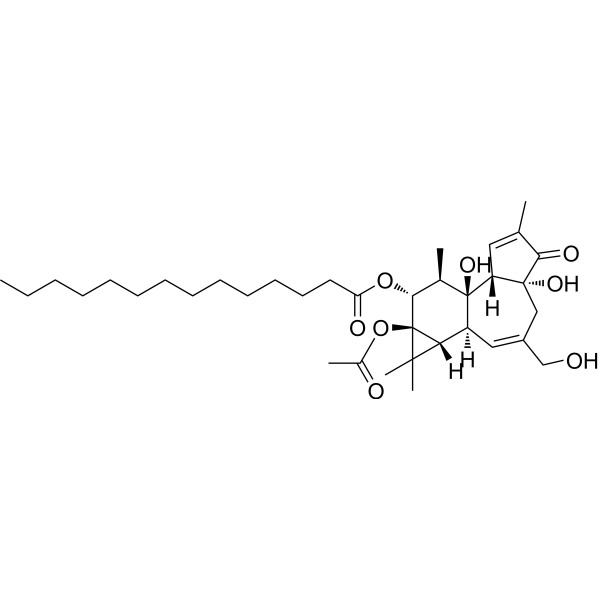
Phorbol 12-myristate 13-acetate -
HY-P701093
IL-4 Protein, Mouse (HEK293) -
HY-P70445
IL-4 Protein, Human -
HY-P70568
IL-13 Protein, Human (HEK293, His) -
HY-P70517
IL-10 Protein, Mouse -
HY-P72795
IL-13 Protein, Human


Biological Activity
Description
IL-13 Protein, Mouse is an immunoregulatory cytokine produced primarily by activated Th2 cells, and also by mast cells and NK cells. IL-13 exerts anti-inflammatory effects on monocytes and macrophages and it inhibits the expression of inflammatory cytokines such as IL-1β, TNF-α, IL-6 and IL-8[1].
Background
IL-13 is a potent down-modulator of macrophage proinflammatory activity in vitro, similar in this context to the anti-inflammatory cytokines IL-4 and IL-10[1].
Verified Bioactivity
The cell proliferation assay using TF-1 human erythroleukemic cells has an ED50 value of <3 ng/mL.
MCE Validation Data
-
Purity - SDS-PAGE
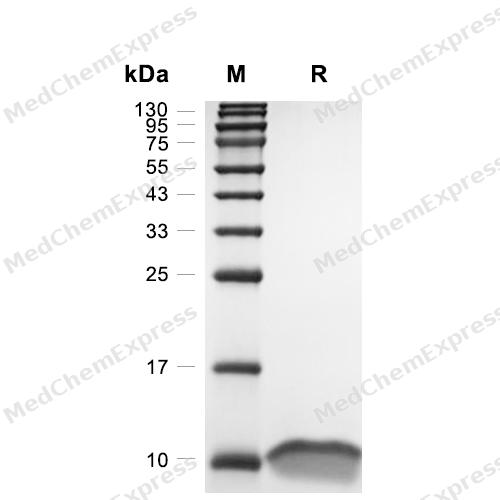
Purity - SDS-PAGE
-
Bioactivity - Cell-Based Assay
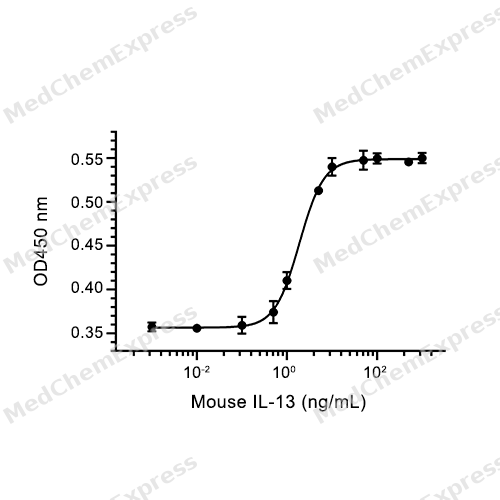
Bioactivity - Cell-Based Assay


Publications (27)
-
Journal Impact Factor
-
Most Recent
-
Immunity
An SPP1-SOCS1 pathway constrains interferon responses in tumor-associated macrophages and shapes an immunosuppressive tumor microenvironment. [Abstract]2026 Apr 27:S1074-7613(26)00141-X. PMID: 42049035 -
Cell Host Microbe
Engineered probiotics recruit CAR macrophages and establish immune memory to eradicate heterogeneous glioblastoma in mice. [Abstract]2026 Feb 11;34(2):212-229.e7. PMID: 41605215 -
Trends Biotechnol
Synthetic M13 phage engagers expand CAR-T cell antigen recognition to overcome tumor heterogeneity. [Abstract]2026 Mar 28:S0167-7799(26)00047-8. PMID: 41904099 -
-
Adv Sci (Weinh)
Tailoring Tumor Cell Golgi Apparatus-Targeting Self-Assembled Peptide for Effective Immunotherapy via Reshaping MIF-Mediated Immunosuppressive Network. [Abstract]2025 Mar;12(12):e2415133. PMID: 39908165 -
Adv Sci (Weinh)
Bacteroides Fragilis Exacerbates T2D Vascular Calcification by Secreting Extracellular Vesicles to Induce M2 Macrophages. [Abstract]2025 Feb;12(5):e2410495. PMID: 39665119 -
Cell Death Dis
Deficiency of G9a boosts muscle regeneration through IL13/Musclin-mediated crosstalk between macrophage and myofiber. [Abstract]2026 Jun 10. PMID: 42270589 -
Cancer Lett
Targeting C/EBPβ/SCD1/C16:1 loop-driven macrophage M2 polarization by Bruceine D improves anti-PD-1 immunotherapy in colorectal cancer. [Abstract]2026 Sep 28:656:218655. PMID: 42250753 -
Allergy
Sensitizer-Induced Basophils Accelerate Skin Re-Epithelialization via IL-4/IL-13-Mediated Macrophage Polarization. [Abstract]2026 May;81(5):1487-1499. PMID: 41787818 -
Int J Biol Macromol
Fucosylated chondroitin sulfate exerts in vitro anti-tumor property through manipulating the metabolism related polarization of macrophages. [Abstract]2025 Jul 7;320(Pt 2):145830. PMID: 40633868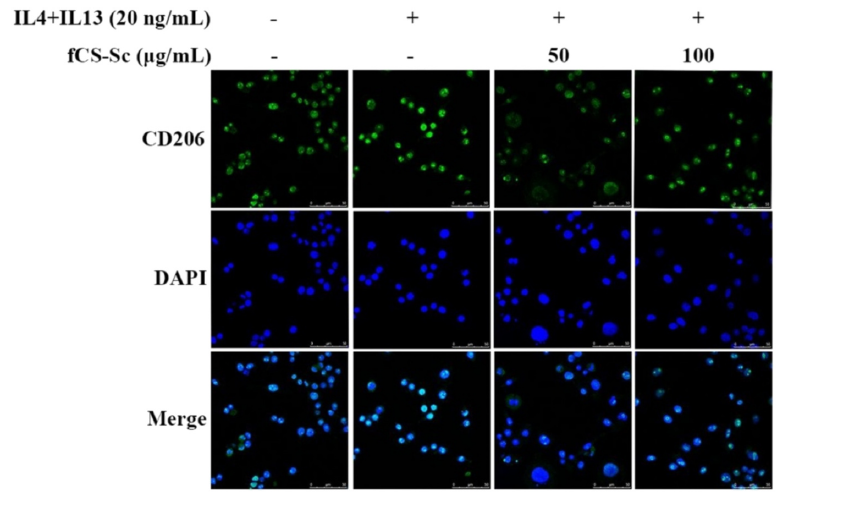
IL-13 Protein, Mouse purchased from MedChemExpress. Usage Cited in: Int J Biol Macromol. 2025 Jul 7;320(Pt 2):145830. [Abstract]
IL-13, Mouse (20 ng/mL; 12 h). M2 cell marker CD206 is determined using the immunofluorescence method. The results indicates that the IL4 and IL-13 induced M2 type clearly expresses higher CD206 in contrast to the blank control.
-
Stem Cell Res Ther
Exosomes from adipose-derived stem cells accelerate wound healing by increasing the release of IL-33 from macrophages. [Abstract]2025 Feb 21;16(1):80. PMID: 39984984 -
Cell Rep
2025 Apr 9;44(4):115542. PMID: 40215166 -
J Ethnopharmacol
Network pharmacology and experimental validation identify the targets of Marsdenia tenacissima in neutrophilic asthma treatment. [Abstract]2026 Feb 10:356:120782. PMID: 41135618 -
Biochem Pharmacol
ATF5 activates LPAR5 to enhance macrophage pro-inflammatory responses to exacerbate rheumatoid arthritis. [Abstract]2026 May:247:117804. PMID: 41690415 -
Food Funct
Cyanidin-3- O-glucoside promotes late-stage venous thrombus resolution in mice, accompanied by reduced macrophage M1-associated inflammation and attenuated HIF-1α-linked signaling. [Abstract]2026 Mar 23;17(6):2718-2735. PMID: 41734240 -
EMBO Rep
Eicosapentaenoic acid induces macrophage Mox polarization to prevent diabetic cardiomyopathy. [Abstract]2024 Dec;25(12):5507-5536. PMID: 39482491 -
Int Immunopharmacol
2025 May 16:155:114632. PMID: 40215780 -
J Biomed Mater Res A
Hyaluronic Acid-Chitosan Nanoparticles Encapsulating Gal-9 Alleviate Severe Acute Pancreatitis by Promoting M2 Macrophage Polarization. [Abstract]2025 Dec;113(12):e70006. PMID: 41307175 -
Arch Physiol Biochem
Polygonatum kingianum alleviates diabetic inflammation via the Mef2d/Rufy4-autophagy axis to drive macrophage M2 polarisation. [Abstract]2026 Jan 6:1-12. PMID: 41493861 -
BMC Pulm Med
Macrophage-derived exosomes carrying miR-30a-5p alleviates IL-13/IL4-induced epithelial-mesenchymal transition in mouse bronchial epithelial cells via Runx1. [Abstract]2025 Oct 28;25(1):496. PMID: 41152768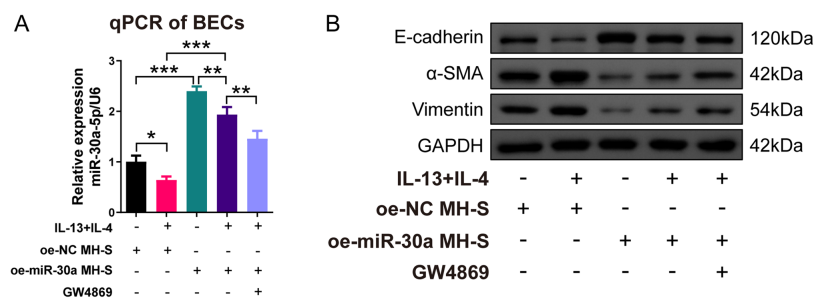
IL-13 Protein, Mouse purchased from MedChemExpress. Usage Cited in: BMC Pulm Med. 2025 Oct 28;25(1):496. [Abstract]
A: The qPCR was used to detect miR-30a-5p level in mouse bronchial epithelial cells. B, C: Western blot was used to measure E-cadherin, α-SMA, and Vimentin protein expressions in mouse bronchial epithelial cells. Protein blot was analyzed by ImageJ. 10 ng/mL IL-13 and 10 ng/mL IL-4 were used to induce EMT by incubating BECs for 48 h.
-
Kaohsiung J Med Sci
Activation of PPARγ regulates M1/M2 macrophage polarization and attenuates dextran sulfate sodium salt-induced inflammatory bowel disease via the STAT-1/STAT-6 pathway. [Abstract]2025 Feb;41(2):e12927. PMID: 39737788 -
Eur J Histochem
Tumor cell-derived exosomal lncRNA LOC441178 inhibits the tumorigenesis of esophageal carcinoma through suppressing macrophage M2 polarization. [Abstract]2022 Oct 14;66(4):3510. PMID: 36250676 -
-
-
-
-


Technical Parameters
-
Species Mouse
-
Source E. coli
-
Tag Tag Free
-
Accession
P20109 (S26-F131)
-
Molecular Construction
-
N-term
-
IL-13 (S26-F131)
Accession # P20109 -
C-term
-
-
Protein Length
Partial
-
Synonyms
IL13; MGC116789; Interleukin 13; ALRH; IL-13; BHR1; Interleukin-13; Bronchial Hyperresponsiveness-1 (Bronchial Asthma); P600; Allergic Rhinitis; MGC116786; NC30; MGC116788
-
AA Sequence
SVSLPLTLKELIEELSNITQDQTPLCNGSMVWSVDLAAGGFCVALDSLTNISNCNAIYRTQRILHGLCNRKAPTTVSSLPDTKIEVAHFITKLLSYTKQLFRHGPF
-
Predicted Molecular Mass
11.7 kDa
-
Molecular Weight
Approximately 9-14 kDa, based on SDS-PAGE under reducing conditions.
-
Purity
≥ 95%, as determined by reducing SDS-PAGE.


Product Properties
Lyophilized powder
1.Lyophilized from a 0.2 μm filtered solution of 20 mM Histidine-HCl, 8% Trehalose, 4% Mannitol, 50 mM NaCl, 0.05% Tween 80, pH 6.0.
2.Lyophilized from a 0.2 μm filtered solution of PBS, 8% trehalose, pH 6.5.
<1 EU/μg, determined by LAL method.
It is not recommended to reconstitute to a concentration less than 100 μg/mL in ddH2O.
Stored at -20°C for 2 years from date of receipt. After reconstitution, it is stable at 4°C for 1 week or -20°C for longer (with carrier protein). It is recommended to freeze aliquots at -20°C or -80°C for extended storage.
Room temperature in continental US; may vary elsewhere.


Documentation
-
Data Sheet (260 KB)
-
SDS (252 KB)
- English - EN (252 KB)
- Français - FR (252 KB)
- Deutsch - DE (252 KB)
- Norwegian - NO (252 KB)
- Español - ES (252 KB)
- Swedish - SV (252 KB)
- Italian - IT (252 KB)
- Korean - KR (252 KB)
- Portuguese - PT (252 KB)
-
Handling Instructions (2659 KB)


References

Calculators
Concentration (start) × Volume (start) = Concentration (final) × Volume (final)


 Powered by Bioz

