



IL-4 Protein, Mouse (HEK293)
Based on 4 publication(s) in Google Scholar
IL-4 Protein, Mouse (HEK293) is a species-specific cytokine which promotes the proliferation, differentiation and cell-surface protein modulation of B lymphocytes.
- Species: Mouse
- Source: HEK293
-
Storage:Stored at -20°C for 2 years from date of receipt. After reconstitution, it is stable at 4°C for 1 week or -20°C for longer (with carrier protein). It is recommended to freeze aliquots at -20°C or -80°C for extended storage.


To place orders, for customer services and technical support, please contact: MedChemExpress USA
Tel: 609-228-6898 E-mail: [email protected] [email protected]


-
 Biological Activity
-
Technical Parameters
-
Product Properties
- Documentation
- Help & FAQs


-

HY-P70460
IL-13 Protein, Mouse -
HY-P7071
IFN-gamma Protein, Mouse -
HY-P7361
GM-CSF Protein, Mouse -

HY-D1056
Lipopolysaccharides, from E. coli O55:B5 -
HY-P70667
IFN-gamma Protein, Mouse (HEK293) -
HY-P7077
IL-2 Protein, Mouse -
HY-P7085
M-CSF Protein, Mouse -
HY-P70445
IL-4 Protein, Human -
HY-P70553
M-CSF Protein, Mouse (HEK293) -
HY-P7361A
GM-CSF Protein, Mouse (His) -
HY-100579
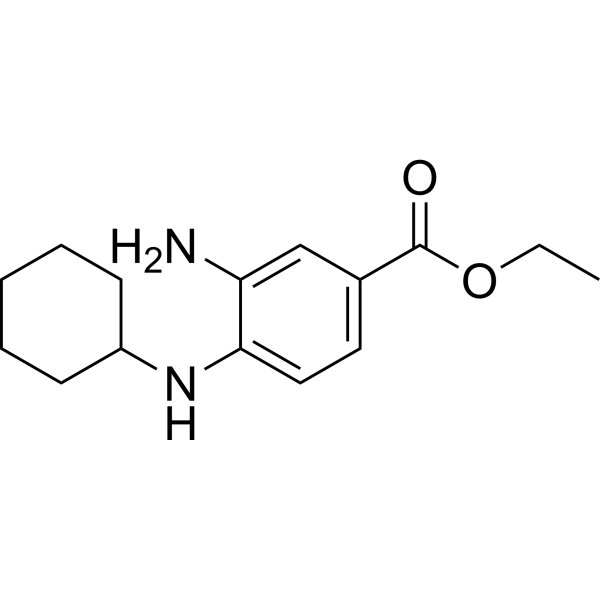
Ferrostatin-1 -
HY-108882
DNase I, Bovine pancreas


Biological Activity
Description
IL-4 Protein, Mouse (HEK293) is a species-specific cytokine which promotes the proliferation, differentiation and cell-surface protein modulation of B lymphocytes.
Background
Mouse Interleukin 4 is a 20-kDa glycoprotein, synthesized by activated T lymphocytes and mast cells, which regulates the growth and/or differentiation of a broad spectrum of target cells of the immune system, including B and T lymphocytes, macrophages, and hematopoietic progenitor cells. Murine Interleukin 4 (IL-4) is a potent mediator of an immune response, affecting both the growth and differentiation of a wide variety of cells in the hematopoietic lineage. This cytokine is expressed by activated T lymphocytes and mast cells as a 20-kDa glycoprotein. The cDNA for IL-4 isinitially is solated by two laboratories, using expression vectors and screening for either a IgG-inducing factor or a mast cell growth factor. The derived amino acid sequence from the cDNA clones is used to predict a protein backbone for IL-4 of 14 kDa. This is consistent with the observation that N-glycanase treatment of natural IL-4, to remove N-linked carbohydrates, yields a protein core of 14 kDa. Initial experiments with deglycosylated native IL-4 and with deglycosylated recombinant IL-4, expressed initially in yeast as a heterogeneous, hyperglycosylated molecule, suggested that the carbohydrate modifications of IL-4 do not affect its ability to bind to receptor and to stimulate T and B cell growth[1].
Verified Bioactivity
Measured in a cell proliferation assay using HT-2 cells. The ED50 for this effect is 0.1-1.5 ng/mL.
MCE Validation Data
-
Purity - SDS-PAGE
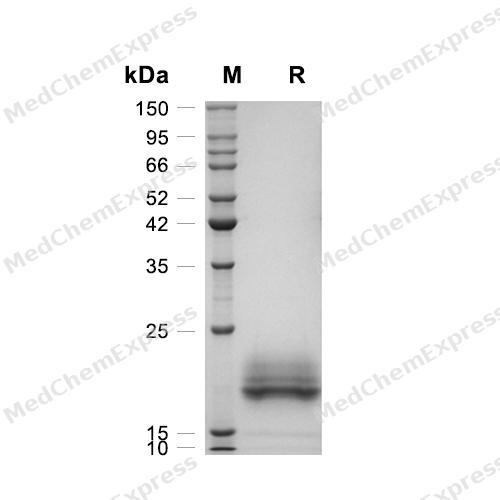
Purity - SDS-PAGE
-
Bioactivity - Cell-Based Assay
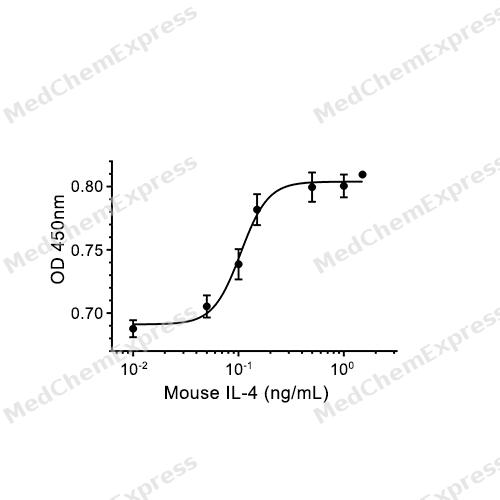
Bioactivity - Cell-Based Assay


Publications (4)
-
Journal Impact Factor
-
Most Recent
-
Microbiome
Periodontitis salivary microbiota exacerbates colitis by CXCL3 derived from gut microbiota-induced macrophages. [Abstract]2025 Dec 10;13(1):255. PMID: 41373016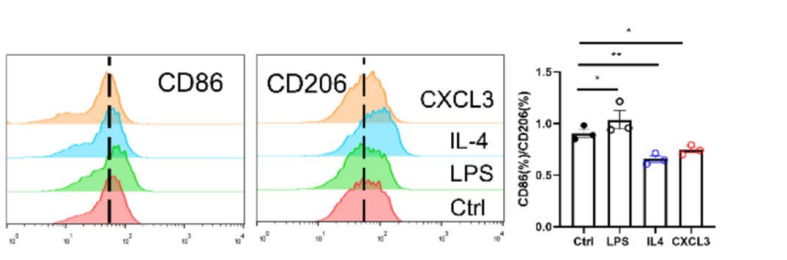
IL-4 Protein, Mouse (HEK293) purchased from MedChemExpress. Usage Cited in: Microbiome. 2025 Dec 10;13(1):255. [Abstract]
FACS representation of CD86 and CD206 expression in RAW264.7 cells treated with LPS, IL4 (20 ng/mL), and CXCL3.
-
Cell Rep Med
HE4 drives PD-L1 expression in myeloid cells via IFN-γR-JAK-STAT3 signaling to promote tumor immune evasion. [Abstract]2026 Apr 21;7(4):102691. PMID: 41861828 -
Cell Commun Signal
Intrinsic STING of CD8 + T cells regulates self-metabolic reprogramming and memory to exert anti-tumor effects. [Abstract]2025 Feb 19;23(1):99. PMID: 39972350 -
Biochem Pharmacol
NEDD4 like E3 ubiquitin protein ligase-mediated ubiquitination and degradation of dipeptidyl peptidase 4 restrains Th2-linked inflammation in allergic rhinitis. [Abstract]2026 Apr 9;250(Pt 1):117960. PMID: 41966487


Technical Parameters
-
Species Mouse
-
Source HEK293
-
Tag Tag Free
-
Accession
P07750 (H21-S140)
-
Molecular Construction
-
N-term
-
IL-4 (H21-S140)
Accession # P07750 -
C-term
-
-
Protein Length
Full Length of Mature Protein
-
Synonyms
IL4; B_cell Stimulatory Factor 1; Interleukin 4; B-Cell Stimulatory Factor 1; IL-4; B Cell Growth Factor 1; Lymphocyte Stimulatory Factor 1; Binetrakin; Interleukin-4; Pitrakinra; BCGF-1; MGC79402; BCGF1; BSF-1; BSF1
-
AA Sequence
HIHGCDKNHLREIIGILNEVTGEGTPCTEMDVPNVLTATKNTTESELVCRASKVLRIFYLKHGKTPCLKKNSSVLMELQRLFRAFRCLDSSISCTMNESKSTSLKDFLESLKSIMQMDYS
-
Predicted Molecular Mass
13.6 kDa
-
Molecular Weight
Approximately 18-20 kDa, based on SDS-PAGE under reducing conditions, due to the glycosylation.
-
Glycosylation
Yes
-
Purity
≥ 95%, as determined by reducing SDS-PAGE.


Product Properties
Lyophilized powder
1.Lyophilized from a 0.2 μm filtered solution of 20 mM PB, 150 mM NaCl, pH 7.4.
2.Lyophilized from a 0.2 μm filtered solution of PBS, pH 7.4, 8% trehalose.
Please refer to the lot-specific COA for specific buffer information.
<0.2 EU/μg, determined by LAL method.
It is not recommended to reconstitute to a concentration less than 100 μg/mL in ddH2O or PBS.
Stored at -20°C for 2 years from date of receipt. After reconstitution, it is stable at 4°C for 1 week or -20°C for longer (with carrier protein). It is recommended to freeze aliquots at -20°C or -80°C for extended storage.
Room temperature in continental US; may vary elsewhere.


Documentation
-
Data Sheet (236 KB)
-
SDS (252 KB)
- English - EN (252 KB)
- Français - FR (252 KB)
- Deutsch - DE (252 KB)
- Norwegian - NO (252 KB)
- Español - ES (252 KB)
- Swedish - SV (252 KB)
- Italian - IT (252 KB)
- Korean - KR (252 KB)
- Portuguese - PT (252 KB)
-
Handling Instructions (2659 KB)

Calculators
Concentration (start) × Volume (start) = Concentration (final) × Volume (final)


 Powered by Bioz

