



GM-CSF Protein, Mouse (His)
Based on 4 publication(s) in Google Scholar
GM-CSF Protein is a hematopoietic growth factor and immunomodulator. By binding to specific receptors on the surface of target cells, GM-CSF Protein activates intracellular signaling pathways to regulate cell proliferation, differentiation, maturation, and function. GM-CSF Protein plays an important role in the hematopoietic process and the immune system. GM-CSF Protein, Mouse (His) is a recombinant GM-CSF Protein expressed by E. coli with a N-6*His tag.
- Species: Mouse
- Source: E. coli
-
Storage:Stored at -20°C for 2 years from date of receipt. After reconstitution, it is stable at 4°C for 1 week or -20°C for longer (with carrier protein). It is recommended to freeze aliquots at -20°C or -80°C for extended storage.


To place orders, for customer services and technical support, please contact: MedChemExpress USA
Tel: 609-228-6898 E-mail: [email protected] [email protected]


-
 Biological Activity
-
Technical Parameters
-
Product Properties
- Documentation
- References
- Help & FAQs


-

HY-P70653
IL-4 Protein, Mouse (HEK293, His) -
HY-P701093
IL-4 Protein, Mouse (HEK293) -
HY-P7080
IL-4 Protein, Mouse (CHO) -
HY-P7085
M-CSF Protein, Mouse -
HY-B0141
EstradiolHuman Endogenous Metabolite -
HY-Y0873
PEG300Neutral Polymer -
HY-19363
GW4869N-SMase Inhibitor -
HY-P7071
IFN-gamma Protein, Mouse -
HY-P7378
IL-6 Protein, Mouse (CHO, His) -
HY-P7117
TGF beta 1/TGFB1 Protein, Mouse/Rat (HEK293, Tag Free) -
HY-P7090
TNF-alpha/TNFSF2 Protein, Mouse (156a.a) -
HY-P70553
M-CSF Protein, Mouse (HEK293)


Biological Activity
Description
GM-CSF Protein is a hematopoietic growth factor and immunomodulator. By binding to specific receptors on the surface of target cells, GM-CSF Protein activates intracellular signaling pathways to regulate cell proliferation, differentiation, maturation, and function. GM-CSF Protein plays an important role in the hematopoietic process and the immune system. GM-CSF Protein, Mouse (His) is a recombinant GM-CSF Protein expressed by E. coli with a N-6*His tag[1][2][3][4].
Background
GM-CSF is a cytokine secreted by various cells (such as T cells, monocytes, endothelial cells, etc.), playing an important role in the immune system and hematopoietic process. GM-CSF can stimulate the proliferation and differentiation of precursor cells of granulocytes (such as neutrophils and eosinophils) and macrophages in the bone marrow, promoting the production of mature blood cells. GM-CSF can also activate mature granulocytes and macrophages, enhancing their phagocytic ability, bactericidal activity, and antigen-presenting function, and participating in innate and adaptive immune responses. In addition, GM-CSF also has pro-inflammatory activity[1][2][3][4].
In Vitro
GM-CSF Protein (25 ng/mL; 30 min-24 h) enhances glycolytic capacity in mouse bone marrow-derived macrophages, upregulates the expression of glucose transporters GLUT-1, -3, and -4, and induces the transcription and protein expression of c-Myc[5].
In Vivo
GM-CSF Protein (2-4 ng; aerosol inhalation; 4-5 weeks) improves pulmonary alveolar proteinosis in GM-CSF-deficient mice[6].
Verified Bioactivity
1.Measured in a cell proliferation assay using THP-1 human erythroleukemic cells. The ED50 for this effect is 9.304-24.86 pg/mL, corresponding to a specific activity is 4.023×10⁷-1.075×10⁸ units/mg.
2.Measured by its binding ability in a functional ELISA. Immobilized Mouse GM-CSF at 5 μg/mL (100 μl/well) can bind Biotinylated Mouse GM-CSF R alpha. The ED50 for this effect is 0.01-0.156 μg/mL.
MCE Validation Data
-
Purity - SDS-PAGE
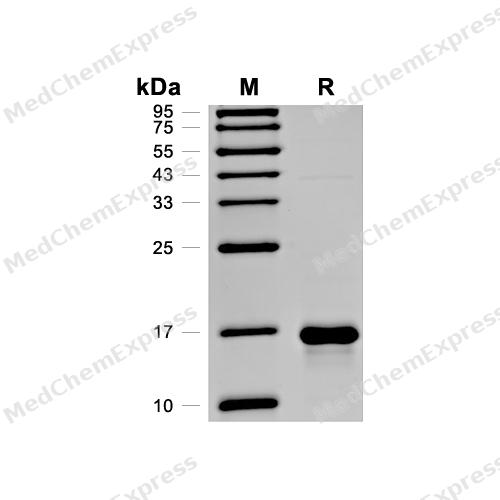
Purity - SDS-PAGE
-
Bioactivity - Cell-Based Assay
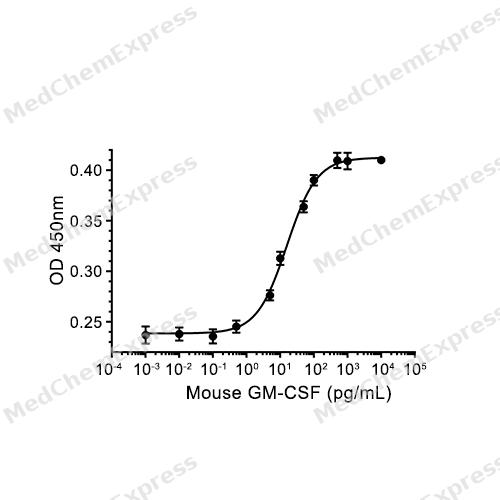
Bioactivity - Cell-Based Assay


Publications (4)
-
Journal Impact Factor
-
Most Recent
-
J Extracell Vesicles
Clostridioides difficile-Derived Extracellular Vesicles Induce Proinflammatory Responses in Macrophages. [Abstract]2026 Apr;15(4):e70251. PMID: 41904635 -
Small
Three-in-One Oncolytic Adenovirus System Initiates a Synergetic Photodynamic Immunotherapy in Immune-Suppressive Cholangiocarcinoma. [Abstract]2023 Aug;19(34):e2207668. PMID: 37127884 -
-
J Biol Chem
Free fatty acids stabilize integrin β1 via S-nitrosylation to promote monocyte-endothelial adhesion. [Abstract]2023 Jan;299(1):102765. PMID: 36470423


Technical Parameters
-
Species Mouse
-
Source E. coli
-
Tag N-6*His
-
Accession
Q14AD9 (A18-K141)
-
Gene ID12981
-
Molecular Construction
-
N-term
-
6*His
-
GM-CSF (A18-K141)
Accession # Q14AD9 -
C-term
-
-
Protein Length
Full Length of Mature Protein
-
Synonyms
CSF2; Molgramostim; Colony Stimulating Factor 2; Molgramostin; GMCSF; CSF; Sargramostim; Granulocyte-Macrophage Colony Stimulating Factor; GM-CSF; Granulocyte Macrophage-Colony Stimulating Factor; Colony Stimulating Factor 2 (Granulocyte-Macrophage); Colo
-
AA Sequence
APTRSPITVTRPWKHVEAIKEALNLLDDMPVTLNEEVEVVSNEFSFKKLTCVQTRLKIFEQGLRGNFTKLKGALNMTASYYQTYCPPTPETDCETQVTTYADFIDSLKTFLTDIPFECKKPVQK
-
Predicted Molecular Mass
14.1 kDa
-
Molecular Weight
Approximately 17 kDa, based on SDS-PAGE under reducing conditions.
-
Purity
≥ 90%, as determined by reducing SDS-PAGE.


Product Properties
Lyophilized powder.
1.Lyophilized from a 0.22 μm filtered solution of 50 mM Tris-HCl, 300 mM NaCl, 200 mM arginine, pH 8.0.
2.Lyophilized from a 0.22 μm filtered solution of 50 mM Tris-HCl, 300 mM NaCl, pH 7.4.
Please refer to the lot-specific COA for specific buffer information.
Note: For SPR assay, please replace the buffer. Primary amine components (e.g., Tris, imidazole) can affect protein-coupled chips.
<1 EU/μg, determined by LAL method.
It is not recommended to reconstitute to a concentration less than 100 μg/mL in ddH2O. For long term storage it is recommended to add a carrier protein (0.1% BSA, 5% HSA, 10% FBS or 5% Trehalose).
Stored at -20°C for 2 years from date of receipt. After reconstitution, it is stable at 4°C for 1 week or -20°C for longer (with carrier protein). It is recommended to freeze aliquots at -20°C or -80°C for extended storage.
Room temperature in continental US; may vary elsewhere.


Documentation
-
Data Sheet (264 KB)
-
SDS (251 KB)
- English - EN (251 KB)
- Français - FR (251 KB)
- Deutsch - DE (251 KB)
- Norwegian - NO (251 KB)
- Español - ES (251 KB)
- Swedish - SV (251 KB)
- Italian - IT (251 KB)
- Korean - KR (251 KB)
- Portuguese - PT (251 KB)
-
Handling Instructions (2659 KB)


References
[1]. Shi Y, et al. Granulocyte-macrophage colony-stimulating factor (GM-CSF) and T-cell responses: what we do and don't know. Cell Res. 2006 Feb;16(2):126-33. [Content Brief]
[2]. Gasson JC, et al. Human granulocyte-macrophage colony-stimulating factor (GM-CSF): regulation of expression. Prog Clin Biol Res. 1990;338:27-41. [Content Brief]
[3]. Gomez-Cambronero J, et al. Granulocyte-macrophage colony-stimulating factor is a chemoattractant cytokine for human neutrophils: involvement of the ribosomal p70 S6 kinase signaling pathway. J Immunol. 2003 Dec 15;171(12):6846-55. [Content Brief]
[4]. Shiomi A, et al. GM-CSF as a therapeutic target in autoimmune diseases. Inflamm Regen. 2016 Jul 5;36:8. [Content Brief]
[5]. Na YR, et al. GM-CSF Induces Inflammatory Macrophages by Regulating Glycolysis and Lipid Metabolism. J Immunol. 2016 Nov 15;197(10):4101-4109. doi: 10.4049/jimmunol.1600745IF: 3.6 Q2 . Epub 2016 Oct 14. Erratum in: J Immunol. 2017 Apr 1;198(7):3000. [Content Brief]

Calculators
Concentration (start) × Volume (start) = Concentration (final) × Volume (final)


 Powered by Bioz

