



M-CSF Protein, Mouse (HEK293)
Based on 7 publication(s) in Google Scholar
M-CSF Protein, Mouse (HEK293) is a pro-inflammatory cytokine which binds to its receptor CSF1R, and is involved in the development and proliferation of cells of the monocyte/macrophage lineage and participates in the induction of osteoclasts.
- Species: Mouse
- Source: HEK293
-
Storage:Stored at -20°C for 2 years from date of receipt. After reconstitution, it is stable at 4°C for 1 week or -20°C for longer (with carrier protein). It is recommended to freeze aliquots at -20°C or -80°C for extended storage.


To place orders, for customer services and technical support, please contact: MedChemExpress USA
Tel: 609-228-6898 E-mail: [email protected] [email protected]


-
 Biological Activity
-
Technical Parameters
-
Product Properties
- Documentation
- References
- Help & FAQs


-

HY-P73388
RANKL/TNFSF11 Protein, Mouse (HEK293, Fc) -
HY-P70667
IFN-gamma Protein, Mouse (HEK293) -
HY-P70460
IL-13 Protein, Mouse -
HY-P701093
IL-4 Protein, Mouse (HEK293) -
HY-P70653
IL-4 Protein, Mouse (HEK293, His) -
HY-P7425
RANKL/TNFSF11 Protein, Mouse -
HY-P7071
IFN-gamma Protein, Mouse -
HY-P7080
IL-4 Protein, Mouse (CHO) -
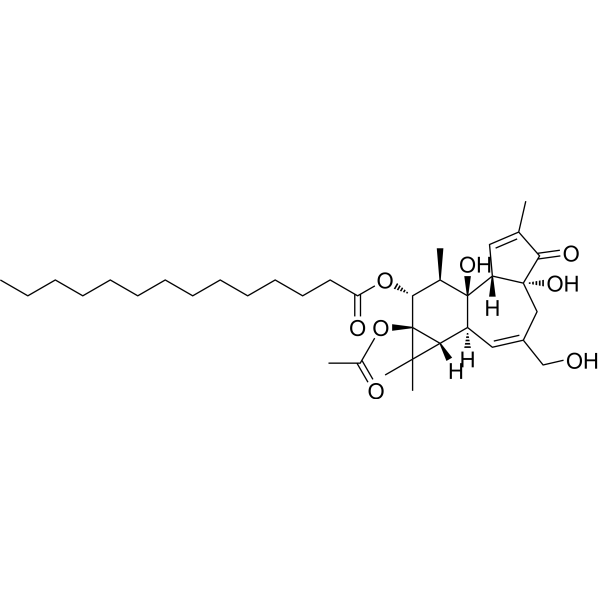
HY-18739
Phorbol 12-myristate 13-acetate -
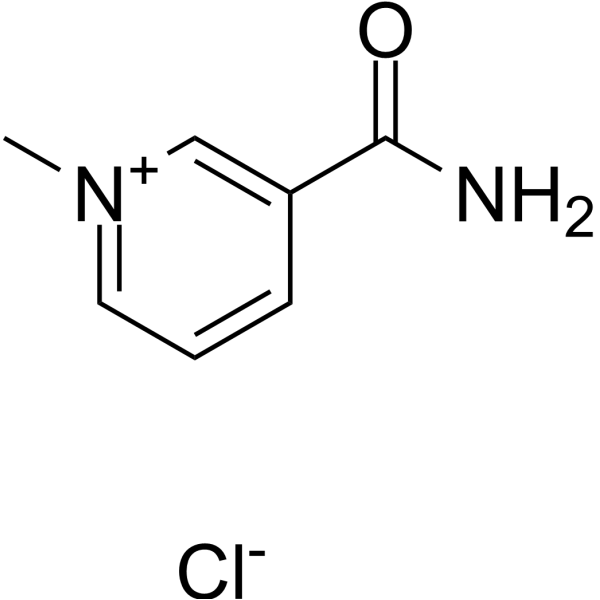
HY-113527
TRIA-662 -
HY-P70644
IL-4 Protein, Mouse -
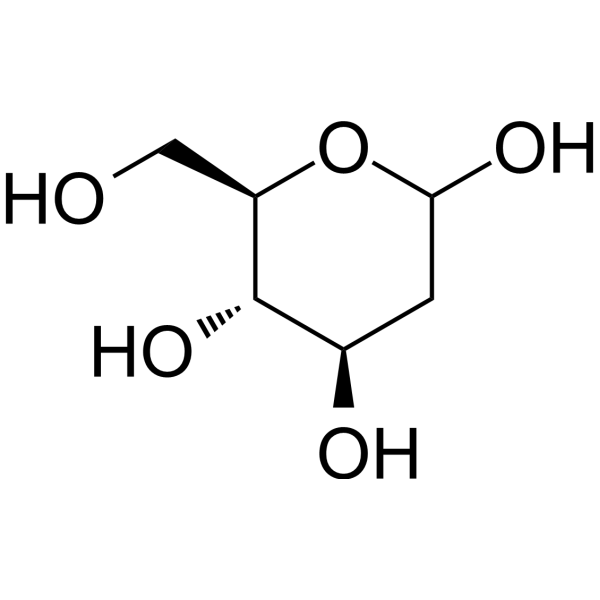
HY-13966
2-Deoxy-D-glucose


Biological Activity
Description
M-CSF Protein, Mouse (HEK293) is a pro-inflammatory cytokine which binds to its receptor CSF1R, and is involved in the development and proliferation of cells of the monocyte/macrophage lineage and participates in the induction of osteoclasts.
Background
Macrophage Colony Stimulating Factor (M-CSF) is a pro-inflammatory cytokine, constitutively produced by several cell types, such as fibroblasts, endothelial cells, stromal cells, macrophages, smooth muscle cells and osteoblasts, binds to its receptor CSF1R, and exists in several isoforms- as a secreted glycoprotein, a cell-surface protein and a proteoglycan[1]. M-CSF is involved in the development and proliferation of cells of the monocyte/macrophage lineage and participates in the induction of osteoclasts, which are important in the destruction of bone and cartilage and in the periarticular osteoporotic changes seen in patients with rheumatoid arthritis[2].
Verified Bioactivity
1.The cell proliferation assay using M-NFS-60 mouse myelogenous leukemia lymphoblast cells with an ED50 value of ≤15 ng/mL.
2.Immobilized mouse CSF1 at 2 μg/mL (100 μl/well) can bind mouse CSF1R-Fch, The EC50 of mouse CSF1R-Fch is 60-220 ng/mL.
MCE Validation Data
-
Purity - SDS-PAGE
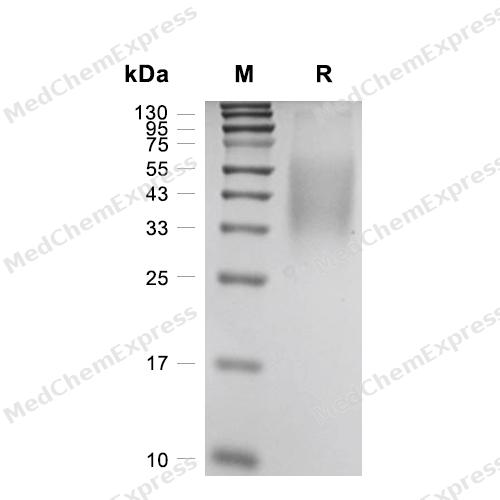
Purity - SDS-PAGE
-
Bioactivity - Cell-Based Assay
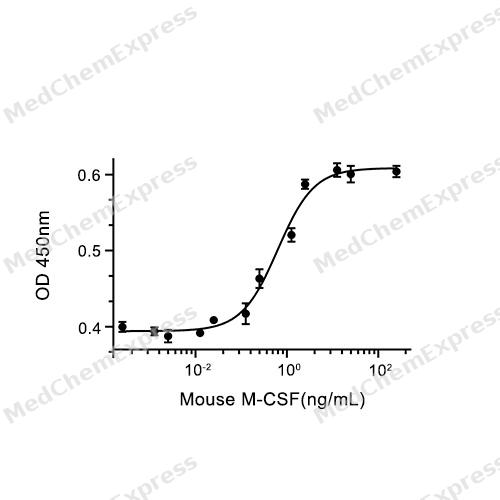
Bioactivity - Cell-Based Assay


Publications (7)
-
Journal Impact Factor
-
Most Recent
-
Adv Sci (Weinh)
Targeted Inhibition of CD74+ Macrophages by Luteolin via CEBPB/P65 Signaling Ameliorates Osteoarthritis Progression. [Abstract]2025 Nov 21:e08472. PMID: 41268703 -
J Control Release
Targeting CXCL16-expressing macrophages with a biomimetic nanocarrier system attenuates cartilage degeneration in osteoarthritis. [Abstract]2026 Apr 10:392:114734. PMID: 41707770 -
Mater Today Bio
Functionalized 3D-printed GelMA/Laponite hydrogel scaffold promotes BMSCs recruitment through osteoimmunomodulatory enhance osteogenic via AMPK/mTOR signaling pathway. [Abstract]2024 Sep 23:29:101261. PMID: 39381262 -
J Transl Med
Osteopontin derived from hypoxia-induced M2 macrophages promotes osteosarcoma progression through modulation of EGR3/ISG15 signaling and RIG-I expression. [Abstract]2025 Aug 21;23(1):950. PMID: 40841904 -
Clin Transl Med
Loss of Brd4 alleviates pathological bone loss via Slc9b2 suppression in osteoclastogenesis. [Abstract]2025 Oct;15(10):e70496. PMID: 41115147 -
Int Immunopharmacol
2023 Feb:115:109696. PMID: 36638666 -
Cardiovasc Toxicol
ETV5-Mediated Transcriptional Repression of DDIT4 Blocks Macrophage Pro-Inflammatory Activation in Diabetic Atherosclerosis. [Abstract]2025 Mar;25(3):379-394. PMID: 39864045


Technical Parameters
-
Species Mouse
-
Source HEK293
-
Tag Tag Free
-
Accession
P07141-1 (K33-E262)
-
Molecular Construction
-
N-term
-
M-CSF (K33-E262)
Accession # P07141 -
C-term
-
-
Protein Length
Partial Extracellular Domain
-
Synonyms
CSF1; Macrophage Colony Stimulating Factor 1; Colony Stimulating Factor 1; Lanimostim; MCSF; MGC31930; Proteoglycan Macrophage Colony-Stimulating Factor; PG-M-CSF; Macrophage Colony-Stimulating Factor 1; CSF-1; M-CSF; CSF1-HERV-LTR71B Fusion Protein; Colo
-
AA Sequence
KEVSEHCSHMIGNGHLKVLQQLIDSQMETSCQIAFEFVDQEQLDDPVCYLKKAFFLVQDIIDETMRFKDNTPNANATERLQELSNNLNSCFTKDYEEQNKACVRTFHETPLQLLEKIKNFFNETKNLLEKDWNIFTKNCNNSFAKCSSRDVVTKPDCNCLYPKATPSSDPASASPHQPPAPSMAPLAGLAWDDSQRTEGSSLLPSELPLRIEDPGSAKQRPPRSTCQTLE
-
Predicted Molecular Mass
26 kDa
-
Molecular Weight
Approximately 32-60 kDa, based on SDS-PAGE under reducing conditions, due to the glycosylation.
-
Glycosylation
Yes
-
Purity
≥ 95%, as determined by reducing SDS-PAGE.


Product Properties
Lyophilized powder
1.Lyophilized from a 0.22 μm filtered solution of PBS, pH 7.4.
2.Lyophilized from a 0.22 μm filtered solution of PBS, pH 7.4, 8% trehalose.
Please refer to the lot-specific COA for specific buffer information.
<1 EU/μg, determined by LAL method.
It is not recommended to reconstitute to a concentration less than 100 μg/mL in ddH2O. For long term storage it is recommended to add a carrier protein (0.1% BSA, 5% HSA, 10% FBS or 5% Trehalose).
Stored at -20°C for 2 years from date of receipt. After reconstitution, it is stable at 4°C for 1 week or -20°C for longer (with carrier protein). It is recommended to freeze aliquots at -20°C or -80°C for extended storage.
Room temperature in continental US; may vary elsewhere.


Documentation
-
Data Sheet (263 KB)
-
SDS (252 KB)
- English - EN (252 KB)
- Français - FR (252 KB)
- Deutsch - DE (252 KB)
- Norwegian - NO (252 KB)
- Español - ES (252 KB)
- Swedish - SV (252 KB)
- Italian - IT (252 KB)
- Korean - KR (252 KB)
- Portuguese - PT (252 KB)
-
Handling Instructions (2659 KB)


References
[1]. Hamilton JA. Colony-stimulating factors in inflammation and autoimmunity. Nat Rev Immunol. 2008 Jul;8(7):533-44. [Content Brief]
[2]. Rioja I, et al. Potential novel biomarkers of disease activity in rheumatoid arthritis patients: CXCL13, CCL23, transforming growth factor alpha, tumor necrosis factor receptor superfamily member 9, and macrophage colony-stimulating factor. Arthritis Rheum. 2008 Aug;58(8):2257-67. [Content Brief]

Calculators
Concentration (start) × Volume (start) = Concentration (final) × Volume (final)


 Powered by Bioz

