



IFN-gamma Protein, Mouse (HEK293)
Based on 2 publication(s) in Google Scholar
IFN-gamma is a type II interferon family cytokine that participates in antiviral, antibacterial, and antitumor responses. IFN-gamma Protein, Mouse (HEK293) is the recombinant mouse-derived IFN-gamma protein, expressed by HEK293 , with tag free.
- Species: Mouse
- Source: HEK293
-
Storage:Stored at -20°C for 2 years from date of receipt. After reconstitution, it is stable at 4°C for 1 week or -20°C for longer (with carrier protein). It is recommended to freeze aliquots at -20°C or -80°C for extended storage.


To place orders, for customer services and technical support, please contact: MedChemExpress USA
Tel: 609-228-6898 E-mail: [email protected] [email protected]


-
 Biological Activity
-
Technical Parameters
-
Product Properties
- Documentation
- Help & FAQs


-

HY-P73130
IFN-beta Protein, Mouse (HEK293) -
HY-P701093
IL-4 Protein, Mouse (HEK293) -

HY-D1056
Lipopolysaccharides, from E. coli O55:B5 -
HY-P70553
M-CSF Protein, Mouse (HEK293) -
HY-P70460
IL-13 Protein, Mouse -
HY-P7090
TNF-alpha/TNFSF2 Protein, Mouse (156a.a) -
HY-P70644
IL-4 Protein, Mouse -
HY-P70653
IL-4 Protein, Mouse (HEK293, His) -
HY-18739
Phorbol 12-myristate 13-acetate -
HY-13740
Resiquimod -
HY-P7080
IL-4 Protein, Mouse (CHO) -
HY-13259
MG-132


Biological Activity
Description
IFN-gamma is a type II interferon family cytokine that participates in antiviral, antibacterial, and antitumor responses. IFN-gamma Protein, Mouse (HEK293) is the recombinant mouse-derived IFN-gamma protein, expressed by HEK293 , with tag free.
Background
IFN-gamma is produced by immune cells such as T cells and NK cells, and plays a key role in antibacterial, antiviral, and antitumor responses by activating effector immune cells and enhancing antigen presentation[1][2][5][6].FN-gamma is involved in the regulation of hematopoietic stem cells under developmental and steady-state conditions by affecting their development, quiescence, and differentiation[3][4].IFN-gamma increases the susceptibility of cancer cells to external and internal apoptosis pathways by regulating the expression of Fas/FasL, TNF-related apoptosis-inducing ligand (TRAIL), caspase-8, -3, -7, and -1, survivin, and Bim[5].IFN-gamma mainly interacts with its receptor IFNGR1 through the JAK-STAT pathway to affect gene regulation. After binding to the receptor, the intracellular domain of IFNGR1 opens, allowing downstream signaling elements JAK2, JAK1, and STAT1 to bind, resulting in STAT1 activation, nuclear translocation, and IFN-gamma-regulated gene transcription[6].IFN-gamma achieves antiviral effects by inducing RNA-activated protein kinase R (PKR) and adenosine deaminase RNA-specific-1 (ADAR-1) to activate antiviral proteins[6].IFN-gamma can inhibit the production of IL-4 by TH1 cells and maintain the sustained expression of T-bet[7].As a central effector of cell-mediated immunity, IFN-gamma can enhance antigen recognition through interactions with homologous T cells, amplify antigen presentation through antigen-presenting cells (APCs), increase the production of reactive oxygen species (ROS) and reactive nitrogen intermediates (RNIs), and induce antiviral responses[8].
Verified Bioactivity
1. Measured by its ability to inhibit the proliferation of HT-29 human coloncancer cells. The ED50 for this effect is <2 ng/mL.
2. Measured by its ability to inhibit the proliferation of BaF3 cells. The ED50 for this effect is <2 ng/mL.
MCE Validation Data
-
Bioactivity - Cell-Based Assay
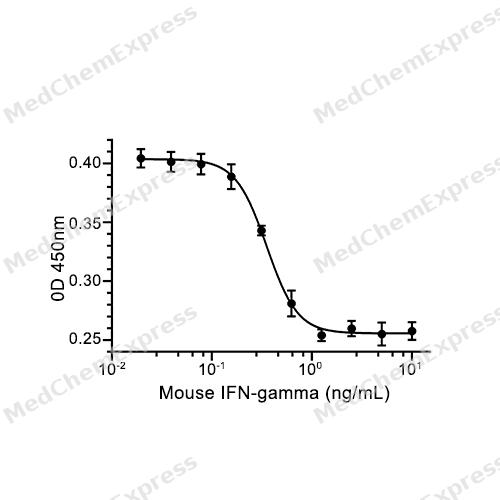
Bioactivity - Cell-Based Assay
-
Purity - SDS-PAGE
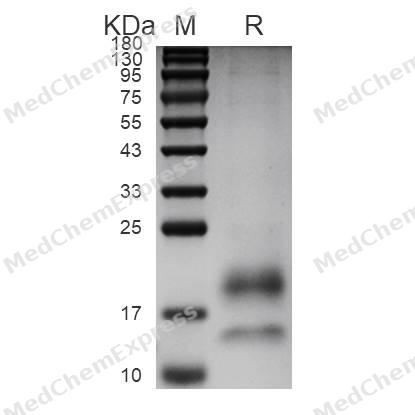
Purity - SDS-PAGE


Publications (2)
-
Journal Impact Factor
-
Most Recent
-
Immunity
An SPP1-SOCS1 pathway constrains interferon responses in tumor-associated macrophages and shapes an immunosuppressive tumor microenvironment. [Abstract]2026 Apr 27:S1074-7613(26)00141-X. PMID: 42049035 -
Cell Rep Med
HE4 drives PD-L1 expression in myeloid cells via IFN-γR-JAK-STAT3 signaling to promote tumor immune evasion. [Abstract]2026 Apr 21;7(4):102691. PMID: 41861828


Technical Parameters
-
Species Mouse
-
Source HEK293
-
Tag Tag Free
-
Accession
P01580 (H23-C155)
-
Molecular Construction
-
N-term
-
IFN-gamma (H23-C155)
Accession # P01580 -
C-term
-
-
Protein Length
Full Length of Mature Protein
-
Synonyms
IFNG; IMD69; Interferon Gamma; IFG; IFN-Gamma; IFI; Immune Interferon
-
AA Sequence
HGTVIESLESLNNYFNSSGIDVEEKSLFLDIWRNWQKDGDMKILQSQIISFYLRLFEVLKDNQAISNNISVIESHLITTFFSNSKAKKDAFMSIAKFEVNNPQVQRQAFNELIRVVHQLLPESSLRKRKRSRC
-
Predicted Molecular Mass
15.5 kDa
-
Molecular Weight
Approximately 12-21 kDa, based on SDS-PAGE under reducing conditions, due to the glycosylation.
-
Glycosylation
Yes
-
Purity
≥ 95%, as determined by reducing SDS-PAGE.


Product Properties
Lyophilized powder
1.Lyophilized from a 0.22 μm filtered solution of 20 mM PB, 150 mM NaCl, pH 7.4.
2.Lyophilized from a 0.22 μm filtered solution of PBS, pH 7.4.
3.Lyophilized from a 0.22 μm filtered solution of PBS, pH 7.4, 5% trehalose, 5% mannitol, 0.01% Tween 80.
4.Lyophilized from a 0.22 μm filtered solution of PBS, pH 7.4, 8% trehalose.
Please refer to the lot-specific COA for specific buffer information.
<1 EU/μg, determined by LAL method.
It is not recommended to reconstitute to a concentration less than 100 μg/mL in ddH2O. For long term storage it is recommended to add a carrier protein (0.1% BSA, 5% HSA, 10% FBS or 5% Trehalose).
Stored at -20°C for 2 years from date of receipt. After reconstitution, it is stable at 4°C for 1 week or -20°C for longer (with carrier protein). It is recommended to freeze aliquots at -20°C or -80°C for extended storage.
Room temperature in continental US; may vary elsewhere.


Documentation
-
Data Sheet (237 KB)
-
SDS (252 KB)
- English - EN (252 KB)
- Français - FR (252 KB)
- Deutsch - DE (252 KB)
- Norwegian - NO (252 KB)
- Español - ES (252 KB)
- Swedish - SV (252 KB)
- Italian - IT (252 KB)
- Korean - KR (252 KB)
- Portuguese - PT (252 KB)
-
Handling Instructions (2659 KB)

Calculators
Concentration (start) × Volume (start) = Concentration (final) × Volume (final)


 Powered by Bioz

