



IFN-beta Protein, Mouse (HEK293)
Based on 12 publication(s) in Google Scholar
IFN-beta is a secretory cytokine produced by cells under viral infection or nucleic acid stimulation. IFNβ binds to cell surface heterodimeric receptors (IFNAR1/IFNAR2), activates the JAK-STAT signaling pathway, and induces the expression of interferon-stimulated genes (ISGs) (such as PKR, 2'5'-OAS). IFN-beta inhibits viral proliferation, regulates immune responses (such as inhibiting Th1 cell polarization, reducing pro-inflammatory cytokine secretion), inhibits the proliferation of vascular smooth muscle cells and tumor cells. IFN-beta has anti-atherosclerotic and vascular remodeling effects. Mouse (HEK293) is the recombinant mouse-derived IFN-beta protein, expressed by HEK293 , with tag free.
- Species: Mouse
- Source: HEK293
-
Storage:Stored at -20°C for 2 years from date of receipt. After reconstitution, it is stable at 4°C for 1 week or -20°C for longer (with carrier protein). It is recommended to freeze aliquots at -20°C or -80°C for extended storage.


To place orders, for customer services and technical support, please contact: MedChemExpress USA
Tel: 609-228-6898 E-mail: [email protected] [email protected]


-
 Biological Activity
-
Technical Parameters
-
Product Properties
- Documentation
- References
- Help & FAQs


-

HY-P7071
IFN-gamma Protein, Mouse -
HY-P7544
IFN-alpha 2/IFNA2 Protein, Mouse -
HY-P73128
IFN-beta Protein, Human (CHO) -
HY-P70667
IFN-gamma Protein, Mouse (HEK293) -
HY-P74866
IFN-alpha 1/IFNA1 Protein, Mouse (P.pastoris, His) -
HY-P7090
TNF-alpha/TNFSF2 Protein, Mouse (156a.a) -
HY-P7044
IL-6 Protein, Human -
HY-P700183AF
Animal-Free IFN alpha 1/IFNA1 Protein, Mouse (His) -
HY-15141
StaurosporinePKC/PKA Inhibitor -
HY-P7024
IFN-beta Protein, Human (HEK293) -
HY-18739
Phorbol 12-myristate 13-acetatePKC Activator -
HY-B0579
Cyclosporin ACalcineurin Inhibitor


Biological Activity
Description
IFN-beta is a secretory cytokine produced by cells under viral infection or nucleic acid stimulation. IFNβ binds to cell surface heterodimeric receptors (IFNAR1/IFNAR2), activates the JAK-STAT signaling pathway, and induces the expression of interferon-stimulated genes (ISGs) (such as PKR, 2'5'-OAS). IFN-beta inhibits viral proliferation, regulates immune responses (such as inhibiting Th1 cell polarization, reducing pro-inflammatory cytokine secretion), inhibits the proliferation of vascular smooth muscle cells and tumor cells. IFN-beta has anti-atherosclerotic and vascular remodeling effects. Mouse (HEK293) is the recombinant mouse-derived IFN-beta protein, expressed by HEK293 , with tag free.
Background
IFN-beta belongs to the type I interferon family[2][3][7]. IFN-beta is a secreted cytokine produced by cells in response to viral infection or nucleic acid stimulation[2][5][7]. IFN-beta binds to cell surface heterodimeric receptors (IFNAR1/IFNAR2), activates the JAK-STAT signaling pathway, and induces the expression of interferon-stimulated genes (ISGs) (such as PKR, 2'5'-OAS)[2][3][4][7]. IFN-beta inhibits viral proliferation, regulates immune responses (such as inhibiting Th1 cell polarization and reducing the secretion of pro-inflammatory cytokines), inhibits the proliferation of vascular smooth muscle cells and tumor cells. IFN-beta has anti-atherosclerotic and vascular remodeling effects[2][5][6][7]. IFN-beta is expressed in tissues such as the spleen, lungs, and kidneys, as well as in vascular endothelial cells and immune cells[5][7]. IFN-beta Protein, Mouse has 50% sequence identity to human IFN-beta[8].
In Vivo
IFN-beta Protein, Mouse (10000 IU/mouse; i.p.; daily; 5 days) enhances DHPG (HY-12598A)-mediated protection against HSV-2 systemic infection in Swiss Webster mice, reducing mortality[6].
IFN-beta Protein, Mouse (10 MIU/kg; s.c.; daily; 4 weeks) attenuates Ang II-induced atherosclerotic plaque formation in apoE-/- mice, reducing lesion area in carotid artery by 30%[7].
Verified Bioactivity
1. Measured in antiviral assays using L929 cells infected with vesicular stomatitisvirus (VSV) and the ED50 is 3-18 pg/mL.
2. Determined by a cytotoxicity assay using human TF-1 cells. The ED50 this effect is ≤0.3901 ng/mL, corresponding to a specific activity is ≥2.563×10⁶ units/mg.
3. Measured by its binding ability in a functional ELISA. Immobilized Recombinant Mouse IFNAR2 at 2 μg/mL (100 μL/well) can bind Biotinylated Recombinant Mouse IFN-beta. The ED50 for this effect is <5 ng/mL.
MCE Validation Data
-
Purity - SDS-PAGE
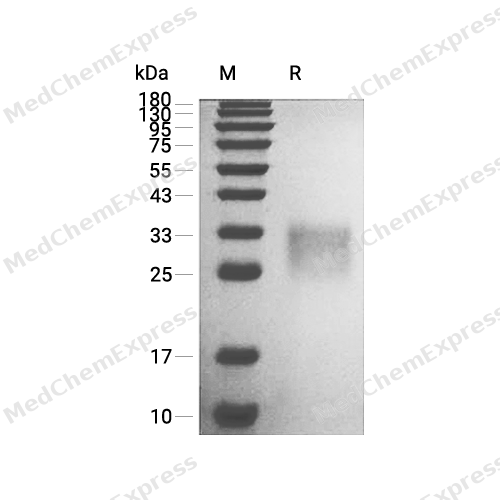
Purity - SDS-PAGE
-
Bioactivity - Cell-Based Assay
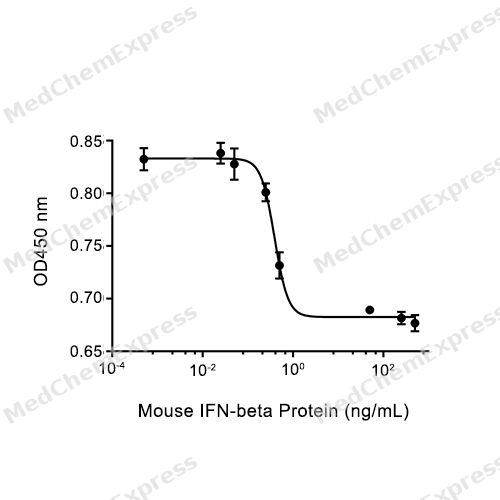
Bioactivity - Cell-Based Assay


Publications (12)
-
Journal Impact Factor
-
Most Recent
-
Immunity
An SPP1-SOCS1 pathway constrains interferon responses in tumor-associated macrophages and shapes an immunosuppressive tumor microenvironment. [Abstract]2026 Apr 27:S1074-7613(26)00141-X. PMID: 42049035 -
Cell Host Microbe
Mycobacterium tuberculosis suppresses host DNA repair to boost its intracellular survival. [Abstract]2023 Nov 8;31(11):1820-1836.e10. PMID: 37848028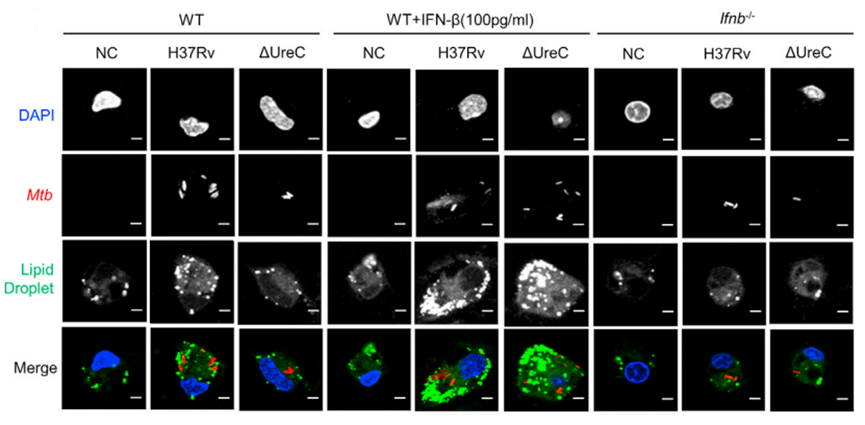
IFN-beta Protein, Mouse (HEK293) purchased from MedChemExpress. Usage Cited in: Cell Host Microbe. 2023 Nov 8;31(11):1820-1836.e10. [Abstract]
Immunofluorescence assay showing the lipid droplets in mouse IFN-β (100 pg/mL, 24 h) treated or Ifnb -/- primary peritoneal macrophages infected with mCherry expressing H37Rv or H37RvDUreC for 24 h.
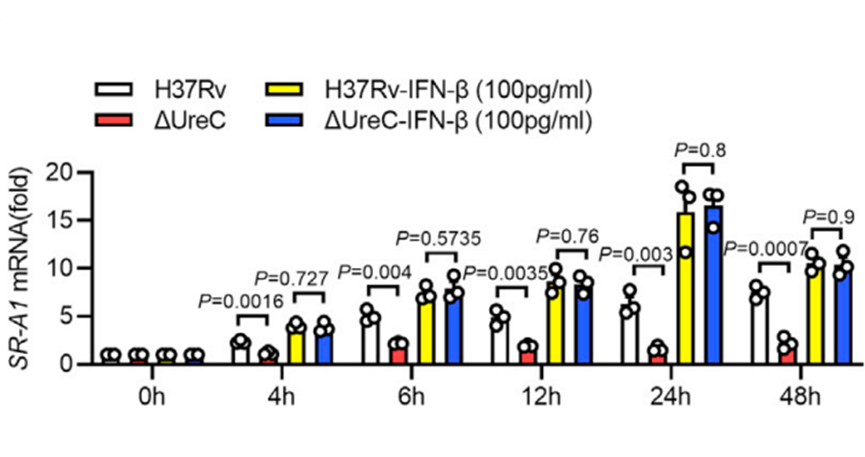
IFN-beta Protein, Mouse (HEK293) purchased from MedChemExpress. Usage Cited in: Cell Host Microbe. 2023 Nov 8;31(11):1820-1836.e10. [Abstract]
RT-PCR analysis of SR-A1 mRNA from mouse IFN-β (100 pg/mL, 24 h) treated primary murine peritoneal macrophages with H37Rv or H37RvDUreC for the indicated times.
-
-
Nat Commun
RNF167 mediates atypical ubiquitylation and degradation of RLRs via two distinct proteolytic pathways. [Abstract]2025 Feb 24;16(1):1920. PMID: 39994288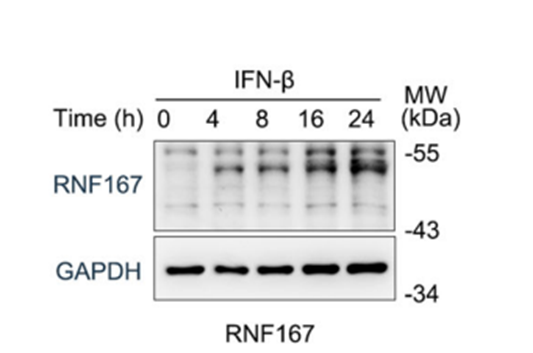
IFN-beta Protein, Mouse (HEK293) purchased from MedChemExpress. Usage Cited in: Nat Commun. 2025 Feb 24;16(1):1920. [Abstract]
Immunoblot analysis the expression of RNF167 protein was upregulated by IFN-β (10 ng/mL, 24 h).
-
Adv Sci (Weinh)
Type I Interferon Signaling Augments Autoimmunity in Neuromyelitis Optica Spectrum Disorder. [Abstract]2025 Jul 21:e00942. PMID: 40686188 -
Cell Rep Med
MPXV infection activates cGAS-STING signaling and IFN-I treatment reduces pathogenicity of mpox in CAST/EiJ mice and rhesus macaques. [Abstract]2025 May 20;6(5):102135. PMID: 40398389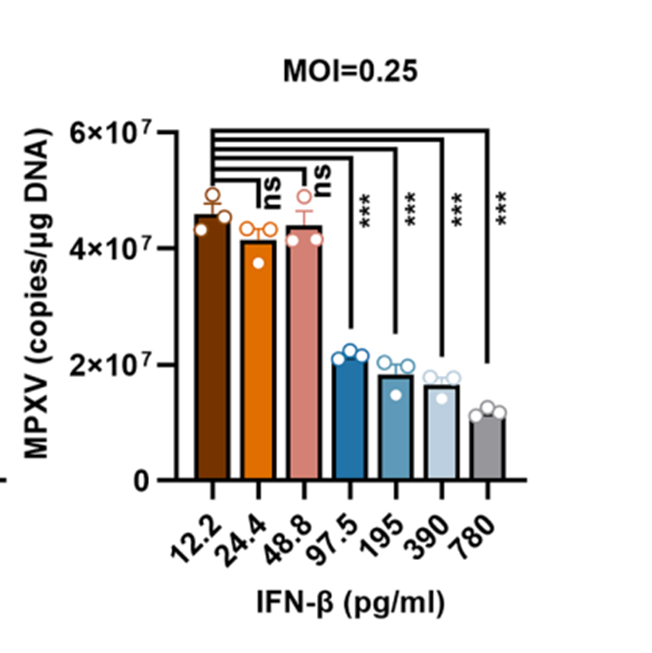
IFN-beta Protein, Mouse (HEK293) purchased from MedChemExpress. Usage Cited in: Cell Rep Med. 2025 May 20;6(5):102135. [Abstract]
IFN-β (approximately 97.5 pg/mL, 24 h) significantly inhibited MPXV replication in BMDMs by qRT-PCR.
-
-
Cell Rep
4-octyl itaconate inhibits cytokine-mediated inflammation via alkylation of TYK2 and JAK1. [Abstract]2026 Mar 30;45(4):117179. PMID: 41915469 -
Sci Signal
IFN-I signaling enhances salivary gland stem and progenitor cell activity after irradiation. [Abstract]2025 Nov 18;18(913):eady0398. PMID: 41252490 -
Radiother Oncol
2026 Feb 21:218:111453. PMID: 41730478 -
Int Immunopharmacol
mtDNA/RNA boosts radiation-induced abscopal effect via M1 macrophage polarization-promoted IFN-β-dependent inflammatory response. [Abstract]2025 May 16:155:114673. PMID: 40245773 -
J Biol Chem
Cytosolic nucleic acid sensing triggers type I interferon activation via the Hippo kinase LATS1. [Abstract]2026 Jan 23;302(3):111204. PMID: 41581871


Technical Parameters
-
Species Mouse
-
Source HEK293
-
Tag Tag Free
-
Accession
P01575 (I22-N182)
-
Molecular Construction
-
N-term
-
IFN-beta (I22-N182)
Accession # P01575 -
C-term
-
-
Protein Length
Full Length of Mature Protein
-
Synonyms
IFNB1; IFF; Prev. IFNB; Fibroblast Interferon; IFB; IFN-Beta; Interferon Beta; Interferon-Beta; Interferon Beta 1; Interferon, Beta 1, Fibroblast
-
AA Sequence
INYKQLQLQERTNIRKCQELLEQLNGKINLTYRADFKIPMEMTEKMQKSYTAFAIQEMLQNVFLVFRNNFSSTGWNETIVVRLLDELHQQTVFLKTVLEEKQEERLTWEMSSTALHLKSYYWRVQRYLKLMKYNSYAWMVVRAEIFRNFLIIRRLTRNFQN
-
Predicted Molecular Mass
19.7 kDa
-
Molecular Weight
Approximately 30 kDa, based on SDS-PAGE under reducing conditions.
-
Glycosylation
Yes
-
Purity
≥ 90%, as determined by reducing SDS-PAGE.


Product Properties
Lyophilized powder
1.Lyophilized from a 0.22 μm filtered solution of 20 mM PB, 150 mM NaCl, pH 7.4.
2.Lyophilized from a 0.22 μm filtered solution of PBS, pH 7.4.
3.Lyophilized from a 0.22 μm filtered solution of PBS, pH 7.4, 8% trehalose.
Please refer to the lot-specific COA for specific buffer information.
<1 EU/μg, determined by LAL method.
It is not recommended to reconstitute to a concentration less than 100 μg/mL in ddH2O. For long term storage it is recommended to add a carrier protein (0.1% BSA, 5% HSA, 10% FBS or 5% Trehalose).
Stored at -20°C for 2 years from date of receipt. After reconstitution, it is stable at 4°C for 1 week or -20°C for longer (with carrier protein). It is recommended to freeze aliquots at -20°C or -80°C for extended storage.
Room temperature in continental US; may vary elsewhere.


Documentation
-
Data Sheet (265 KB)
-
SDS (252 KB)
- English - EN (252 KB)
- Français - FR (252 KB)
- Deutsch - DE (252 KB)
- Norwegian - NO (252 KB)
- Español - ES (252 KB)
- Swedish - SV (252 KB)
- Italian - IT (252 KB)
- Korean - KR (252 KB)
- Portuguese - PT (252 KB)
-
Handling Instructions (2659 KB)


References
[1]. Jeannin S, et al. Response to interferon-Beta treatment in afro-caribbeans with multiple sclerosis. Mult Scler Int. 2011;2011:950126. [Content Brief]
[2]. Stübgen JP. Recombinant interferon-beta therapy and neuromuscular disorders. J Neuroimmunol. 2009 Jul 25;212(1-2):132-41. [Content Brief]
[4]. Yeung VP, et al. Elimination of an immunodominant CD4+ T cell epitope in human IFN-beta does not result in an in vivo response directed at the subdominant epitope. J Immunol. 2004 Jun 1;172(11):6658-65. [Content Brief]
[5]. Singh R, et al. Cell density-dependent modulation of basic fibroblast growth factor expression by human interferon-beta. Int J Oncol. 1996 Apr;8(4):649-56. [Content Brief]
[6]. Fraser-Smith EB, et al. Enhanced efficacy of the acyclic nucleoside 9-(1,3-dihydroxy-2-propoxymethyl)guanine in combination with beta-interferon against herpes simplex virus type 2 in mice. Antimicrob Agents Chemother. 1984 May;25(5):563-5. [Content Brief]
[7]. Zhang LN, et al. Interferon-beta attenuates angiotensin II-accelerated atherosclerosis and vascular remodeling in apolipoprotein E deficient mice. Atherosclerosis. 2008 Mar;197(1):204-11. [Content Brief]
[8]. Karpusas M, et al. The crystal structure of human interferon beta at 2.2-A resolution. Proc Natl Acad Sci U S A. 1997 Oct 28;94(22):11813-8. [Content Brief]

Calculators
Concentration (start) × Volume (start) = Concentration (final) × Volume (final)


 Powered by Bioz

