



IFN-gamma Protein, Human (HEK293)
Based on 7 publication(s) in Google Scholar
IFN-gamma is a cytokine. IFN-gamma can exert anticancer effects by activating p53 and p21, leading to cell cycle arrest, and/or by activating IRF-1 and Caspase-1, leading to pyroptosis, and by activating IRF-1, Caspase-8, cytochrome c release from mitochondria, Caspase cascades, and inhibiting PARP, leading to intrinsic apoptotic signaling. IFN-gamma can induce fusion of human monocytes to form multinucleated giant cells and activate monocytes, increasing their ability to produce hydrogen peroxide, acid phosphatase, and plasminogen activator. IFN-gamma can enhance the sensitivity of human macrophages to lysis mediated by extracellular ATP. IFN-gamma upregulates the transcription and expression of TNF-α by inhibiting the expression of IL-10 and relieving the feedback inhibition of IL-10 on TNF-α. IFN-gamma Protein, Human (HEK293) is a recombinant interferon-gamma protein expressed in HEK293 cells without a tag.
- Species: Human
- Source: HEK293
-
Storage:Stored at -20°C for 2 years from date of receipt. After reconstitution, it is stable at 4°C for 1 week or -20°C for longer (with carrier protein). It is recommended to freeze aliquots at -20°C or -80°C for extended storage.


To place orders, for customer services and technical support, please contact: MedChemExpress USA
Tel: 609-228-6898 E-mail: [email protected] [email protected]


-
 Biological Activity
-
Technical Parameters
-
Product Properties
- Documentation
- References
- Help & FAQs


-

HY-P70568
IL-13 Protein, Human (HEK293, His) -

HY-D1056
Lipopolysaccharides, from E. coli O55:B5 -
HY-18739
Phorbol 12-myristate 13-acetate -
HY-P7058
TNF-alpha/TNFSF2 Protein, Human -
HY-P70445
IL-4 Protein, Human -
HY-P7028
IL-1 beta Protein, Human -
HY-P70750
IL-4 Protein, Human (HEK293) -
HY-P704246
TNF-alpha/TNFSF2 Protein, Human (HEK293) -

HY-D1056A1
Lipopolysaccharides, from E. coli O111:B4 -
HY-P70426A
TNF-alpha/TNFSF2 protein, Human (His) -
HY-Y0320
Dimethyl sulfoxide, meets analytical specification of Ch.P. -
HY-B0579
Cyclosporin A


Biological Activity
Description
IFN-gamma is a cytokine. IFN-gamma can exert anticancer effects by activating p53 and p21, leading to cell cycle arrest, and/or by activating IRF-1 and Caspase-1, leading to pyroptosis, and by activating IRF-1, Caspase-8, cytochrome c release from mitochondria, Caspase cascades, and inhibiting PARP, leading to intrinsic apoptotic signaling. IFN-gamma can induce fusion of human monocytes to form multinucleated giant cells and activate monocytes, increasing their ability to produce hydrogen peroxide, acid phosphatase, and plasminogen activator. IFN-gamma can enhance the sensitivity of human macrophages to lysis mediated by extracellular ATP. IFN-gamma upregulates the transcription and expression of TNF-α by inhibiting the expression of IL-10 and relieving the feedback inhibition of IL-10 on TNF-α. IFN-gamma Protein, Human (HEK293) is a recombinant interferon-gamma protein expressed in HEK293 cells without a tag.
Background
IFN-gamma belongs to the interferon family. IFN-gamma is a cytokine[1]. IFN-gamma can exert anticancer effects by activating p53 and p21, leading to cell cycle arrest, and/or by activating IRF-1 and Caspase-1, leading to pyroptosis, and by activating IRF-1, Caspase-8, cytochrome c release from mitochondria, caspase cascades, and inhibiting PARP, leading to intrinsic apoptotic signaling[1]. IFN-gamma can induce fusion of human monocytes to form multinuclear giant cells and activate monocytes, increasing their ability to produce hydrogen peroxide, acid phosphatase, and plasminogen activator[2]. IFN-gamma can enhance the sensitivity of human macrophages to lysis mediated by extracellular ATP[3]. IFN-gamma upregulates the transcription and expression of TNF-α by inhibiting the expression of IL-10 and relieving the feedback inhibition of IL-10 on TNF-α[4]. IFN-gamma can be produced by CD4+ T helper type 1 lymphocytes, CD8+ cytotoxic lymphocytes, and natural killer (NK) cells[1]. The active form of IFN-gamma, Human is a soluble homodimer with two N-glycosylation sites on the surface of each dimer, at asparagine (N25 and N97). The glycan at N25 is fucosylated, primarily as a complex sialylated oligosaccharide composed of sialic acid, galactose, mannose, N-acetylglucosamine, and fucose, whereas the glycan at N97 is a non-fucosylated hybrid high-mannose structure with a sugar composition of sialic acid, galactose, mannose, and N-acetylglucosamine[1].
In Vitro
IFN-γ, Human (HEK293) (100 ng/mL; 72 h) induces cell death and G2 cell cycle arrest in the ovarian cancer cell line PEO1[1].
IFN-γ, Human (E. coli) (0.1-1 nM) induces multinuclear giant cell formation and enhances H2O2 production and lysosomal enzyme activity in human monocyte cultures[2].
IFN-γ, Human (1-100 ng/mL; 4-18 h) inhibits IL-10 mRNA and protein expression and dose-dependently upregulates TNF-α transcript and protein levels in LPS-stimulated human monocytes[4].
Verified Bioactivity
Measured by its ability to inhibit the proliferation of HT-29 human coloncancer cells.The ED50 for this effect is 0.4003-0.61 ng/mL, corresponding to a specific activity is 1.639×10⁶-2.498×10⁶ Unit/mg.
MCE Validation Data
-
Purity - SDS-PAGE
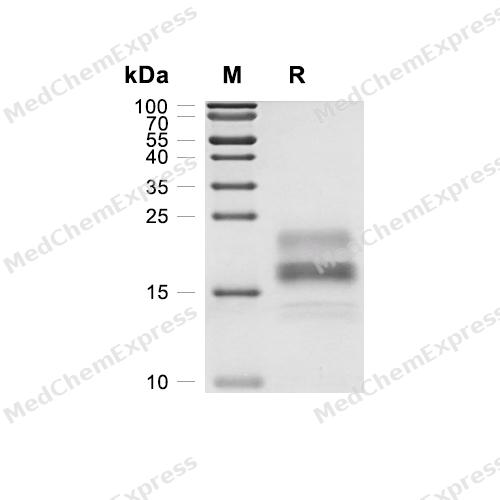
Purity - SDS-PAGE
-
Bioactivity - Cell-Based Assay
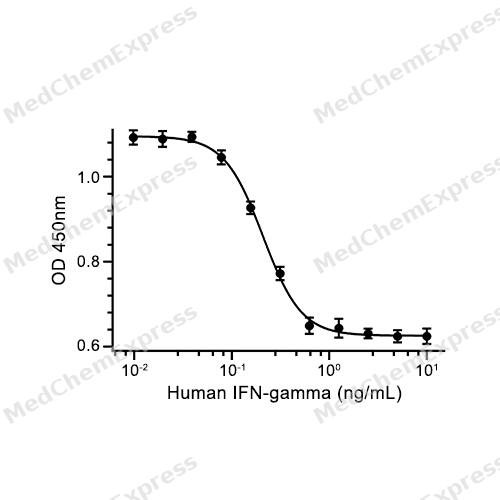
Bioactivity - Cell-Based Assay


Publications (7)
-
Journal Impact Factor
-
Most Recent
-
Bioact Mater
M1 macrophage-derived exosomal miR-155-5p exacerbates aortic dissection via SMAD5-Mediated regulation of vascular smooth muscle cell phenotype. [Abstract]2026 Jun 24:65:984-1004. PMID: 42389022 -
Dev Cell
Vimentin intermediate filaments coordinate actin stress fibers and podosomes to determine the extracellular matrix degradation by macrophages. [Abstract]2025 Jun 23;60(12):1669-1685.e6. PMID: 39952241 -
ACS Synth Biol
Targeting Barrier Reinforcement and MAPK Inhibition: Recombinant Mucin-Type Collagen Tandems Ameliorate Inflammation in TNF-α/IFN-γ-Induced Atopic Dermatitis-like HaCaT Keratinocytes. [Abstract]2026 Apr 17;15(4):1480-1492. PMID: 41927484 -
iScience
M1-like macrophages regulate T cell infiltration in colorectal cancer through P2X4 receptor. [Abstract]2025 Sep 5;28(10):113517. PMID: 41031375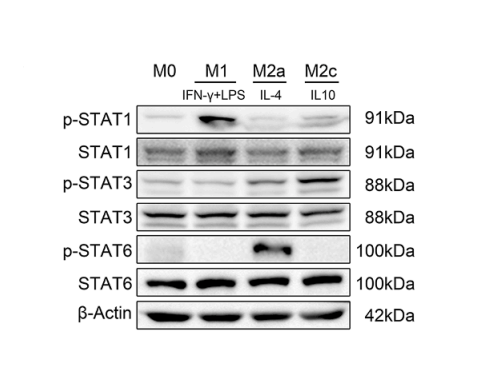
IFN-gamma Protein, Human (HEK293) purchased from MedChemExpress. Usage Cited in: iScience. 2025 Sep 5;28(10):113517. [Abstract]
THP-1-derived macrophages polarization were induced by IFN-γ (10 ng/mL; 48 h) + LPS (M1), IL-4 (M2a), or IL-10 (M2c).
-
Mol Carcinog
Methylseleninic acid overcomes programmed death-ligand 1-mediated resistance of prostate cancer and lung cancer. [Abstract]2021 Nov;60(11):746-757. PMID: 34411338 -
-
bioRxiv
Cellular antibody affinity-based CRISPR Screening identifies JUNB as a broadly acting anti-viral factor. [Abstract]2025 Jun 13:2025.06.12.659131. PMID: 40661610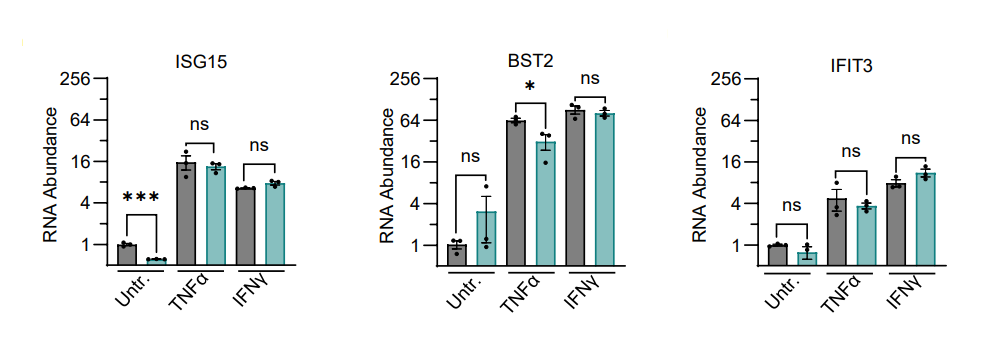
IFN-gamma Protein, Human (HEK293) purchased from MedChemExpress. Usage Cited in: bioRxiv. 2025 Jun 13:2025.06.12.659131. [Abstract]
EV and JUNB KO cells were left untreated or treated with 10 ng/ml TNFα or 10 ng/ml IFNγ for 24 hours and harvested for RNA.


Technical Parameters
-
Species Human
-
Source HEK293
-
Tag Tag Free
-
Accession
P01579 (Q24-Q166)
-
Molecular Construction
-
N-term
-
IFN-gamma (Q24-Q166)
Accession # P01579 -
C-term
-
-
Protein Length
Full Length of Mature Protein
-
Synonyms
IFNG; IMD69; Interferon Gamma; IFG; IFN-Gamma; IFI; Immune Interferon
-
AA Sequence
QDPYVKEAENLKKYFNAGHSDVADNGTLFLGILKNWKEESDRKIMQSQIVSFYFKLFKNFKDDQSIQKSVETIKEDMNVKFFNSNKKKRDDFEKLTNYSVTDLNVQRKAIHELIQVMAELSPAAKTGKRKRSQMLFRGRRASQ
-
Predicted Molecular Mass
16.8 kDa
-
Molecular Weight
Approximately 20-24 kDa & 16-17 kDa, based on SDS-PAGE under reducing conditions, due to the glycosylation.
-
Glycosylation
Yes
-
Purity
≥ 95%, as determined by reducing SDS-PAGE.


Product Properties
Lyophilized powder
Lyophilized from a 0.22 μm filtered solution of PBS, pH 7.4.
<1 EU/μg, determined by LAL method.
It is not recommended to reconstitute to a concentration less than 100 μg/mL in ddH2O. For long term storage it is recommended to add a carrier protein (0.1% BSA, 5% HSA, 10% FBS or 5% Trehalose).
Stored at -20°C for 2 years from date of receipt. After reconstitution, it is stable at 4°C for 1 week or -20°C for longer (with carrier protein). It is recommended to freeze aliquots at -20°C or -80°C for extended storage.
Room temperature in continental US; may vary elsewhere.


Documentation
-
Data Sheet (264 KB)
-
SDS (252 KB)
- English - EN (252 KB)
- Français - FR (252 KB)
- Deutsch - DE (252 KB)
- Norwegian - NO (252 KB)
- Español - ES (252 KB)
- Swedish - SV (252 KB)
- Italian - IT (252 KB)
- Korean - KR (252 KB)
- Portuguese - PT (252 KB)
-
Handling Instructions (2659 KB)


References
[1]. Razaghi A, et al. Improved therapeutic efficacy of mammalian expressed-recombinant interferon gamma against ovarian cancer cells. Exp Cell Res. 2017 Oct 1;359(1):20-29. [Content Brief]
[2]. Weinberg JB, et al. Recombinant human gamma-interferon induces human monocyte polykaryon formation. Proc Natl Acad Sci U S A. 1984 Jul;81(14):4554-7. [Content Brief]
[3]. Blanchard DK, et al. IFN-gamma enhances sensitivity of human macrophages to extracellular ATP-mediated lysis. J Immunol. 1991 Oct 15;147(8):2579-85. [Content Brief]
[4]. Donnelly RP, et al. Inhibition of IL-10 expression by IFN-gamma up-regulates transcription of TNF-alpha in human monocytes. J Immunol. 1995 Aug 1;155(3):1420-7. [Content Brief]

Calculators
Concentration (start) × Volume (start) = Concentration (final) × Volume (final)


 Powered by Bioz

