



M-CSF Protein, Human (CHO)
Based on 9 publication(s) in Google Scholar
M-CSF (CSF-1) protein is a homodimeric hematopoietic growth factor and proinflammatory cytokine, belonging to the colony stimulating factor. M-CSF can act specifically on the monocyte-macrophage lineage, drive monocyte proliferation and differentiation into macrophages/osteoclasts, and induce M1 macrophages to enhance ADCC anti-tumor activity and M2 macrophages to promote VEGF angiogenesis. M-CSF Protein, Human (CHO) is a recombinant human M-CSF protein expressed in CHO cells with tag-free.
- Species: Human
- Source: CHO
-
Storage:Stored at -20°C for 2 years from date of receipt. After reconstitution, it is stable at 4°C for 1 week or -20°C for longer (with carrier protein). It is recommended to freeze aliquots at -20°C or -80°C for extended storage.


To place orders, for customer services and technical support, please contact: MedChemExpress USA
Tel: 609-228-6898 E-mail: [email protected] [email protected]


-
 Biological Activity
-
Technical Parameters
-
Product Properties
- Documentation
- References
- Help & FAQs


-

HY-P70445
IL-4 Protein, Human -
HY-P7118
TGF beta 1/TGFB1 Protein, Human (CHO) -
HY-P7016
GM-CSF Protein, Human (CHO) -
HY-P7025
IFN-gamma Protein, Human -
HY-P7016A
GM-CSF Protein, Human -
HY-P7085A
M-CSF Protein, Mouse (CHO) -
HY-P70781
SCF Protein, Human -
HY-P7040A
IL-3 Protein, Human (CHO) -
HY-B0511
Biotin -

HY-P0035
Insulin (human) -
HY-P7007
BMP-4 Protein, Human -
HY-18739
Phorbol 12-myristate 13-acetate


Biological Activity
Description
M-CSF (CSF-1) protein is a homodimeric hematopoietic growth factor and proinflammatory cytokine, belonging to the colony stimulating factor. M-CSF can act specifically on the monocyte-macrophage lineage, drive monocyte proliferation and differentiation into macrophages/osteoclasts, and induce M1 macrophages to enhance ADCC anti-tumor activity and M2 macrophages to promote VEGF angiogenesis[1][2][3][4]. M-CSF Protein, Human (CHO) is a recombinant human M-CSF protein expressed in CHO cells with tag-free.
Background
1. M-CSF Protein Protein Characteristics[1][2][3]
M-CSF, or macrophage colony stimulating factor, CSF-1, is a disulfide-linked homodimer belonging to the colony stimulating factor (CSF) family. M-CSF is a hematopoietic growth factor and proinflammatory cytokine with multiple glycosylation sites, belonging to the hematopoietic growth factor family along with GM-CSF and G-CSF. M-CSF affects the survival and function of tissue macrophages and has anti-tumor activity[1]. M-CSF is expressed in a variety of cells, such as fibroblasts, endothelial cells, stromal cells, macrophages, smooth muscle cells and osteoblasts, and has multiple subtypes. M-CSF can be a secreted glycoprotein, a cell surface protein and a proteoglycan, binding to its receptor CSF1R[2]. M-CSF can specifically act on the monocyte-macrophage lineage, participate in the development and proliferation of monocyte/macrophage lineage cells, and participate in the induction of osteoclasts. Osteoclasts are very important for the destruction of bone and cartilage and the changes in periarticular osteoporosis in patients with rheumatoid arthritis[3].
2. M-CSF Protein Functional Characteristics[1][4]
M-CSF is regulated by LPS and IFN-γ upstream, and regulates inflammatory factors such as IL-12 and TNF-α downstream. M-CSF induces macrophage polarization to M1 type, and enhances antibody-dependent cellular cytotoxicity (ADCC) by upregulating surface molecules such as CD80 and CD16, exerting anti-tumor effects. M-CSF may induce macrophage polarization to M2 type, promoting VEGF secretion and angiogenesis.
3. Application of M-CSF Protein[1][4][5][6]
Oncology: Clinical trials have shown that M-CSF combined with monoclonal antibodies can enhance tumor-targeted killing, but its pro-angiogenic effect may promote metastasis.
Infection and Immunity: Enhance the antifungal (such as Candida) and anti-tuberculosis activity of macrophages, and use it to treat infections in immunocompromised patients.
Hematopoietic Repair: Restore monocyte counts after chemotherapy/transplantation and shorten the neutrophil deficiency period.
Bone Disease: Regulate osteoclasts, used in osteoporosis and rheumatoid arthritis research.
Verified Bioactivity
The ED50 is <5 ng/mL as measured by Murine M-NFS-60 cells, corresponding to a specific activity of >2 × 10⁵ units/mg.
MCE Validation Data
-
Purity - SDS-PAGE
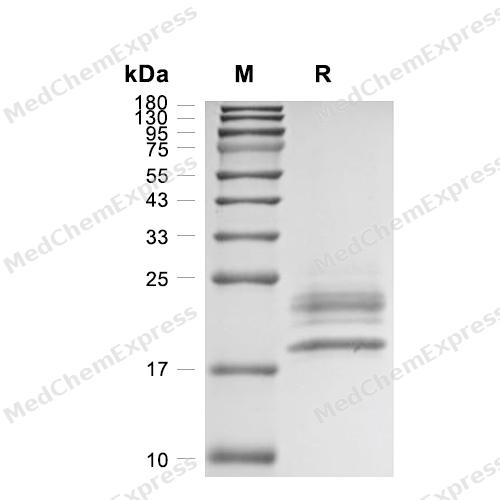
Purity - SDS-PAGE
-
Bioactivity - Cell-Based Assay
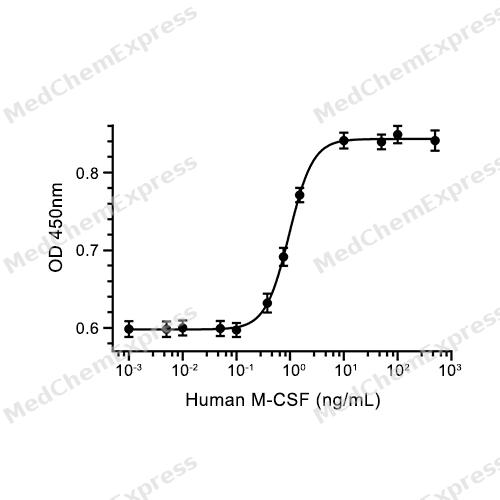
Bioactivity - Cell-Based Assay


Publications (9)
-
Journal Impact Factor
-
Most Recent
-
Signal Transduct Target Ther
2025 Oct 24;10(1):352. PMID: 41130939 -
Small
2024 Jun;20(25):e2308265. PMID: 38225704 -
Int J Mol Med
SPP1 promotes the polarization of M2 macrophages through the Jak2/Stat3 signaling pathway and accelerates the progression of idiopathic pulmonary fibrosis. [Abstract]2024 Oct;54(4):89. PMID: 39129313 -
iScience
TFAP2A enhances tumor stemness and promotes metastasis in pancreatic ductal adenocarcinoma. [Abstract]2025 Jul 5;28(8):113060. PMID: 40727938 -
Autoimmunity
LncRNA TUG1 positively regulates osteoclast differentiation by targeting v-maf musculoaponeurotic fibrosarcoma oncogene homolog B. [Abstract]2020 Dec;53(8):443-449. PMID: 33146047 -
-
Ann Clin Transl Neurol
Clinical, genetic, and molecular characteristics in a central-southern Chinese cohort of genetic leukodystrophies. [Abstract]2023 Sep;10(9):1556-1568. PMID: 37434390 -
Orphanet J Rare Dis
Therapeutic delivery of recombinant glucocerebrosidase enzyme-containing extracellular vesicles to human cells from Gaucher disease patients. [Abstract]2024 Oct 2;19(1):363. PMID: 39358794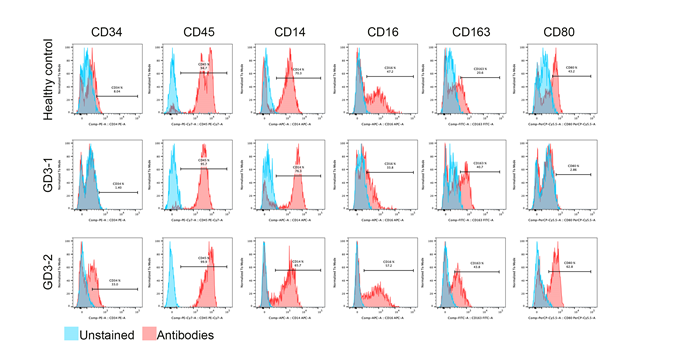
M-CSF Protein, Human (CHO) purchased from MedChemExpress. Usage Cited in: Orphanet J Rare Dis. 2024 Oct 2;19(1):363. [Abstract]
Macrophage marker expression level in hiPSCs M-CSF (50 ng/mL)-exposed macrophages.
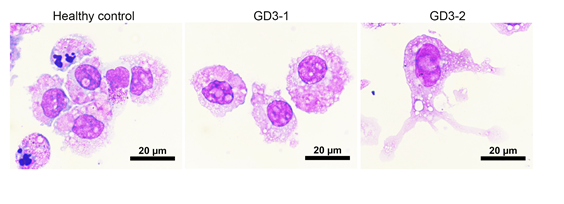
M-CSF Protein, Human (CHO) purchased from MedChemExpress. Usage Cited in: Orphanet J Rare Dis. 2024 Oct 2;19(1):363. [Abstract]
Representative images of cell morphology hiPSC M-CSF (50 ng/mL)-exposed macrophages.
-
Exp Ther Med
LPS inhibits TRIM65 expression in macrophages and C57BL/6J mouse by activating the ERK1/2 signaling pathway. [Abstract]2023 Mar 14;25(4):188. PMID: 37021067


Technical Parameters
-
Species Human
-
Source CHO
-
Tag Tag Free
-
Accession
P09603-3 (E33-S190)
-
Molecular Construction
-
N-term
-
M-CSF (E33-S190)
Accession # P09603-3 -
C-term
-
-
Protein Length
Partial
-
Synonyms
CSF1; Macrophage Colony Stimulating Factor 1; Colony Stimulating Factor 1; Lanimostim; MCSF; MGC31930; Proteoglycan Macrophage Colony-Stimulating Factor; PG-M-CSF; Macrophage Colony-Stimulating Factor 1; CSF-1; M-CSF; CSF1-HERV-LTR71B Fusion Protein; Colo
-
AA Sequence
EEVSEYCSHMIGSGHLQSLQRLIDSQMETSCQITFEFVDQEQLKDPVCYLKKAFLLVQDIMEDTMRFRDNTPNAIAIVQLQELSLRLKSCFTKDYEEHDKACVRTFYETPLQLLEKVKNVFNETKNLLDKDWNIFSKNCNNSFAECSSQGHERQSEGS
-
Molecular Weight
Approximately 18-22 kDa under reduced (R) conditions, 32-40 kDa under non reducing (N) conditions, based on SDS-PAGE due to the glycosylation.
-
Glycosylation
Yes
-
Structure/Form
Disulfide-linked homodimer
-
Purity
≥ 95%, as determined by reducing SDS-PAGE.


Product Properties
Lyophilized powder
1.Lyophilized after extensive dialysis against PBS.
2.Lyophilized after extensive dialysis against PBS, pH 7.4, 8% trehalose.
Please refer to the lot-specific COA for specific buffer information.
<0.2 EU/μg, determined by LAL method.
It is not recommended to reconstitute to a concentration less than 100 μg/mL in ddH2O. For long term storage it is recommended to add a carrier protein (0.1% BSA, 5% HSA, 10% FBS or 5% Trehalose).
Stored at -20°C for 2 years from date of receipt. After reconstitution, it is stable at 4°C for 1 week or -20°C for longer (with carrier protein). It is recommended to freeze aliquots at -20°C or -80°C for extended storage.
Room temperature in continental US; may vary elsewhere.


Documentation
-
Data Sheet (264 KB)
-
SDS (252 KB)
- English - EN (252 KB)
- Français - FR (252 KB)
- Deutsch - DE (252 KB)
- Norwegian - NO (252 KB)
- Español - ES (252 KB)
- Swedish - SV (252 KB)
- Italian - IT (252 KB)
- Korean - KR (252 KB)
- Portuguese - PT (252 KB)
-
Handling Instructions (2659 KB)


References
[1]. Garnick MB, et al. Preclinical and clinical evaluation of recombinant human macrophage colony-stimulating factor (rhM-CSF). Int J Cell Cloning. 1990 Jan;8 Suppl 1:356-71. [Content Brief]
[2]. Hamilton JA. Colony-stimulating factors in inflammation and autoimmunity. Nat Rev Immunol. 2008 Jul;8(7):533-44. [Content Brief]
[3]. Rioja I, et al. Potential novel biomarkers of disease activity in rheumatoid arthritis patients: CXCL13, CCL23, transforming growth factor alpha, tumor necrosis factor receptor superfamily member 9, and macrophage colony-stimulating factor. Arthritis Rheum. 2008 Aug;58(8):2257-67. [Content Brief]

Calculators
Concentration (start) × Volume (start) = Concentration (final) × Volume (final)


 Powered by Bioz

