



M-CSF Protein, Human (HEK293, His)
Based on 1 Customer Validation
The M-CSF protein is an important cytokine that modulates hematopoietic precursor cells, especially mononuclear phagocytes, affecting innate immunity and inflammation through the release of proinflammatory chemokines. It is essential for osteoclast proliferation and regulates bone resorption, bone development and fertility. M-CSF Protein, Human (HEK293, His) is the recombinant human-derived M-CSF protein, expressed by HEK293 , with C-10*His labeled tag.
- Species: Human
- Source: HEK293
-
Storage:Stored at -20°C for 2 years from date of receipt. After reconstitution, it is stable at 4°C for 1 week or -20°C for longer (with carrier protein). It is recommended to freeze aliquots at -20°C or -80°C for extended storage.


To place orders, for customer services and technical support, please contact: MedChemExpress USA
Tel: 609-228-6898 E-mail: [email protected] [email protected]


-
 Biological Activity
-
Technical Parameters
-
Product Properties
- Documentation
- Help & FAQs




Biological Activity
Description
The M-CSF protein is an important cytokine that modulates hematopoietic precursor cells, especially mononuclear phagocytes, affecting innate immunity and inflammation through the release of proinflammatory chemokines. It is essential for osteoclast proliferation and regulates bone resorption, bone development and fertility. M-CSF Protein, Human (HEK293, His) is the recombinant human-derived M-CSF protein, expressed by HEK293 , with C-10*His labeled tag.
Background
M-CSF Protein is a vital cytokine involved in regulating the survival, proliferation, and differentiation of hematopoietic precursor cells, particularly mononuclear phagocytes like macrophages and monocytes. It plays a crucial role in innate immunity and inflammatory processes by promoting the release of pro-inflammatory chemokines. Additionally, M-CSF Protein is essential for osteoclast proliferation and differentiation, regulating bone resorption, and normal bone development. It is also necessary for normal male and female fertility. Moreover, M-CSF Protein contributes to the reorganization of the actin cytoskeleton, facilitating membrane ruffle formation, cell adhesion, and cell migration. Furthermore, it plays a role in lipoprotein clearance. M-CSF Protein can exist in different forms, such as homodimer or heterodimer configurations, and it interacts with CSF1R.
Verified Bioactivity
1.Measured in a cell proliferation assay using M-NFS-60 mouse myelogenous leukemia lymphoblast cells and the ED50 is typically 1-8 ng/mL.
2.Immobilized M-CSF Protein, Human, Recombinant (His Tag) at 2 μg/mL (100 μL/well) can bind CSF1R Protein, Human, Recombinant (hFc & AVI Tag), Biotinylated, the EC50 is 8-50 ng/mL.
MCE Validation Data
-
Purity - SDS-PAGE
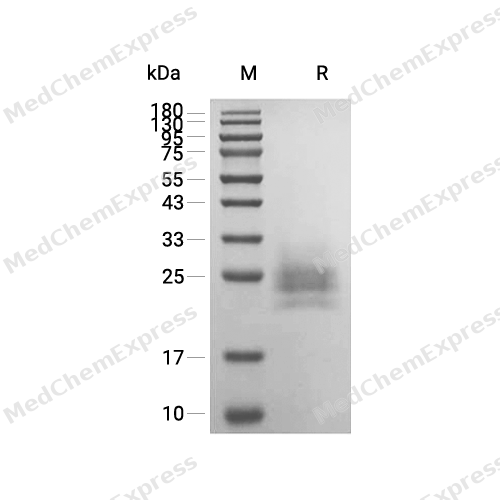
Purity - SDS-PAGE
-
Bioactivity - Cell-Based Assay

Bioactivity - Cell-Based Assay


Technical Parameters
-
Species Human
-
Source HEK293
-
Tag C-10*His
-
Accession
P09603-1 (E33-N190)
-
Molecular Construction
-
N-term
-
M-CSF (E33-N190)
Accession # P09603-1 -
10*His
-
C-term
-
-
Protein Length
Partial Extracellular Domain
-
Synonyms
CSF1; Macrophage Colony Stimulating Factor 1; Colony Stimulating Factor 1; Lanimostim; MCSF; MGC31930; Proteoglycan Macrophage Colony-Stimulating Factor; PG-M-CSF; Macrophage Colony-Stimulating Factor 1; CSF-1; M-CSF; CSF1-HERV-LTR71B Fusion Protein; Colo
-
AA Sequence
EEVSEYCSHMIGSGHLQSLQRLIDSQMETSCQITFEFVDQEQLKDPVCYLKKAFLLVQDIMEDTMRFRDNTPNAIAIVQLQELSLRLKSCFTKDYEEHDKACVRTFYETPLQLLEKVKNVFNETKNLLDKDWNIFSKNCNNSFAECSSQDVVTKPDCN
-
Predicted Molecular Mass
19.8 kDa
-
Molecular Weight
Approximately 20-32 kDa, based on SDS-PAGE under reducing conditions, due to the glycosylation.
-
Glycosylation
Yes
-
Purity
≥ 95%, as determined by reducing SDS-PAGE.


Product Properties
Lyophilized powder
1.Lyophilized from a 0.2 μm filtered solution of PBS, pH 7.4, 5% trehalose, 5% mannitol and 0.01% Tween 80.
2.Lyophilized from a 0.22 μm filtered solution of PBS, pH 7.4, 8% trehalose.
Please refer to the lot-specific COA for specific buffer information.
<1 EU/μg, determined by LAL method.
It is not recommended to reconstitute to a concentration less than 100 μg/mL in ddH2O.
Stored at -20°C for 2 years from date of receipt. After reconstitution, it is stable at 4°C for 1 week or -20°C for longer (with carrier protein). It is recommended to freeze aliquots at -20°C or -80°C for extended storage.
Room temperature in continental US; may vary elsewhere.


Documentation
-
Data Sheet (236 KB)
-
SDS (251 KB)
- English - EN (251 KB)
- Français - FR (251 KB)
- Deutsch - DE (251 KB)
- Norwegian - NO (251 KB)
- Español - ES (251 KB)
- Swedish - SV (251 KB)
- Italian - IT (251 KB)
- Korean - KR (251 KB)
- Portuguese - PT (251 KB)
-
Handling Instructions (2659 KB)

Calculators
Concentration (start) × Volume (start) = Concentration (final) × Volume (final)


 Powered by Bioz

