



GM-CSF Protein, Mouse (CHO)
Based on 3 publication(s) in Google Scholar
GM-CSF Protein, Mouse (CHO) is a hematopoietic growth factor and immune modulator.
- Species: Mouse
- Source: CHO
-
Storage:Stored at -20°C for 2 years from date of receipt. After reconstitution, it is stable at 4°C for 1 week or -20°C for longer (with carrier protein). It is recommended to freeze aliquots at -20°C or -80°C for extended storage.


To place orders, for customer services and technical support, please contact: MedChemExpress USA
Tel: 609-228-6898 E-mail: [email protected] [email protected]


-
 Biological Activity
-
Technical Parameters
-
Product Properties
- Documentation
- References
- Help & FAQs


-

HY-P7080
IL-4 Protein, Mouse (CHO) -
HY-P70563
FLT3LG Protein, Mouse (HEK293, His) -
HY-P7085A
M-CSF Protein, Mouse (CHO) -
HY-B0141
Estradiol -
HY-15141
Staurosporine -
HY-13259
MG-132 -
HY-P7090
TNF-alpha/TNFSF2 Protein, Mouse (156a.a) -
HY-P1156
Insulin(cattle) -
HY-P7071
IFN-gamma Protein, Mouse -
HY-P70553
M-CSF Protein, Mouse (HEK293) -
HY-136175
Revumenib -
HY-P7016
GM-CSF Protein, Human (CHO)


Biological Activity
Description
GM-CSF Protein, Mouse (CHO) is a hematopoietic growth factor and immune modulator.
Background
Granulocyte-macrophage colony-stimulating factor (GM-CSF) is produced by a variety of cell types including T cells, macrophages, endothelial cells and fibroblasts upon receiving immune stimuli. It is an important hematopoietic growth factor and immune modulator. GM-CSF also has profound effects on the functional activities of various circulating leukocytes. GM-CSF stimulates multipotent progenitor cells depending on its concentration, the proliferation of macrophage progenitors at the lowest doses, followed by granulocyte, erythroid, eosinophil, megakaryocyte and multipotent progenitors. It also stimulates the differentiation of myeloid leukemic cells and controls eosinophil function in some instances[1][2]. GM-CSF also enhances the functionality of mature cells, such as neutrophils. In neutrophils, GM-CSF potentiates degranulation, the release of oxygen and nitrogen radical ions, phagocytosis, and inhibits apoptosis[3]. GM-CSF inhibition in some animal models of autoimmune diseases showed significant beneficial effects[4]. GM-CSF also has many pro-inflammatory functions and recent data implicates GM-CSF as a key factor in Th17 driven autoimmune inflammatory conditions[5].
Verified Bioactivity
1.The ED50 is 21.54 pg/mL as measured by mouse FDC-P1 cells, corresponding to a specific activity of 4.643 × 10⁷ units/mg.
2.Measured in a cell proliferation assay using THP 1 cells. The ED50 for this effect is 21.54 pg/mL, corresponding to a specific activity is 4.643×10⁷ units/mg.
3. Measured by its binding ability in a functional ELISA. Immobilized Mouse GM-CSF at 5 μg/mL (100 μL/well) on the plate can bind Mouse GM-CSF R alpha. The ED50 for this effect is 0.1-0.5 μg/mL.
MCE Validation Data
-
Purity - SDS-PAGE
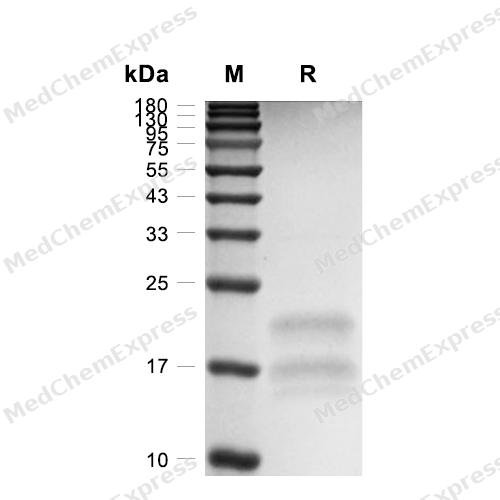
Purity - SDS-PAGE
-
Bioactivity - Cell-Based Assay
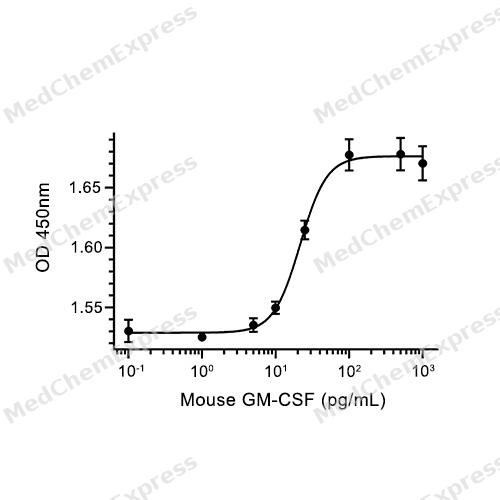
Bioactivity - Cell-Based Assay


Publications (3)
-
Journal Impact Factor
-
Most Recent
-
Biomaterials
Nanoparticles retard immune cells recruitment in vivo by inhibiting chemokine expression. [Abstract]2021 Jan:265:120392. PMID: 32992116 -
Brain Behav Immun
Regulation of macrophage efferocytosis by the CLCF1/NF-κB pathway improves neurological and cognitive impairment following CO poisoning. [Abstract]2025 Jul:127:126-146. PMID: 40081779 -
J Funct Biomater
ATP-Responsive Bimetallic Metal-Organic Frameworks Amplify Oxidative Stress in the Tumor Microenvironment for Synergistic Chemo-Immunotherapy. [Abstract]2026 Apr 19;17(4):199. PMID: 42042305


Technical Parameters
-
Species Mouse
-
Source CHO
-
Tag Tag Free
-
Accession
Q14AD9 (A18-K141)
-
Molecular Construction
-
N-term
-
GM-CSF (A18-K141)
Accession # Q14AD9 -
C-term
-
-
Protein Length
Full Length of Mature Protein
-
Synonyms
CSF2; Molgramostim; Colony Stimulating Factor 2; Molgramostin; GMCSF; CSF; Sargramostim; Granulocyte-Macrophage Colony Stimulating Factor; GM-CSF; Granulocyte Macrophage-Colony Stimulating Factor; Colony Stimulating Factor 2 (Granulocyte-Macrophage); Colony-Stimulating Factor; Granulocyte-Macrophage Colony-Stimulating Factor
-
AA Sequence
APTRSPITVTRPWKHVEAIKEALNLLDDMPVTLNEEVEVVSNEFSFKKLTCVQTRLKIFEQGLRGNFTKLKGALNMTASYYQTYCPPTPETDCETQVTTYADFIDSLKTFLTDIPFECKKPVQK
-
Predicted Molecular Mass
14.2 kDa
-
Molecular Weight
Approximately 15-19 kDa, based on SDS-PAGE under non reducing (N) conditions.
-
Purity
≥ 95%, as determined by reducing SDS-PAGE.


Product Properties
Lyophilized powder
Lyophilized from a 0.22 μm filtered solution of PBS, pH 7.4.
<0.2 EU/μg, determined by LAL method.
It is not recommended to reconstitute to a concentration less than 100 μg/mL in ddH2O. For long term storage it is recommended to add a carrier protein (0.1% BSA, 5% HSA, 10% FBS or 5% Trehalose).
Stored at -20°C for 2 years from date of receipt. After reconstitution, it is stable at 4°C for 1 week or -20°C for longer (with carrier protein). It is recommended to freeze aliquots at -20°C or -80°C for extended storage.
Room temperature in continental US; may vary elsewhere.


Documentation
-
Data Sheet (263 KB)
-
SDS (252 KB)
- English - EN (252 KB)
- Français - FR (252 KB)
- Deutsch - DE (252 KB)
- Norwegian - NO (252 KB)
- Español - ES (252 KB)
- Swedish - SV (252 KB)
- Italian - IT (252 KB)
- Korean - KR (252 KB)
- Portuguese - PT (252 KB)
-
Handling Instructions (2659 KB)


References
[1]. Shi Y, et al. Granulocyte-macrophage colony-stimulating factor (GM-CSF) and T-cell responses: what we do and don't know. Cell Res. 2006 Feb;16(2):126-33. [Content Brief]
[2]. Gasson JC, et al. Human granulocyte-macrophage colony-stimulating factor (GM-CSF): regulation of expression. Prog Clin Biol Res. 1990;338:27-41. [Content Brief]
[3]. Gomez-Cambronero J, et al. Granulocyte-macrophage colony-stimulating factor is a chemoattractant cytokine for human neutrophils: involvement of the ribosomal p70 S6 kinase signaling pathway. J Immunol. 2003 Dec 15;171(12):6846-55. [Content Brief]
[4]. Shiomi A, et al. GM-CSF as a therapeutic target in autoimmune diseases. Inflamm Regen. 2016 Jul 5;36:8. [Content Brief]
[5]. van Nieuwenhuijze A, et al. GM-CSF as a therapeutic target in inflammatory diseases. Mol Immunol. 2013 Dec;56(4):675-82. [Content Brief]

Calculators
Concentration (start) × Volume (start) = Concentration (final) × Volume (final)


 Powered by Bioz

