



GM-CSF Protein, Rat (HEK293, His)
Based on 3 publication(s) in Google Scholar
GM-CSF Protein, a cytokine, promotes the growth and differentiation of hematopoietic precursor cells, including granulocytes, macrophages, eosinophils, and erythrocytes. It functions as a monomer, interacting with the GM-CSF receptor complex, forming a dodecamer structure with two alpha, two beta, and two ligand subunits in head-to-head hexamers (By similarity). GM-CSF Protein, Rat (HEK293, His) is the recombinant rat-derived GM-CSF protein, expressed by HEK293 , with C-6*His labeled tag.
- Species: Rat
- Source: HEK293
-
Storage:Stored at -20°C for 2 years from date of receipt. After reconstitution, it is stable at 4°C for 1 week or -20°C for longer (with carrier protein). It is recommended to freeze aliquots at -20°C or -80°C for extended storage.


To place orders, for customer services and technical support, please contact: MedChemExpress USA
Tel: 609-228-6898 E-mail: [email protected] [email protected]


-
 Biological Activity
-
Technical Parameters
-
Product Properties
- Documentation
- Help & FAQs




Biological Activity
Description
GM-CSF Protein, a cytokine, promotes the growth and differentiation of hematopoietic precursor cells, including granulocytes, macrophages, eosinophils, and erythrocytes. It functions as a monomer, interacting with the GM-CSF receptor complex, forming a dodecamer structure with two alpha, two beta, and two ligand subunits in head-to-head hexamers (By similarity). GM-CSF Protein, Rat (HEK293, His) is the recombinant rat-derived GM-CSF protein, expressed by HEK293 , with C-6*His labeled tag.
Background
GM-CSF Protein is a cytokine known for its ability to promote the growth and differentiation of hematopoietic precursor cells from multiple lineages, including granulocytes, macrophages, eosinophils, and erythrocytes. It functions as a monomer and interacts with the GM-CSF receptor complex, which consists of two head-to-head hexamers of two alpha, two beta, and two ligand subunits, forming a dodecamer structure (By similarity).
MCE Validation Data
-
Purity - SDS-PAGE
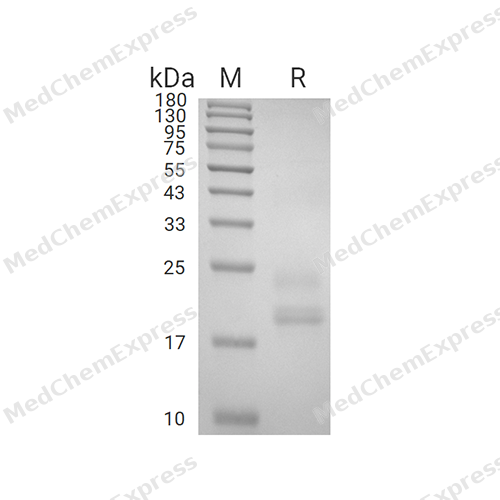
Purity - SDS-PAGE


Publications (3)
-
Journal Impact Factor
-
Most Recent
-
Biomaterials
Bioactive prosthetic interface constructed with cascading multi-nanozyme hydrogel to induce M2 macrophage polarization and heal diabetic bone defects. [Abstract]2026 Feb:325:123624. PMID: 40811942 -
ACS Appl Mater Interfaces
Hypoxia Induces HIF-1α Activation in Tendon Stem Cells to Enhance Extracellular Vesicle-Mediated Tendon Repair. [Abstract]2025 Jul 30;17(30):42637-42657. PMID: 40675622 -
Brain Behav Immun
Regulation of macrophage efferocytosis by the CLCF1/NF-κB pathway improves neurological and cognitive impairment following CO poisoning. [Abstract]2025 Jul:127:126-146. PMID: 40081779


Technical Parameters
-
Species Rat
-
Source HEK293
-
Tag C-6*His
-
Accession
P48750 (A18-K144)
-
Molecular Construction
-
N-term
-
GM-CSF (A18-K144)
Accession # P48750 -
6*His
-
C-term
-
-
Protein Length
Full Length of Mature Protein
-
Synonyms
CSF2; Molgramostim; Colony Stimulating Factor 2; Molgramostin; GMCSF; CSF; Sargramostim; Granulocyte-Macrophage Colony Stimulating Factor; GM-CSF; Granulocyte Macrophage-Colony Stimulating Factor; Colony Stimulating Factor 2 (Granulocyte-Macrophage); Colo
-
AA Sequence
APTRSPNPVTRPWKHVDAIKEALSLLNDMRALENEKNEDVDIISNEFSIQRPTCVQTRLKLYKQGLRGNLTKLNGALTMIASHYQTNCPPTPETDCEIEVTTFEDFIKNLKGFLFDIPFDCWKPVQK
-
Predicted Molecular Mass
15.6 kDa
-
Molecular Weight
Approximately 17-25 kDa, based on SDS-PAGE under reducing conditions.
-
Glycosylation
Yes
-
Purity
≥ 95%, as determined by reducing SDS-PAGE.


Product Properties
Lyophilized powder
Lyophilized from a 0.22 μm filtered solution of PBS pH 7.4.
<1 EU/μg, determined by LAL method.
It is not recommended to reconstitute to a concentration less than 100 μg/mL in ddH2O. For long term storage it is recommended to add a carrier protein (0.1% BSA, 5% HSA, 10% FBS or 5% Trehalose).
Stored at -20°C for 2 years from date of receipt. After reconstitution, it is stable at 4°C for 1 week or -20°C for longer (with carrier protein). It is recommended to freeze aliquots at -20°C or -80°C for extended storage.
Room temperature in continental US; may vary elsewhere.


Documentation
-
Data Sheet (235 KB)
-
SDS (252 KB)
- English - EN (252 KB)
- Français - FR (252 KB)
- Deutsch - DE (252 KB)
- Norwegian - NO (252 KB)
- Español - ES (252 KB)
- Swedish - SV (252 KB)
- Italian - IT (252 KB)
- Korean - KR (252 KB)
- Portuguese - PT (252 KB)
-
Handling Instructions (2659 KB)

Calculators
Concentration (start) × Volume (start) = Concentration (final) × Volume (final)


 Powered by Bioz

