



gp130/IL6ST Protein, Human (HEK293, His)

Based on 1 Customer Validation
gp130/IL6ST is an important signal transduction molecule that can form high-affinity receptor complexes for cytokines such as IL6, LIF, and OSM. Upon IL6 binding, gp130/IL6ST homodimerizes and activates the JAK-MAPK and JAK-STAT3 pathways, leading to the phosphorylation of IL6ST tyrosine residues and subsequent activation of STAT3. gp130/IL6ST Protein, Human (HEK293, His) is the recombinant human-derived gp130/IL6ST protein, expressed by HEK293 , with C-His labeled tag.
- Species: Human
- Source: HEK293
-
Storage:Stored at -20°C for 2 years from date of receipt. After reconstitution, it is stable at 4°C for 1 week or -20°C for longer (with carrier protein). It is recommended to freeze aliquots at -20°C or -80°C for extended storage.


To place orders, for customer services and technical support, please contact: MedChemExpress USA
Tel: 609-228-6898 E-mail: [email protected] [email protected]


-
 Biological Activity
-
Technical Parameters
-
Product Properties
- Documentation
- Help & FAQs




Biological Activity
Description
gp130/IL6ST is an important signal transduction molecule that can form high-affinity receptor complexes for cytokines such as IL6, LIF, and OSM. Upon IL6 binding, gp130/IL6ST homodimerizes and activates the JAK-MAPK and JAK-STAT3 pathways, leading to the phosphorylation of IL6ST tyrosine residues and subsequent activation of STAT3. gp130/IL6ST Protein, Human (HEK293, His) is the recombinant human-derived gp130/IL6ST protein, expressed by HEK293 , with C-His labeled tag.
Background
gp130/IL6ST, a signal-transducing molecule, serves as a crucial component in receptor systems for various cytokines, including IL6, LIF, OSM, CNTF, IL11, CTF1, and BSF3, facilitating signal transmission. Upon binding of IL6 to IL6R, IL6ST undergoes homodimerization, forming a high-affinity receptor complex that activates the JAK-MAPK and JAK-STAT3 signaling pathways. This activation leads to the phosphorylation of IL6ST tyrosine residues, subsequently activating STAT3. Simultaneously, IL6 signaling induces the expression of cytokine receptor signaling inhibitors, SOCS1 and SOCS3, establishing a negative feedback loop to regulate JAK activity (By similarity). Furthermore, IL6ST plays a role in controlling inflammation-induced epithelial regeneration independently of STAT3 by activating the yes-associated protein 1 (YAP) and NOTCH pathways (By similarity). Acting as a receptor for the neuroprotective peptide humanin in conjunction with IL27RA/WSX1 and CNTFR, IL6ST mediates signals crucial for immune response, hematopoiesis, pain control, bone metabolism, and embryonic development (By similarity). Additionally, IL6ST is essential for the survival and differentiation of motor and sensory neurons, the expression of TRPA1 in nociceptive neurons, and the maintenance of PTH1R expression in the osteoblast lineage (By similarity). It binds to the soluble IL6:sIL6R complex, known as hyper-IL6, inhibiting IL6 trans-signaling and blocking IL11 cluster signaling through IL11R.
Verified Bioactivity
1.Measured by its binding ability in a
functional ELISA. Immobilized Human
gp130 at 5 μg/mL(100 uL/well) can
bind Biotinylated Human IL-6 R alpha
in the presence of Human IL-6. The
ED50 for this effect is 13.46 ng/mL.
2.Measured by its binding ability in a
functional ELISA. Immobilized Human IL-6 R alpha, hFc Tag at 2 μg/mL (100 μL/well) on the Human IL-6, No Tag precoated plate (5 μg/mL). Dose response curve for Human gp130, His Tag with the EC50 of 45-52 ng/mL.
MCE Validation Data
-
Bioactivity - ELISA
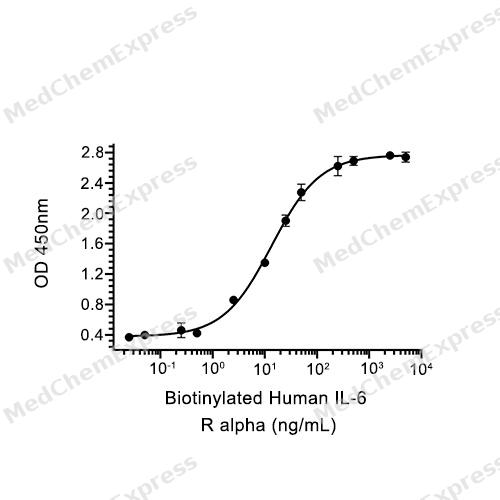
Bioactivity - ELISA


Technical Parameters
-
Species Human
-
Source HEK293
-
Tag C-8*His
-
Accession
P40189-1 (E23-I618)
-
Gene ID3572
-
Molecular Construction
-
N-term
-
gp130 (E23-I618)
Accession # P40189-1 -
8*His
-
C-term
-
-
Protein Length
Extracellular Domain
-
Synonyms
IL6ST; Interleukin Receptor Beta Chain; Interleukin 6 Cytokine Family Signal Transducer; Membrane Glycoprotein Gp130; Interleukin-6 Receptor Subunit Beta; IL6ST Nirs Variant 5; Membrane Glycoprotein 130; IL6ST Nirs Variant 2; IL-6RB; IL6ST Nirs Variant 3;
-
AA Sequence
ELLDPCGYISPESPVVQLHSNFTAVCVLKEKCMDYFHVNANYIVWKTNHFTIPKEQYTIINRTASSVTFTDIASLNIQLTCNILTFGQLEQNVYGITIISGLPPEKPKNLSCIVNEGKKMRCEWDGGRETHLETNFTLKSEWATHKFADCKAKRDTPTSCTVDYSTVYFVNIEVWVEAENALGKVTSDHINFDPVYKVKPNPPHNLSVINSEELSSILKLTWTNPSIKSVIILKYNIQYRTKDASTWSQIPPEDTASTRSSFTVQDLKPFTEYVFRIRCMKEDGKGYWSDWSEEASGITYEDRPSKAPSFWYKIDPSHTQGYRTVQLVWKTLPPFEANGKILDYEVTLTRWKSHLQNYTVNATKLTVNLTNDRYLATLTVRNLVGKSDAAVLTIPACDFQATHPVMDLKAFPKDNMLWVEWTTPRESVKKYILEWCVLSDKAPCITDWQQEDGTVHRTYLRGNLAESKCYLITVTPVYADGPGSPESIKAYLKQAPPSKGPTVRTKKVGKNEAVLEWDQLPVDVQNGFIRNYTIFYRTIIGNETAVNVDSSHTEYTLSSLTSDTLYMVRMAAYTDEGGKDGPEFTFTTPKFAQGEI
-
Predicted Molecular Mass
68.9 kDa
-
Molecular Weight
Approximately 80-110 kDa, based on SDS-PAGE under reducing conditions, due to the glycosylation.
-
Glycosylation
Yes
-
Purity
≥ 95%, as determined by reducing SDS-PAGE.


Product Properties
Lyophilized powder
Lyophilized from a 0.22 μm filtered solution of PBS, pH 7.4, 8% trehalose.
<1 EU/μg, determined by LAL method.
It is not recommended to reconstitute to a concentration less than 100 μg/mL in ddH2O.
Stored at -20°C for 2 years from date of receipt. After reconstitution, it is stable at 4°C for 1 week or -20°C for longer (with carrier protein). It is recommended to freeze aliquots at -20°C or -80°C for extended storage.
Room temperature in continental US; may vary elsewhere.


Documentation
-
Data Sheet (240 KB)
-
SDS (251 KB)
- English - EN (251 KB)
- Français - FR (251 KB)
- Deutsch - DE (251 KB)
- Norwegian - NO (251 KB)
- Español - ES (251 KB)
- Swedish - SV (251 KB)
- Italian - IT (251 KB)
- Korean - KR (251 KB)
- Portuguese - PT (251 KB)
-
Handling Instructions (2659 KB)

Calculators
Concentration (start) × Volume (start) = Concentration (final) × Volume (final)


 Powered by Bioz

