



GSTP1 Protein, Rat (His)

Based on 1 Customer Validation
GSTP1 protein conjugates reduced glutathione to hydrophobic electrophiles, forms glutathione conjugates of PGA2 and PGJ2, and contributes to hepoxilin production.It also regulates CDK5 activity by facilitating p25/p35 translocation, preventing neurodegeneration.GSTP1 Protein, Rat (His) is the recombinant rat-derived GSTP1 protein, expressed by E.coli , with N-6*His labeled tag.
- Species: Rat
- Source: E. coli
-
Storage:Stored at -20°C for 2 years from date of receipt. After reconstitution, it is stable at 4°C for 1 week or -20°C for longer (with carrier protein). It is recommended to freeze aliquots at -20°C or -80°C for extended storage.


To place orders, for customer services and technical support, please contact: MedChemExpress USA
Tel: 609-228-6898 E-mail: [email protected] [email protected]


-
 Biological Activity
-
Technical Parameters
-
Product Properties
- Documentation
- Help & FAQs




Biological Activity
Description
GSTP1 protein conjugates reduced glutathione to hydrophobic electrophiles, forms glutathione conjugates of PGA2 and PGJ2, and contributes to hepoxilin production.It also regulates CDK5 activity by facilitating p25/p35 translocation, preventing neurodegeneration.GSTP1 Protein, Rat (His) is the recombinant rat-derived GSTP1 protein, expressed by E.coli , with N-6*His labeled tag.
Background
GSTP1 protein is responsible for conjugating reduced glutathione to various hydrophobic electrophiles, both exogenous and endogenous. It plays a role in forming glutathione conjugates of prostaglandin A2 (PGA2) and prostaglandin J2 (PGJ2), as well as contributing to the production of unique hepoxilin regioisomers. Additionally, GSTP1 helps regulate CDK5 activity by facilitating the translocation of p25/p35, thereby preventing neurodegeneration.
Verified Bioactivity
Measured by the conjugation of reduced glutathione to 2mM 1-bromo-2,4-dinitrobenzene that incubate at room temperature in kinetic mode for 5 minutes. The specific activity is ≤26085.069 pmol/min/μg.
MCE Validation Data
-
Purity - SDS-PAGE
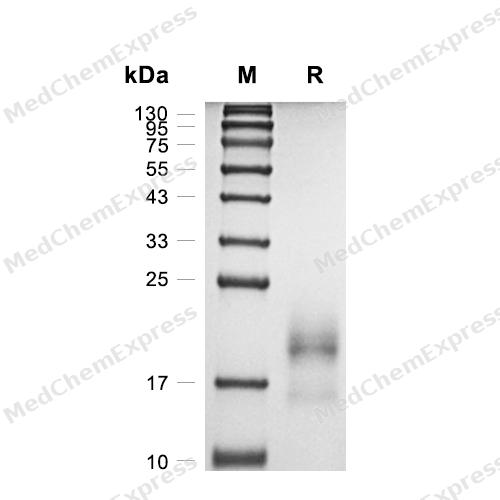
Purity - SDS-PAGE

Assay Procedure
Materials
Assay buff: 100 mM NaH2PO4, pH 7.0
Substrate: 1-bromo-2,4-dinitrobenzene (BDNB) , 75 mM stock solution in ethanol
L-Glutathione, reduced (GSH, HY-D0187), 250 mM deionized water storage solution
Test protein: GSTP1 Protein, Rat (His) (HY-P72217)
Procedure
1. Dilute Rat GSTP1 to 0.2 ng/μL in detection buffer.
2. Dilute GSH to 4 mM in detection buffer.
3. Combine equal volumes of 0.2 ng/μL Rat GSTP1 and 4 mM GSH to achieve a final concentration of 0.1 ng/μL Rat GSTP1 and 2 mM GSH.
4. Dilute the substrate to 2 mM in assay buffer.
Experimental group: Load 50 μL of the Rat GSTP1/GSH mixture onto the UV plate.
Control group: 25 μL of assay buffer and 25 μL of the 4 mM GSH prepared in step 2.
5. Initiate the reaction by adding 50 μL of 2 mM substrate to the wells.
6. Read in kinetic mode at an absorbance of 340 nm for 5 minutes.
7. Calculate the specific activity:
Specific Activity (pmol/min/μg) = | Adjusted Vmax* (OD/min) x well volume (L) x 1012 pmol/mol |
| ext. coeff ** (M-1cm-1) x path corr.*** (cm) x amount of enzyme (μg) |
*Adjusted for Control
**ext. coeff:5580 M-1cm-1
***path correction: 0.320 cm


Technical Parameters
-
Species Rat
-
Source E. coli
-
Tag N-6*His
-
Accession
P04906 (P2-Q210)
-
Molecular Construction
-
N-term
-
6*His
-
GSTP1 (P2-Q210)
Accession # P04906 -
C-term
-
-
Protein Length
Full Length
-
Synonyms
GSTP1; Epididymis Secretory Protein Li 22; Prev. FAEES3; Glutathione Transferase; Prev. GST3; Deafness, X-Linked 7; Glutathione S-Transferase P; Mutant GSTP1; GST Class-Pi; HEL-S-22; GSTP; DFN7; GSTP1-1; PI; Fatty Acid Ethyl Ester Synthase III; Glutathion
-
AA Sequence
PPYTIVYFPVRGRCEATRMLLADQGQSWKEEVVTIDVWLQGSLKSTCLYGQLPKFEDGDLTLYQSNAILRHLGRSLGLYGKDQKEAALVDMVNDGVEDLRCKYGTLIYTNYENGKDDYVKALPGHLKPFETLLSQNQGGKAFIVGNQISFADYNLLDLLLVHQVLAPGCLDNFPLLSAYVARLSARPKIKAFLSSPDHLNRPINGNGKQ
-
Molecular Weight
Approximately 24 kDa, based on SDS-PAGE under reducing conditions.
-
Purity
≥ 90%, as determined by reducing SDS-PAGE.


Product Properties
Lyophilized powder.
1.Lyophilized from a 0.22 μm filtered solution of 20 mM Tris-HCl, 0.5 M NaCl, 6% trehalose, pH 8.0.
2.Lyophilized from a 0.22 μm filtered solution of 50 mM Tris-HCl, 300 mM NaCl, pH 8.0, 5% trehalose, mannitol, 0.01% Tween 80.
3.Lyophilized from a 0.22 μm filtered solution of 50 mM Tris-HCl, 300 mM NaCl, pH 8.0.
Please refer to the lot-specific COA for specific buffer information.
Note: For SPR assay, please replace the buffer. Primary amine components (e.g., Tris, imidazole) can affect protein-coupled chips.
<1 EU/μg, determined by LAL method.
It is not recommended to reconstitute to a concentration less than 100 μg/mL in ddH2O. For long term storage it is recommended to add a carrier protein (0.1% BSA, 5% HSA, 10% FBS or 5% Trehalose).
Stored at -20°C for 2 years from date of receipt. After reconstitution, it is stable at 4°C for 1 week or -20°C for longer (with carrier protein). It is recommended to freeze aliquots at -20°C or -80°C for extended storage.
Room temperature in continental US; may vary elsewhere.


Documentation
-
Data Sheet (260 KB)
-
SDS (252 KB)
- English - EN (252 KB)
- Français - FR (252 KB)
- Deutsch - DE (252 KB)
- Norwegian - NO (252 KB)
- Español - ES (252 KB)
- Swedish - SV (252 KB)
- Italian - IT (252 KB)
- Korean - KR (252 KB)
- Portuguese - PT (252 KB)
-
Handling Instructions (2659 KB)

Calculators
Concentration (start) × Volume (start) = Concentration (final) × Volume (final)


 Powered by Bioz

