



HABP1/C1QBP Protein, Mouse (His)
Based on 1 publication(s) in Google Scholar
The HABP1/C1QBP proteins are part of the MAM33 family, related to a unique family of proteins known for unique characteristics and functions. Among the MAM33 family, HABP1 may play an important role in related cellular processes, but its specific function still needs to be explored. HABP1/C1QBP Protein, Mouse (His) is the recombinant mouse-derived HABP1/C1QBP protein, expressed by E. coli , with N-His labeled tag.
- Species: Mouse
- Source: E. coli
-
Storage:Stored at -80°C for 1 year from date of receipt. It is stable at -20°C for 3 months after opening. It is recommended to freeze aliquots at -80°C for extended storage. Avoid repeated freeze-thaw cycles.


To place orders, for customer services and technical support, please contact: MedChemExpress USA
Tel: 609-228-6898 E-mail: [email protected] [email protected]


-
 Biological Activity
-
Technical Parameters
-
Product Properties
- Documentation
- Help & FAQs




Biological Activity
Description
The HABP1/C1QBP proteins are part of the MAM33 family, related to a unique family of proteins known for unique characteristics and functions. Among the MAM33 family, HABP1 may play an important role in related cellular processes, but its specific function still needs to be explored. HABP1/C1QBP Protein, Mouse (His) is the recombinant mouse-derived HABP1/C1QBP protein, expressed by E. coli , with N-His labeled tag.
Background
HABP1/C1QBP protein is a member of the MAM33 family, categorizing it within a specific protein family known for its distinctive characteristics and functions. As part of the MAM33 family, HABP1 likely plays a significant role in cellular processes associated with this family, though specific functions require further exploration. Investigating the functions and implications of HABP1 within the broader context of the MAM33 family will contribute to a better understanding of its unique properties and potential roles in cellular processes, providing insights into its significance within this protein family.
MCE Validation Data
-
Purity - SDS-PAGE
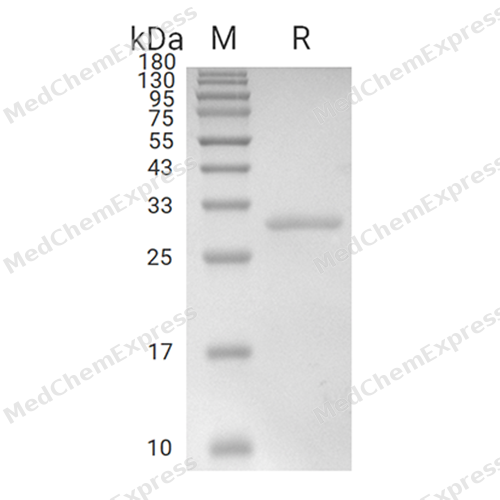
Purity - SDS-PAGE


Publications (1)
-
Journal Impact Factor
-
Most Recent
-
Biomaterials
Probiotic domestication and engineering enable one-shot treatment for bladder mucosal repair. [Abstract]2025 Jul:318:123123. PMID: 39893782


Technical Parameters
-
Species Mouse
-
Source E. coli
-
Tag N-His
-
Accession
Q8R5L1 (L72-Q279)
-
Molecular Construction
-
N-term
-
His
-
HABP1 (L72-Q279)
Accession # Q8R5L1 -
C-term
-
-
Protein Length
Partial
-
Synonyms
C1QBP; Splicing Factor SF2-Associated Protein; Prev. HABP1; ASF/SF2-Associated Protein P32; Complement Component 1 Q Subcomponent-Binding Protein, Mitochondrial; Glycoprotein GC1qBP; Mitochondrial Matrix Protein P32; SF2AP32; Hyaluronan-Binding Protein 1;
-
AA Sequence
LHTEGDKAFVEFLTDEIKEEKKIQKHKSLPKMSGDWELEVNGTEAKLLRKVAGEKITVTFNINNSIPPTFDGEEEPSQGQKAEEQEPELTSTPNFVVEVTKTDGKKTLVLDCHYPEDEIGHEDEAESDIFSIKEVSFQATGDSEWRDTNYTLNTDSLDWALYDHLMDFLADRGVDNTFADELVELSTALEHQEYITFLEDLKSFVKNQ
-
Predicted Molecular Mass
24.7 kDa
-
Molecular Weight
Approximately 32 kDa, based on SDS-PAGE under reducing conditions.
-
Purity
≥ 90%, as determined by reducing SDS-PAGE.


Product Properties
Solution
Supplied as a 0.22 μm filtered solution of PBS, pH 7.4.
<1 EU/μg, determined by LAL method.
Stored at -80°C for 1 year from date of receipt. It is stable at -20°C for 3 months after opening. It is recommended to freeze aliquots at -80°C for extended storage. Avoid repeated freeze-thaw cycles.
Shipping with dry ice.


Documentation
-
Data Sheet (235 KB)
-
SDS (251 KB)
- English - EN (251 KB)
- Français - FR (251 KB)
- Deutsch - DE (251 KB)
- Norwegian - NO (251 KB)
- Español - ES (251 KB)
- Swedish - SV (251 KB)
- Italian - IT (251 KB)
- Korean - KR (251 KB)
- Portuguese - PT (251 KB)
-
Handling Instructions (2659 KB)

Calculators
Concentration (start) × Volume (start) = Concentration (final) × Volume (final)


 Powered by Bioz

