



HABP2 Protein, Human (HEK293, His)
Based on 2 publication(s) in Google Scholar
HABP2 is a protein that cleaves the alpha chain of fibrinogen as well as the beta chain between "Lys-53" and "Lys-54" at multiple sites, preventing direct formation of a fibrin clot. It activates coagulation factor VII and converts prourokinase into its active form. HABP2 Protein, Human (HEK293, His) is the recombinant human-derived HABP2 protein, expressed by HEK293 , with C-6*His labeled tag.
- Species: Human
- Source: HEK293
-
Storage:Stored at -20°C for 2 years from date of receipt. After reconstitution, it is stable at 4°C for 1 week or -20°C for longer (with carrier protein). It is recommended to freeze aliquots at -20°C or -80°C for extended storage.


To place orders, for customer services and technical support, please contact: MedChemExpress USA
Tel: 609-228-6898 E-mail: [email protected] [email protected]


-
 Biological Activity
-
Technical Parameters
-
Product Properties
- Documentation
- Help & FAQs




Biological Activity
Description
HABP2 is a protein that cleaves the alpha chain of fibrinogen as well as the beta chain between "Lys-53" and "Lys-54" at multiple sites, preventing direct formation of a fibrin clot. It activates coagulation factor VII and converts prourokinase into its active form. HABP2 Protein, Human (HEK293, His) is the recombinant human-derived HABP2 protein, expressed by HEK293 , with C-6*His labeled tag.
Background
HABP2, a multifunctional protein, exhibits proteolytic activity by cleaving the alpha-chain at multiple sites and the beta-chain between 'Lys-53' and 'Lys-54' of fibrinogen, while sparing the gamma-chain, thereby preventing direct initiation of fibrin clot formation and fibrinolysis. Notably, HABP2 does not activate prothrombin and plasminogen but facilitates the conversion of pro-urokinase to its active two-chain form. Additionally, it serves as an activator of coagulation factor VII. Beyond its role in hemostasis, HABP2 may act as a tumor suppressor, exerting negative regulation on cell proliferation and migration. Structurally, HABP2 exists as a heterodimer, with a 50 kDa heavy chain and a 27 kDa light chain linked by a disulfide bond.
MCE Validation Data
-
Purity - SDS-PAGE
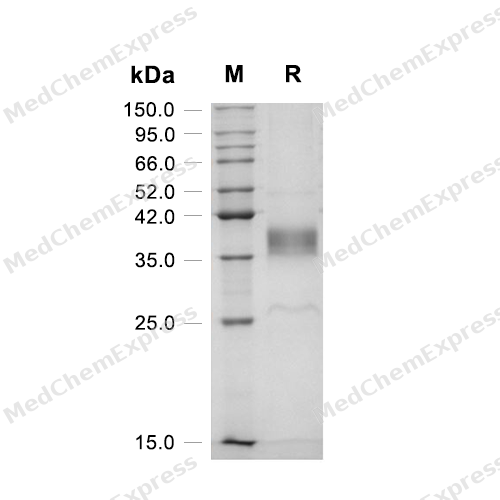
Purity - SDS-PAGE


Publications (2)
-
Journal Impact Factor
-
Most Recent
-
Signal Transduct Target Ther
FSAP aggravated endothelial dysfunction and neurological deficits in acute ischemic stroke due to large vessel occlusion. [Abstract]2022 Jan 7;7(1):6. PMID: 34992208 -
MedComm
Low-dose exercise protects the heart against established myocardial infarction via IGF-1-upregulated CTRP9 in male mice. [Abstract]2023 Nov 24;4(6):e411. PMID: 38020715


Technical Parameters
-
Species Human
-
Source HEK293
-
Tag C-6*His
-
Accession
Q14520-1 (F24-Q279)
-
Molecular Construction
-
N-term
-
HABP2 (F24-Q279)
Accession # Q14520-1 -
6*His
-
C-term
-
-
Protein Length
Partial
-
Synonyms
HABP2; Factor VII Activating Protein; Hyaluronan Binding Protein 2; Hyaluronan-Binding Protein 2; HGFAL; FVII Activator; PHBP; PHBSP; FSAP; Hyaluronic Acid Binding Protein 2; HABP; Plasma Hyaluronan-Binding Protein; Hepatocyte Growth Factor Activator-Like
-
AA Sequence
FSLMSLLESLDPDWTPDQYDYSYEDYNQEENTSSTLTHAENPDWYYTEDQADPCQPNPCEHGGDCLVHGSTFTCSCLAPFSGNKCQKVQNTCKDNPCGRGQCLITQSPPYYRCVCKHPYTGPSCSQVVPVCRPNPCQNGATCSRHKRRSKFTCACPDQFKGKFCEIGSDDCYVGDGYSYRGKMNRTVNQHACLYWNSHLLLQENYNMFMEDAETHGIGEHNFCRNPDADEKPWCFIKVTNDKVKWEYCDVSACSAQ
-
Molecular Weight
Approximately 35-40 kDa, based on SDS-PAGE under reducing conditions.
-
Glycosylation
Yes
-
Purity
≥ 95%, as determined by reducing SDS-PAGE.


Product Properties
Lyophilized powder
Lyophilized from a 0.2 μm filtered solution of PBS, pH 7.4 or 20 mM PB, 150 mM NaCl, pH 7.4.
<1 EU/μg, determined by LAL method.
It is not recommended to reconstitute to a concentration less than 100 μg/mL in ddH2O. For long term storage it is recommended to add a carrier protein (0.1% BSA, 5% HSA, 10% FBS or 5% Trehalose).
Stored at -20°C for 2 years from date of receipt. After reconstitution, it is stable at 4°C for 1 week or -20°C for longer (with carrier protein). It is recommended to freeze aliquots at -20°C or -80°C for extended storage.
Room temperature in continental US; may vary elsewhere.


Documentation
-
Data Sheet (237 KB)
-
SDS (252 KB)
- English - EN (252 KB)
- Français - FR (252 KB)
- Deutsch - DE (252 KB)
- Norwegian - NO (252 KB)
- Español - ES (252 KB)
- Swedish - SV (252 KB)
- Italian - IT (252 KB)
- Korean - KR (252 KB)
- Portuguese - PT (252 KB)
-
Handling Instructions (2659 KB)

Calculators
Concentration (start) × Volume (start) = Concentration (final) × Volume (final)


 Powered by Bioz

