



HMGB2/HMG-2 Protein, Human (HEK293, His)
Based on 1 publication(s) in Google Scholar
The multifunctional HMGB2/HMG-2 protein exhibits multiple cellular functions and may function in a redox-sensitive manner. In the nucleus, it acts as a chromatin-associated non-histone protein that is essential for transcription, chromatin remodeling and V(D)J reorganization. HMGB2/HMG-2 Protein, Human (HEK293, His) is the recombinant human-derived HMGB2/HMG-2 protein, expressed by HEK293 , with C-6*His labeled tag.
- Species: Human
- Source: HEK293
-
Storage:Stored at -20°C for 2 years from date of receipt. After reconstitution, it is stable at 4°C for 1 week or -20°C for longer (with carrier protein). It is recommended to freeze aliquots at -20°C or -80°C for extended storage.


To place orders, for customer services and technical support, please contact: MedChemExpress USA
Tel: 609-228-6898 E-mail: [email protected] [email protected]


-
 Biological Activity
-
Technical Parameters
-
Product Properties
- Documentation
- Help & FAQs




Biological Activity
Description
The multifunctional HMGB2/HMG-2 protein exhibits multiple cellular functions and may function in a redox-sensitive manner. In the nucleus, it acts as a chromatin-associated non-histone protein that is essential for transcription, chromatin remodeling and V(D)J reorganization. HMGB2/HMG-2 Protein, Human (HEK293, His) is the recombinant human-derived HMGB2/HMG-2 protein, expressed by HEK293 , with C-6*His labeled tag.
Background
HMGB2/HMG-2, a versatile protein with diverse cellular functions across various compartments, may act in a redox-sensitive manner. In the nucleus, it serves as an abundant chromatin-associated non-histone protein, playing crucial roles in transcription, chromatin remodeling, and V(D)J recombination, among other processes. HMGB2/HMG-2 exhibits a DNA-binding preference for non-canonical DNA structures, such as single-stranded DNA, and possesses the ability to bend DNA, enhancing flexibility through looping. This looping mechanism facilitates the promotion of activities on various gene promoters by augmenting transcription factor binding and bringing distant regulatory sequences into close proximity. Involved in V(D)J recombination, HMGB2/HMG-2 acts as a cofactor of the RAG complex, stimulating cleavage and RAG protein binding at the conserved recombination signal sequences. Additionally, it is proposed to participate in the innate immune response to nucleic acids by acting as a promiscuous immunogenic DNA/RNA sensor, cooperating with subsequent discriminative sensing by specific pattern recognition receptors. In the extracellular compartment, HMGB2/HMG-2 acts as a chemokine, promoting proliferation and migration of endothelial cells and exhibiting antimicrobial activity in gastrointestinal epithelial tissues. It is implicated in inflammatory responses to antigenic stimuli and involved in the modulation of neurogenesis, likely by regulating neural stem proliferation. Furthermore, HMGB2/HMG-2 contributes to articular cartilage surface maintenance through interactions with LEF1 and the Wnt/beta-catenin pathway. It interacts with various proteins, including POU2F2, POU2F1, POU3F1, SET, and LEF1, highlighting its intricate role in diverse cellular processes.
MCE Validation Data
-
Purity - SDS-PAGE
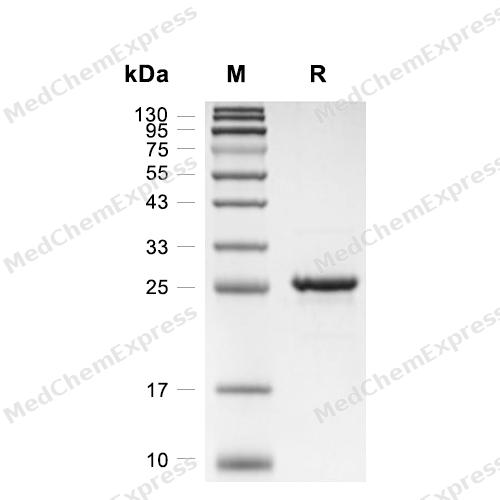
Purity - SDS-PAGE


Publications (1)
-
Journal Impact Factor
-
Most Recent
-
Free Radic Biol Med
HMGB2 causes photoreceptor death via down-regulating Nrf2/HO-1 and up-regulating NF-κB/NLRP3 signaling pathways in light-induced retinal degeneration model. [Abstract]2022 Mar:181:14-28. PMID: 35091064


Technical Parameters
-
Species Human
-
Source HEK293
-
Tag C-6*His
-
Accession
P26583 (G2-E209)
-
Molecular Construction
-
N-term
-
HMGB2 (G2-E209)
Accession # P26583 -
6*His
-
C-term
-
-
Protein Length
Full Length
-
Synonyms
HMGB2; High Mobility Group Protein 2; Prev. HMG2; HMG-2; High Mobility Group Protein B2; High-Mobility Group Box 2; High Mobility Group Box 2; High-Mobility Group (Nonhistone Chromosomal) Protein 2
-
AA Sequence
GKGDPNKPRGKMSSYAFFVQTCREEHKKKHPDSSVNFAEFSKKCSERWKTMSAKEKSKFEDMAKSDKARYDREMKNYVPPKGDKKGKKKDPNAPKRPPSAFFLFCSEHRPKIKSEHPGLSIGDTAKKLGEMWSEQSAKDKQPYEQKAAKLKEKYEKDIAAYRAKGKSEAGKKGPGRPTGSKKKNEPEDEEEEEEEEDEDEEEEDEDEE
-
Predicted Molecular Mass
25 kDa
-
Molecular Weight
Approximately 28 kDa, based on SDS-PAGE under reducing conditions.
-
Purity
≥ 95%, as determined by reducing SDS-PAGE.


Product Properties
Lyophilized powder
Lyophilized from a 0.22 μm filtered solution of 20 mM Tris-HCl, 100 mM NaCl, pH 8.0.
Note: For SPR assay, please replace the buffer. Primary amine components (e.g., Tris, imidazole) can affect protein-coupled chips.
<1 EU/μg, determined by LAL method.
It is not recommended to reconstitute to a concentration less than 100 μg/mL in ddH2O. For long term storage it is recommended to add a carrier protein (0.1% BSA, 5% HSA, 10% FBS or 5% Trehalose).
Stored at -20°C for 2 years from date of receipt. After reconstitution, it is stable at 4°C for 1 week or -20°C for longer (with carrier protein). It is recommended to freeze aliquots at -20°C or -80°C for extended storage.
Room temperature in continental US; may vary elsewhere.


Documentation
-
Data Sheet (237 KB)
-
SDS (252 KB)
- English - EN (252 KB)
- Français - FR (252 KB)
- Deutsch - DE (252 KB)
- Norwegian - NO (252 KB)
- Español - ES (252 KB)
- Swedish - SV (252 KB)
- Italian - IT (252 KB)
- Korean - KR (252 KB)
- Portuguese - PT (252 KB)
-
Handling Instructions (2659 KB)

Calculators
Concentration (start) × Volume (start) = Concentration (final) × Volume (final)


 Powered by Bioz

