



IL-11 Protein, Mouse
Based on 1 Customer Validation
IL-11 protein is a multifunctional cytokine that stimulates the proliferation of hematopoietic stem cells and megakaryocyte progenitor cells and induces megakaryocyte maturation to increase platelet production. It also contributes to liver cell proliferation in response to liver injury. IL-11 Protein, Mouse is the recombinant mouse-derived IL-11 protein, expressed by E. coli , with tag free.
- Species: Mouse
- Source: E. coli
-
Storage:Stored at -20°C for 2 years from date of receipt. After reconstitution, it is stable at 4°C for 1 week or -20°C for longer (with carrier protein). It is recommended to freeze aliquots at -20°C or -80°C for extended storage.


To place orders, for customer services and technical support, please contact: MedChemExpress USA
Tel: 609-228-6898 E-mail: [email protected] [email protected]


-
 Biological Activity
-
Technical Parameters
-
Product Properties
- Documentation
- Help & FAQs




Biological Activity
Description
IL-11 protein is a multifunctional cytokine that stimulates the proliferation of hematopoietic stem cells and megakaryocyte progenitor cells and induces megakaryocyte maturation to increase platelet production. It also contributes to liver cell proliferation in response to liver injury. IL-11 Protein, Mouse is the recombinant mouse-derived IL-11 protein, expressed by E. coli , with tag free.
Background
The IL-11 Protein emerges as a versatile cytokine with multifaceted roles, stimulating the proliferation of hematopoietic stem cells and megakaryocyte progenitor cells while inducing megakaryocyte maturation, leading to heightened platelet production. Additionally, IL-11 contributes to hepatocyte proliferation in response to liver damage. Upon binding to its receptor, formed by IL6ST and either IL11RA1 or IL11RA2, IL-11 activates a signaling cascade promoting cell proliferation, a process implicated in various cancers. This signaling triggers the activation of intracellular protein kinases and the phosphorylation of STAT3. Notably, the interaction with membrane-bound IL11RA and IL6ST leads to 'classic signaling,' while the binding of soluble IL11RA to IL6ST stimulates 'trans-signaling.' IL-11 further forms a multimeric signaling complex by interacting with either IL11RA1 or IL11RA2, highlighting its pivotal role in orchestrating diverse cellular responses.
Verified Bioactivity
Measured in a cell proliferation assay using TF-1 cells. The ED50 for this effect is 2.386-5.863 ng/mL, corresponding to a specific activity is 3.05×10⁵-4.19×10⁵ U/mg.
MCE Validation Data
-
Purity - SDS-PAGE
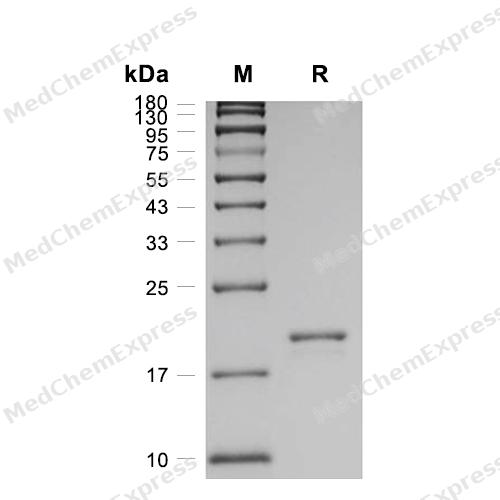
Purity - SDS-PAGE
-
Bioactivity - Cell-Based Assay
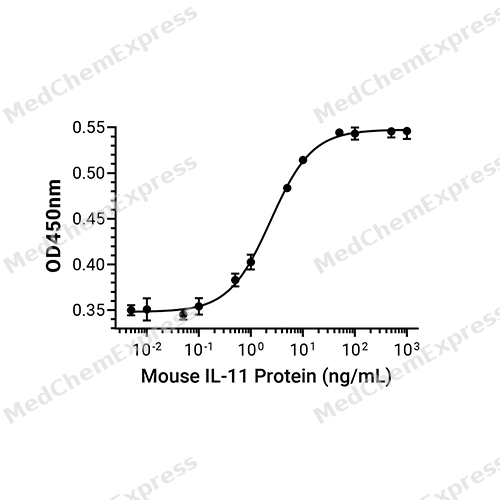
Bioactivity - Cell-Based Assay


Technical Parameters
-
Species Mouse
-
Source E. coli
-
Tag Tag Free
-
Accession
P47873/NP_032376.1 (P22-L199)
-
Molecular Construction
-
N-term
-
IL-11 (P22-L199)
Accession # P47873 -
C-term
-
-
Protein Length
Full Length of Mature Protein
-
Synonyms
IL11; Adipogenesis Inhibitory Factor; Interleukin 11; Interleukin-11; IL-11; Oprelvekin; AGIF
-
AA Sequence
PGPPAGSPRVSSDPRADLDSAVLLTRSLLADTRQLAAQMRDKFPADGDHSLDSLPTLAMSAGTLGSLQLPGVLTRLRVDLMSYLRHVQWLRRAGGPSLKTLEPELGALQARLERLLRRLQLLMSRLALPQAAPDQPVIPLGPPASAWGSIRAAHAILGGLHLTLDWAVRGLLLLKTRL
-
Predicted Molecular Mass
19.2 kDa
-
Molecular Weight
Approximately 18-20 kDa, based on SDS-PAGE under reducing conditions.
-
Purity
≥ 95%, as determined by reducing SDS-PAGE.


Product Properties
Lyophilized powder
Lyophilized from a 0.22 μm filtered solution of PBS, pH 7.4, 8% trehalose.
<1 EU/μg, determined by LAL method.
It is not recommended to reconstitute to a concentration less than 100 μg/mL in ddH2O.
Stored at -20°C for 2 years from date of receipt. After reconstitution, it is stable at 4°C for 1 week or -20°C for longer (with carrier protein). It is recommended to freeze aliquots at -20°C or -80°C for extended storage.
Room temperature in continental US; may vary elsewhere.


Documentation
-
Data Sheet (236 KB)
-
SDS (251 KB)
- English - EN (251 KB)
- Français - FR (251 KB)
- Deutsch - DE (251 KB)
- Norwegian - NO (251 KB)
- Español - ES (251 KB)
- Swedish - SV (251 KB)
- Italian - IT (251 KB)
- Korean - KR (251 KB)
- Portuguese - PT (251 KB)
-
Handling Instructions (2659 KB)

Calculators
Concentration (start) × Volume (start) = Concentration (final) × Volume (final)


 Powered by Bioz

