



IL-12 beta Protein, Rabbit (HEK293, His)

Based on 1 Customer Validation
IL-12 beta Protein, also known as natural killer cell stimulatory factor 2, is a common subunit (p40) of IL-12 and IL-23. IL-12 is a inflammatory factor expressed by activated macrophages, and involves in Th1-type immune response against cancer. IL-12 beta Protein located outside the cell membrane, involves in singalling mediated by Jak-STAT. IL-12 beta Protein consists of 335 amino acids (M1-N324) with a fibronectin type-III domain (233-324 a.a). IL-12 beta Protein, Rabbit is produced in HEK293 cells with a C-Terminal His-tag.
- Species: Rabbit
- Source: HEK293
-
Storage:Stored at -20°C for 2 years from date of receipt. After reconstitution, it is stable at 4°C for 1 week or -20°C for longer (with carrier protein). It is recommended to freeze aliquots at -20°C or -80°C for extended storage.


To place orders, for customer services and technical support, please contact: MedChemExpress USA
Tel: 609-228-6898 E-mail: [email protected] [email protected]


-
 Biological Activity
-
Technical Parameters
-
Product Properties
- Documentation
- References
- Help & FAQs




Biological Activity
Description
IL-12 beta Protein, also known as natural killer cell stimulatory factor 2, is a common subunit (p40) of IL-12 and IL-23. IL-12 is a inflammatory factor expressed by activated macrophages, and involves in Th1-type immune response against cancer[1]. IL-12 beta Protein located outside the cell membrane, involves in singalling mediated by Jak-STAT[3]. IL-12 beta Protein consists of 335 amino acids (M1-N324) with a fibronectin type-III domain (233-324 a.a). IL-12 beta Protein, Rabbit is produced in HEK293 cells with a C-Terminal His-tag.
Background
IL-12 beta Protein, as known as IL12 p40 subunit or IL-12B, heterodimerizes with the IL-12 p35 subunit (IL-12A) to form IL-12 and with the IL23 p19 subunit to form IL-23, exerting different regulating functions[1].
IL-12 and IL23 belong to IL-12 family, are involved in proinflammatory responses and expressed by activated macrophages that serve as an essential inducer of Th1 cells development[2].
IL-12 signals via IL-12Rβ1 and IL-12Rβ2 mediated by p-STAT4, whereas IL-23 signals via IL-12Rβ1 and IL-23R mediated by p-STAT1 and p-STAT3[3].
Interleukin 12 (IL-12) family have been known to be inflammatory factors, induce autoimmune inflammation and thus may be responsible for autoimmune inflammatory diseases and may be important for tumorigenesis[4].
In Vitro
IL-12 beta Protein (IL-12B), as an innate immunity marker, involves in natural killer (NK) cell activation network, significantly differentially expressed in NK cells in Mtb-infected rabbit lungs, while IL12A involves in T cells activation network[5].
Verified Bioactivity
Measured by its binding ability in a functional ELISA. When Recombinant Human IL-12R beta 1 is present at 1 μg/mL, can bind Rabbit IL-12 beta Protein. The ED50 for this effect is 5.816 ng/mL.
MCE Validation Data
-
Purity - SDS-PAGE
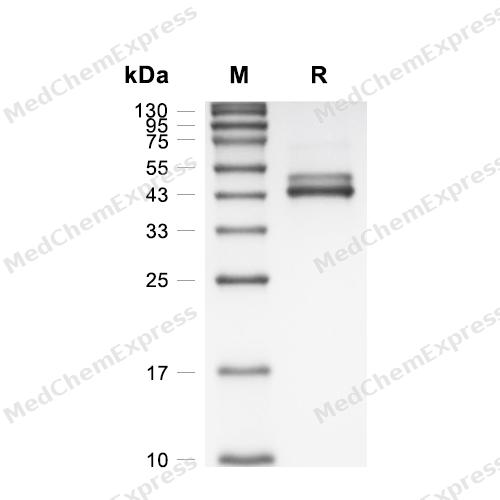
Purity - SDS-PAGE
-
Bioactivity - ELISA
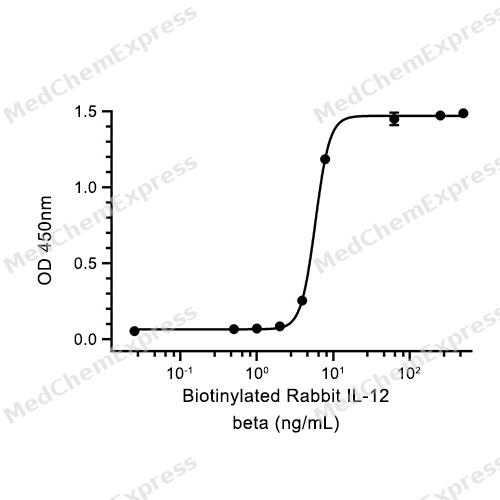
Bioactivity - ELISA


Technical Parameters
-
Species Rabbit
-
Source HEK293
-
Tag C-6*His
-
Accession
G1TBD7/XP_002710393.1 (I23-N324)
-
Molecular Construction
-
N-term
-
IL-12β (I23-N324)
Accession # G1TBD7/XP_002710393.1 -
6*His
-
C-term
-
-
Protein Length
Full Length of Mature Protein
-
Synonyms
IL12B; Interleukin-12 Subunit Beta; Prev. NKSF2; Interleukin 12, P40; IL-12B; IL12, Subunit P40; CLMF2; IL-12 Subunit P40; NKSF; CLMF P40; CLMF; Cytotoxic Lymphocyte Maturation Factor 2, P40; Interleukin 12B (Natural Killer Cell Stimulatory Factor 2, Cyto
-
AA Sequence
IWELEKDVYVVELDWYPDAPGETVVLTCDTSEEDGITWTSEQSNKVLGSGKTLTILVKEFGDAGQYTCHKGDKVLGHSKVLLHKKEDGIWSTDILKDQKEPKSKTFLKCEAKNYSGHFTCWWLTAISRDVKFSVKSNRGSSDPQGVTCGVPERVSVNHTEYKYSVECQEDNACPAAEESLHLEVMLDAIHKLKYENYTSSFFIRDIIKPDPPQNLQMKPLKNSRHVEVSWEYPDTWSTPHSYFSLTFCVQVQNKNKKEKKDRLCVDKTSATVMCHKDAKIRVQARDRYYSSSWSEWAFVSCN
-
Predicted Molecular Mass
36.1 kDa
-
Molecular Weight
Approximately 40-50 kDa, based on SDS-PAGE under reducing conditions, due to the glycosylation.
-
Glycosylation
Yes
-
Purity
≥ 95%, as determined by reducing SDS-PAGE.


Product Properties
Lyophilized powder.
Lyophilized from a 0.22 μm filtered solution of PBS, pH 7.4.
<1 EU/μg, determined by LAL method.
It is not recommended to reconstitute to a concentration less than 100 μg/mL in ddH2O. For long term storage it is recommended to add a carrier protein (0.1% BSA, 5% HSA, 10% FBS or 5% Trehalose).
Stored at -20°C for 2 years from date of receipt. After reconstitution, it is stable at 4°C for 1 week or -20°C for longer (with carrier protein). It is recommended to freeze aliquots at -20°C or -80°C for extended storage.
Room temperature in continental US; may vary elsewhere.


Documentation
-
Data Sheet (265 KB)
-
SDS (251 KB)
- English - EN (251 KB)
- Français - FR (251 KB)
- Deutsch - DE (251 KB)
- Norwegian - NO (251 KB)
- Español - ES (251 KB)
- Swedish - SV (251 KB)
- Italian - IT (251 KB)
- Korean - KR (251 KB)
- Portuguese - PT (251 KB)
-
Handling Instructions (2659 KB)


References
[1]. Lu X. Impact of IL-12 in Cancer. Curr Cancer Drug Targets. 2017;17(8):682-697. [Content Brief]
[2]. Gunsten S, et al. IL-12 p80-dependent macrophage recruitment primes the host for increased survival following a lethal respiratory viral infection. Immunology. 2009 Apr;126(4):500-13. [Content Brief]
[3]. Gotthardt D, Trifinopoulos J, Sexl V, Putz EM. JAK/STAT Cytokine Signaling at the Crossroad of NK Cell Development and Maturation. Front Immunol. 2019 Nov 12;10:2590. [Content Brief]
[4]. Tait Wojno ED, Hunter CA, Stumhofer JS. The Immunobiology of the Interleukin-12 Family: Room for Discovery. Immunity. 2019 Apr 16;50(4):851-870. [Content Brief]
[5]. Subbian S, et al. Molecular immunologic correlates of spontaneous latency in a rabbit model of pulmonary tuberculosis. Cell Commun Signal. 2013 Feb 28;11(1):16. [Content Brief]

Calculators
Concentration (start) × Volume (start) = Concentration (final) × Volume (final)


 Powered by Bioz

