



IL-17F Protein, Rat (sf9, N-His)

Based on 1 Customer Validation
Rat IL-17F is predicted to have cytokine binding and dimerization activities and is involved in bacterial defense, IL-17-mediated signaling, and regulation of cytokine production. It acts upstream of the inflammatory response, and its homologue to human IL17F has been implicated in chronic mucocutaneous candidiasis. IL-17F Protein, Rat (sf9, N-His) is the recombinant rat-derived IL-17F, Rat, expressed by E. coli , with N-6*His labeled tag.
- Species: Rat
- Source: E. coli
-
Storage:Stored at -20°C for 2 years from date of receipt. After reconstitution, it is stable at 4°C for 1 week or -20°C for longer (with carrier protein). It is recommended to freeze aliquots at -20°C or -80°C for extended storage.


To place orders, for customer services and technical support, please contact: MedChemExpress USA
Tel: 609-228-6898 E-mail: [email protected] [email protected]


-
 Biological Activity
-
Technical Parameters
-
Product Properties
- Documentation
- Help & FAQs




Biological Activity
Description
Rat IL-17F is predicted to have cytokine binding and dimerization activities and is involved in bacterial defense, IL-17-mediated signaling, and regulation of cytokine production. It acts upstream of the inflammatory response, and its homologue to human IL17F has been implicated in chronic mucocutaneous candidiasis. IL-17F Protein, Rat (sf9, N-His) is the recombinant rat-derived IL-17F, Rat, expressed by E. coli , with N-6*His labeled tag.
Background
IL-17F, Rat is predicted to possess cytokine binding activity, protein dimerization activity, and signaling receptor binding activity. The gene is anticipated to participate in various processes, including the defense response to bacterium, interleukin-17-mediated signaling pathways, and the regulation of cytokine production. It is predicted to act upstream of or within positive regulation of cytokine production involved in the inflammatory response and positive regulation of transcription by RNA polymerase II. The anticipated subcellular location is in the extracellular space. As the ortholog of human IL17F (interleukin 17F), IL-17F, Rat is implicated in chronic mucocutaneous candidiasis. Despite its functional significance, low expression levels have been observed in the reference dataset, suggesting that its regulatory functions may be tightly controlled or context-dependent.
Verified Bioactivity
Measured by its ability to induce IL-6 secretion by NIH-3T3 mouse embryonic fibroblast cells. The ED50 for this effect is 45.19 ng/mL, corresponding to a specific activity is 2.212×10⁴ U/mg.
MCE Validation Data
-
Purity - SDS-PAGE
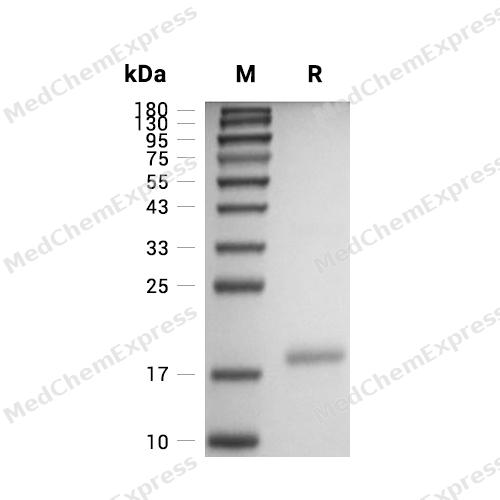
Purity - SDS-PAGE
-
Bioactivity - Cell-Based Assay
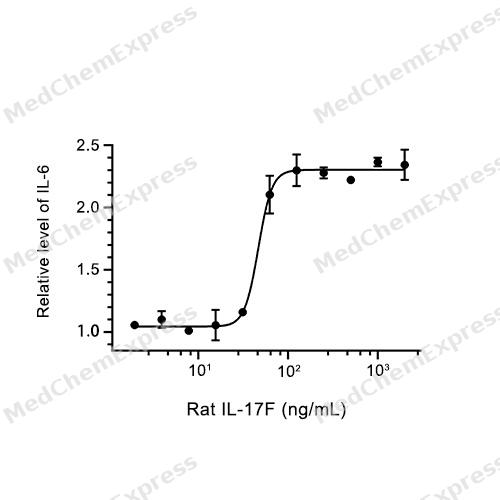
Bioactivity - Cell-Based Assay


Technical Parameters
-
Species Rat
-
Source E. coli
-
Tag N-6*His
-
Accession
NP_001015011.2 (A28-A161)
-
Molecular Construction
-
N-term
-
6*His
-
IL-17F (A28-A161)
Accession # NP_001015011.2 -
C-term
-
-
Protein Length
Full Length of Mature Protein
-
Synonyms
IL17F; ML1; Interleukin 17F; Interleukin-17F; IL-17F; Cytokine ML-1; ML-1; CANDF6
-
AA Sequence
ARRNPKVGLSALQKAGNCPPLEDNSVRVDIRIFNQNQGISVPRDFQNRSSSPWDYNITRDPDRFPSEIAEAQCRHSGCINAQGQEDGSMNSVPIQQEILVLRREPQGCSNSFRLEKMLIKVGCTCVTPIVHHAA
-
Predicted Molecular Mass
15.8 kDa
-
Molecular Weight
Approximately 18 kDa, based on SDS-PAGE under reducing conditions.
-
Purity
≥ 95%, as determined by reducing SDS-PAGE.


Product Properties
Lyophilized powder.
Lyophilized from a 0.22 μm filtered solution of 4 mM HCL, pH 2.5.
<1 EU/μg, determined by LAL method.
It is not recommended to reconstitute to a concentration less than 100 μg/mL in ddH2O. For long term storage it is recommended to add a carrier protein (0.1% BSA, 5% HSA, 10% FBS or 5% Trehalose).
Stored at -20°C for 2 years from date of receipt. After reconstitution, it is stable at 4°C for 1 week or -20°C for longer (with carrier protein). It is recommended to freeze aliquots at -20°C or -80°C for extended storage.
Room temperature in continental US; may vary elsewhere.


Documentation
-
Data Sheet (236 KB)
-
SDS (252 KB)
- English - EN (252 KB)
- Français - FR (252 KB)
- Deutsch - DE (252 KB)
- Norwegian - NO (252 KB)
- Español - ES (252 KB)
- Swedish - SV (252 KB)
- Italian - IT (252 KB)
- Korean - KR (252 KB)
- Portuguese - PT (252 KB)
-
Handling Instructions (2659 KB)

Calculators
Concentration (start) × Volume (start) = Concentration (final) × Volume (final)


 Powered by Bioz

