



IL-17RD Protein, Canine (HEK293, His)

Based on 1 Customer Validation
Interleukin-17 receptor D (IL-17RD) also known as Sef (similar expression to fibroblast growth factor), is a type I transmembrane protein that can regulate several signaling pathways. Within the cell, IL-17RD expression has been localized mainly to the plasma membrane. IL-17RD is a feedback inhibitor of fibroblast growth factor (FGF) signaling. IL-17RD Protein, Canine (HEK293, His) is produced in HEK293 cells with a His-Terminal Fc-tag.
- Species: Canine
- Source: HEK293
-
Storage:Stored at -20°C for 2 years from date of receipt. After reconstitution, it is stable at 4°C for 1 week or -20°C for longer (with carrier protein). It is recommended to freeze aliquots at -20°C or -80°C for extended storage.


To place orders, for customer services and technical support, please contact: MedChemExpress USA
Tel: 609-228-6898 E-mail: [email protected] [email protected]


-
 Biological Activity
-
Technical Parameters
-
Product Properties
- Documentation
- References
- Help & FAQs




Biological Activity
Description
Interleukin-17 receptor D (IL-17RD) also known as Sef (similar expression to fibroblast growth factor), is a type I transmembrane protein that can regulate several signaling pathways. Within the cell, IL-17RD expression has been localized mainly to the plasma membrane. IL-17RD is a feedback inhibitor of fibroblast growth factor (FGF) signaling[1]. IL-17RD Protein, Canine (HEK293, His) is produced in HEK293 cells with a His-Terminal Fc-tag.
Background
IL-17RD is a type I transmembrane protein that is evolutionarily conserved among vertebrates and is encoded by a single locus on chromosome 3p14.3 in humans. Within the cell, IL-17RD expression has been localized mainly to the plasma membrane although its expression has also been observed in the Golgi apparatus and in early and recycling endosomes (perinuclear structures) in overexpression systems[1].
The amino acid sequence of human IL-17RC protein shares 87% homology with mouse IL-17C protein.
Structurally, human IL-17RD is encoded by a single locus on chromosome 3p14.3 in humans. The mRNA consists of 13 exons encoding a polypeptide product of 739 amino acids comprised of a 26-residue amino terminal signal peptide, followed by a 272 amino acid extracellular domain, a short transmembrane domain consisting of 20 amino acids, and a 420 amino acid intracellular domain. The extracellular domain of IL-17RD consisting of a signal peptide, an immunoglobulin-like domain and a fibronectin type III repeat. Physiologically, IL-17RD has been shown to exist in monomeric, dimeric as well as oligomeric forms, showing a preference for oligomerization. In its dimeric form, SEF exists as a homodimer as well as in heterodimeric forms with FGFR1 (through its extracellular, transmembrane and intracellular domain), FGFR2 (via its extracellular, transmembrane and intracellular), IL-17RA (predominantly through its SEFIR domain), TNFR2 (via its extracellular domain) TLR3 (partly through its SEFIR domain) and TLR4 (partly through its SEFIR domain) and with Epidermal Growth Factor Receptor (EGFR)[1][2].
IL-17RD is initially established as a negative regulator of FGF-induced Ras and MAPK signalling pathways during zebrafish and frog development. It is subsequently determined to regulate other receptor tyrosine kinase signaling cascades as well as several proinflammatory signaling pathways including Interleukin-17A (IL17A), Toll-like receptors (TLR) and Interleukin-1α (IL1α) in several vertebrate species including humans. In addition, in mammalian IL-17RD can inhibit ERK and PI3K pathways in response to a number of receptor tyrosine kinase ligands. IL-17RD is a negative regulator of both NF-κB and IRF signalling pathways initiated by Toll-like receptors (TLRs). The SEFIR domain of IL-17RD targets the TIR adaptors, MyD88, Mal, TRIF and TRAM, and strongly inhibits TLR-mediated activation of NF-κB with IL-17RD deficiency leading to increased NF-κB and IRF activation and upregulation of pro-inflammatory genes. IL-17RD might regulate the activation of the TGFβ/BMP pathway. Additionally, the IL-17RD isoform is also shown to associate with and promote Lys63 polyubiquitination of TAK1 in HEK293T cells. IL-17RD promotes apoptosis by activating both p38 MAPK and JNK pathways upon ultraviolet light exposure in an overexpression model. IL-17RD is involved in the regulation of cancer, neuroendocrine, inflammatory and immunomodulatory diseases[1][2].
Verified Bioactivity
Measured by its ability to inhibit bFGF induced NIH3T3 cell proliferation. The ED50 for this effect is 0.1293 μg/ml, corresponding to a specific activity is 7.734×10³ units/mg in the presence of 0.1 ng/mL bFGF.
MCE Validation Data
-
Purity - SDS-PAGE
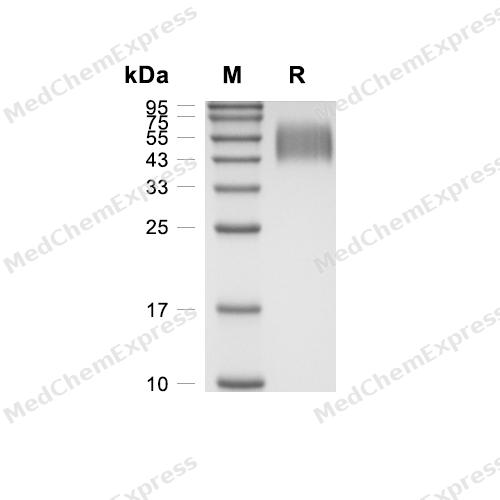
Purity - SDS-PAGE
-
Bioactivity - Cell-Based Assay
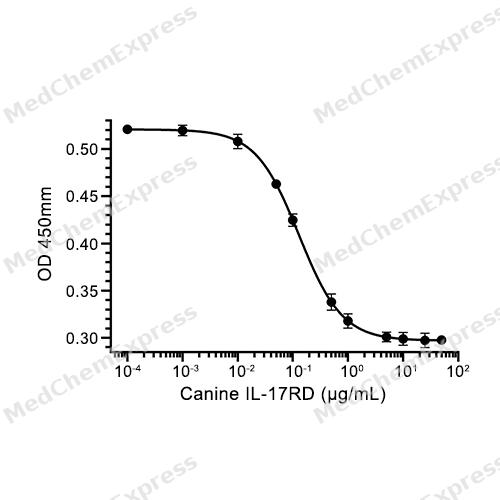
Bioactivity - Cell-Based Assay


Technical Parameters
-
Species Canine
-
Source HEK293
-
Tag C-His
-
Accession
A0A8C0JXH0/XP_541835 (A27-R299)
-
Molecular Construction
-
N-term
-
IL-17RD (A27-R299)
Accession # A0A8C0JXH0/XP_541835 -
His
-
C-term
-
-
Protein Length
Partial
-
Synonyms
IL17RD; Interleukin-17 Receptor D; Interleukin 17 Receptor D; IL-17 Receptor D; IL17RLM; Sef Homolog; IL-17RD; FLJ35755; SEF; IL17Rhom; Interleukin-17 Receptor-Like Protein; HH18; Similar Expression To Fgf Genes; HSef
-
AA Sequence
AGGSSRARGADTCGWRGVGPASRNSGLYNITFRYDNCTTYLNPVGKHVIADAQNITISQYACHDQVAVTILWSPGALGIEFLKGFRVILEELKSEGRRCQQLILKDPKQLNSSFKRTGMESQPFLNMKFETDYFVKIVPFPSIKNESNYHPFFFRTRACDLLLQPDNLACKPFWKPRNLNITQHGLDMQVSFDHAPHTFGFRFFYLHYKLKHEGPFKRKACKQEQNTETTSCLLQNVSPGDYIIELVDDTNTTRKVMHYALKPAHSPWAGPIR
-
Molecular Weight
Approximately 51 kDa, based on SDS-PAGE under reducing conditions, due to the glycosylation.
-
Glycosylation
Yes
-
Purity
≥ 95%, as determined by reducing SDS-PAGE.


Product Properties
Lyophilized powder.
Lyophilized from a 0.22 μm filtered solution of PBS, pH 7.4.
<1 EU/μg, determined by LAL method.
It is not recommended to reconstitute to a concentration less than 100 μg/mL in ddH2O. For long term storage it is recommended to add a carrier protein (0.1% BSA, 5% HSA, 10% FBS or 5% Trehalose).
Stored at -20°C for 2 years from date of receipt. After reconstitution, it is stable at 4°C for 1 week or -20°C for longer (with carrier protein). It is recommended to freeze aliquots at -20°C or -80°C for extended storage.
Room temperature in continental US; may vary elsewhere.


Documentation
-
Data Sheet (265 KB)
-
SDS (251 KB)
- English - EN (251 KB)
- Français - FR (251 KB)
- Deutsch - DE (251 KB)
- Norwegian - NO (251 KB)
- Español - ES (251 KB)
- Swedish - SV (251 KB)
- Italian - IT (251 KB)
- Korean - KR (251 KB)
- Portuguese - PT (251 KB)
-
Handling Instructions (2659 KB)


References
[1]. Shivangi Pande, et al. Interleukin-17 receptor D (Sef) is a multi-functional regulator of cell signaling. Cell Commun Signal. 2021 Jan 12;19(1):6. [Content Brief]
[2]. Mark Mellett, et al. Orphan receptor IL-17RD regulates Toll-like receptor signalling via SEFIR/TIR interactions. Nat Commun. 2015 Mar 26;6:6669. [Content Brief]

Calculators
Concentration (start) × Volume (start) = Concentration (final) × Volume (final)


 Powered by Bioz

