



IL-4 Protein, Rhesus macaque
Based on 1 publication(s) in Google Scholar
IL-4 protein actively engages in B-cell activation, serving as a costimulator for DNA synthesis, inducing class II MHC molecule expression, and enhancing IgE and IgG1 secretion. It regulates CD23 expression on lymphocytes and monocytes, positively influences IL31RA expression in macrophages, and induces autophagy in dendritic cells through mTORC1 signaling interference and RUFY4 induction. IL-4 Protein, Rhesus macaque is the recombinant Rhesus Macaque-derived IL-4 protein, expressed by E. coli , with tag free.
- Species: Rhesus Macaque
- Source: E. coli
-
Storage:Stored at -20°C for 2 years from date of receipt. After reconstitution, it is stable at 4°C for 1 week or -20°C for longer (with carrier protein). It is recommended to freeze aliquots at -20°C or -80°C for extended storage.


To place orders, for customer services and technical support, please contact: MedChemExpress USA
Tel: 609-228-6898 E-mail: [email protected] [email protected]


-
 Biological Activity
-
Technical Parameters
-
Product Properties
- Documentation
- Help & FAQs




Biological Activity
Description
IL-4 protein actively engages in B-cell activation, serving as a costimulator for DNA synthesis, inducing class II MHC molecule expression, and enhancing IgE and IgG1 secretion. It regulates CD23 expression on lymphocytes and monocytes, positively influences IL31RA expression in macrophages, and induces autophagy in dendritic cells through mTORC1 signaling interference and RUFY4 induction. IL-4 Protein, Rhesus macaque is the recombinant Rhesus Macaque-derived IL-4 protein, expressed by E. coli , with tag free.
Background
IL-4 protein actively participates in various B-cell activation processes and other cell types, acting as a costimulator of DNA synthesis. Moreover, it induces the expression of class II MHC molecules on resting B-cells and enhances the secretion and cell surface expression of IgE and IgG1. IL-4 also plays a regulatory role in the expression of the low affinity Fc receptor for IgE (CD23) on lymphocytes and monocytes. Additionally, it positively regulates IL31RA expression in macrophages and stimulates autophagy in dendritic cells by interfering with mTORC1 signaling and inducing RUFY4.
Verified Bioactivity
The ED50 as determined by a cell proliferation assay using human TF-1 cells is less than 1.0 ng/mL, corresponding to a specific activity of >1.0x10⁶ IU/mg.
MCE Validation Data
-
Purity - SDS-PAGE
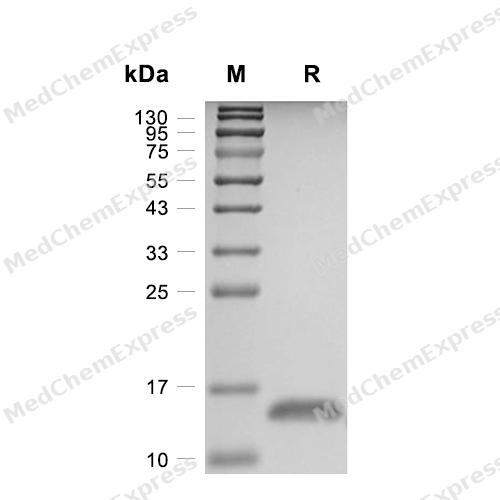
Purity - SDS-PAGE
-
Bioactivity - Cell-Based Assay
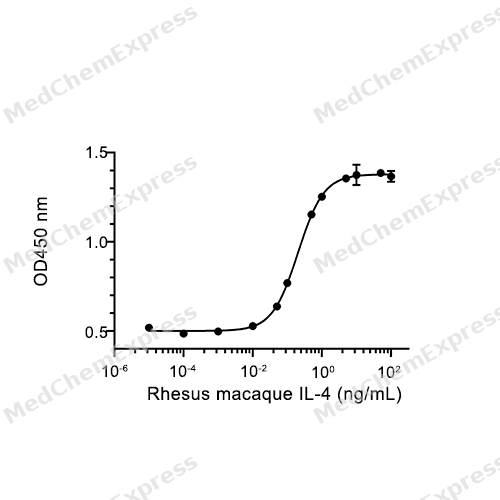
Bioactivity - Cell-Based Assay


Publications (1)
-
Journal Impact Factor
-
Most Recent
-
Nature
2026 May;653(8116):1205-1215. PMID: 41951742


Technical Parameters
-
Species Rhesus Macaque
-
Source E. coli
-
Tag Tag Free
-
Accession
P51492 (H25-S153)
-
Molecular Construction
-
N-term
-
IL-4 (H25-S153)
Accession # P51492 -
C-term
-
-
Protein Length
Full Length of Mature Protein
-
Synonyms
IL4; B_cell Stimulatory Factor 1; Interleukin 4; B-Cell Stimulatory Factor 1; IL-4; B Cell Growth Factor 1; Lymphocyte Stimulatory Factor 1; Binetrakin; Interleukin-4; Pitrakinra; BCGF-1; MGC79402; BCGF1; BSF-1; BSF1
-
AA Sequence
HNCHIALREIIETLNSLTEQKTLCTKLTITDILAASKNTTEKETFCRAATVLRQFYSHHEKDTRCLGATAQQFHRHKQLIRFLKRLDRNLWGLAGLNSCPVKEANQSTLEDFLERLKTIMREKYSKCSS
-
Predicted Molecular Mass
14.9 kDa
-
Molecular Weight
Approximately 14-18 kDa, based on SDS-PAGE under reducing conditions.
-
Purity
≥ 95%, as determined by reducing SDS-PAGE.


Product Properties
Lyophilized powder
1.Lyophilized from a 0.2 μm solution of 2xPBS, 5 % Trehalose, pH 7.4.
2.Lyophilized from a 0.2 μm solution of PBS, pH 7.4, 8% trehalose.
<1 EU/μg, determined by LAL method.
It is not recommended to reconstitute to a concentration less than 100 μg/mL in ddH2O.
Stored at -20°C for 2 years from date of receipt. After reconstitution, it is stable at 4°C for 1 week or -20°C for longer (with carrier protein). It is recommended to freeze aliquots at -20°C or -80°C for extended storage.
Room temperature in continental US; may vary elsewhere.


Documentation
-
Data Sheet (235 KB)
-
SDS (251 KB)
- English - EN (251 KB)
- Français - FR (251 KB)
- Deutsch - DE (251 KB)
- Norwegian - NO (251 KB)
- Español - ES (251 KB)
- Swedish - SV (251 KB)
- Italian - IT (251 KB)
- Korean - KR (251 KB)
- Portuguese - PT (251 KB)
-
Handling Instructions (2659 KB)

Calculators
Concentration (start) × Volume (start) = Concentration (final) × Volume (final)


 Powered by Bioz

