



Importin alpha-1/KPNA2 Protein, Human (His)

Based on 1 Customer Validation
Importin alpha-1/KPNA2 is essential for nuclear protein import, acting as an adapter for the nuclear receptor KPNB1. It directly binds the substrate to the nuclear localization signal to form a complex that docks with the nuclear pore complex mediated by KPNB1. Importin alpha-1/KPNA2 Protein, Human (His) is the recombinant human-derived Importin alpha-1/KPNA2 protein, expressed by E. coli , with N-6*His labeled tag.
- Species: Human
- Source: E. coli
-
Storage:Stored at -80°C for 1 year from date of receipt. It is stable at -20°C for 3 months after opening. It is recommended to freeze aliquots at -80°C for extended storage. Avoid repeated freeze-thaw cycles.


To place orders, for customer services and technical support, please contact: MedChemExpress USA
Tel: 609-228-6898 E-mail: [email protected] [email protected]


-
 Biological Activity
-
Technical Parameters
-
Product Properties
- Documentation
- Help & FAQs




Biological Activity
Description
Importin alpha-1/KPNA2 is essential for nuclear protein import, acting as an adapter for the nuclear receptor KPNB1. It directly binds the substrate to the nuclear localization signal to form a complex that docks with the nuclear pore complex mediated by KPNB1. Importin alpha-1/KPNA2 Protein, Human (His) is the recombinant human-derived Importin alpha-1/KPNA2 protein, expressed by E. coli , with N-6*His labeled tag.
Background
Importin alpha-1/KPNA2 plays a pivotal role in nuclear protein import by serving as an adapter protein for the nuclear receptor KPNB1. It exhibits specific and direct binding to substrates containing either a simple or bipartite nuclear localization signal (NLS) motif. The importin/substrate complex docks to the nuclear pore complex (NPC) through the mediation of KPNB1, binding to nucleoporin FxFG repeats. Subsequently, the complex is translocated through the pore via an energy-requiring, Ran-dependent mechanism. At the nucleoplasmic side of the NPC, Ran binds to importin-beta, leading to the separation of the three components. Importin-alpha and -beta are then re-exported from the nucleus to the cytoplasm, where GTP hydrolysis releases Ran from importin. The directionality of nuclear import is believed to be determined by the asymmetric distribution of GTP- and GDP-bound forms of Ran between the cytoplasm and nucleus. Importin alpha-1 forms a heterodimer with KPNB1 and interacts with various proteins, including ANP32E, CSE1L, RAN, PLAG1, APEX1, FRG1, ARL4A, CTNNBL1, NBN, SNAI1, SNAI2, BAG6, AIFM2, and RSL1D1.
MCE Validation Data
-
Purity - SDS-PAGE
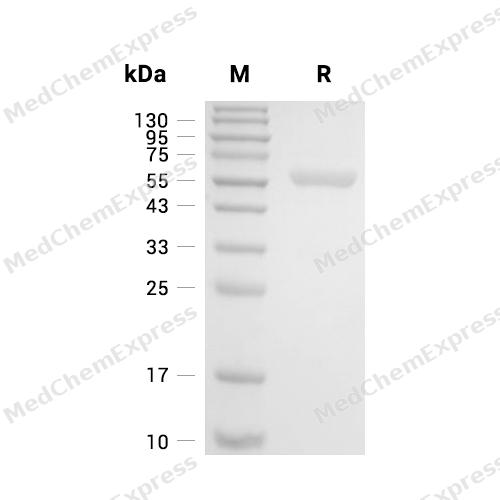
Purity - SDS-PAGE


Technical Parameters
-
Species Human
-
Source E. coli
-
Tag N-6*His
-
Accession
P52292 (M1-F529)
-
Molecular Construction
-
N-term
-
6*His
-
KPNA2 (M1-F529)
Accession # P52292 -
C-term
-
-
Protein Length
Full Length
-
Synonyms
KPNA2; Nuclear Pore-Targeting Complex 58kD Component; Prev. RCH1; Importin Subunit Alpha-2; Importin Subunit Alpha-1; Importin Subunit Alpha; RAG Cohort Protein 1; Karyopherin Alpha 2; SRP1-Alpha; Importin-Alpha-P1; SRP1alpha; Importin Alpha 1; PTAC58; RA
-
AA Sequence
MSTNENANTPAARLHRFKNKGKDSTEMRRRRIEVNVELRKAKKDDQMLKRRNVSSFPDDATSPLQENRNNQGTVNWSVDDIVKGINSSNVENQLQATQAARKLLSREKQPPIDNIIRAGLIPKFVSFLGRTDCSPIQFESAWALTNIASGTSEQTKAVVDGGAIPAFISLLASPHAHISEQAVWALGNIAGDGSVFRDLVIKYGAVDPLLALLAVPDMSSLACGYLRNLTWTLSNLCRNKNPAPPIDAVEQILPTLVRLLHHDDPEVLADTCWAISYLTDGPNERIGMVVKTGVVPQLVKLLGASELPIVTPALRAIGNIVTGTDEQTQVVIDAGALAVFPSLLTNPKTNIQKEATWTMSNITAGRQDQIQQVVNHGLVPFLVSVLSKADFKTQKEAVWAVTNYTSGGTVEQIVYLVHCGIIEPLMNLLTAKDTKIILVILDAISNIFQAAEKLGETEKLSIMIEECGGLDKIEALQNHENESVYKASLSLIEKYFSVEEEEDQNVVPETTSEGYTFQVQDGAPGTFNF
-
Molecular Weight
Approximately 46-63 kDa, based on SDS-PAGE under reducing conditions.
-
Purity
≥ 90%, as determined by reducing SDS-PAGE.


Product Properties
Solution
1.Supplied as a 0.22 μm filtered solution of 20 mM Tris-HCl, 1 mM DTT, 20% Glycerol, pH 8.0.
2.Supplied as a 0.22 μm filtered solution of 20 mM Glycine, 8% sucrose, 20% glycerol, 150 mM NaCl, 0.1% Tween 80, 2 mM DTT, pH 3.0.
3.Supplied as a 0.22 μm filtered solution of 20 mM Tris-HCL, 1 mM DTT, pH 8.0, 20% glycerol.
Please refer to the lot-specific COA for specific buffer information.
Note: For SPR assay, please replace the buffer. Primary amine components (e.g., Tris, imidazole) can affect protein-coupled chips.
<1 EU/μg, determined by LAL method.
Stored at -80°C for 1 year from date of receipt. It is stable at -20°C for 3 months after opening. It is recommended to freeze aliquots at -80°C for extended storage. Avoid repeated freeze-thaw cycles.
Shipping with dry ice.


Documentation
-
Data Sheet (239 KB)
-
SDS (252 KB)
- English - EN (252 KB)
- Français - FR (252 KB)
- Deutsch - DE (252 KB)
- Norwegian - NO (252 KB)
- Español - ES (252 KB)
- Swedish - SV (252 KB)
- Italian - IT (252 KB)
- Korean - KR (252 KB)
- Portuguese - PT (252 KB)
-
Handling Instructions (2659 KB)

Calculators
Concentration (start) × Volume (start) = Concentration (final) × Volume (final)


 Powered by Bioz

