



LILRA4/ILT-7/CD85g Protein, Human (HEK293, His)

Based on 1 Customer Validation
The LILRA4/ILT-7/CD85g protein is a coreceptor that critically limits the innate immune response during viral infection through FCER1G signaling.It negatively regulates TLR7 and TLR9 signaling and reduces IFNA1, IFNA2, IFNA4, IFNB1, and TNF production in dendritic cells exposed to influenza virus or CpG dinucleotides.LILRA4/ILT-7/CD85g Protein, Human (HEK293, His) is the recombinant human-derived LILRA4/ILT-7/CD85g protein, expressed by HEK293 , with C-His labeled tag.
- Species: Human
- Source: HEK293
-
Storage:Stored at -20°C for 2 years from date of receipt. After reconstitution, it is stable at 4°C for 1 week or -20°C for longer (with carrier protein). It is recommended to freeze aliquots at -20°C or -80°C for extended storage.


To place orders, for customer services and technical support, please contact: MedChemExpress USA
Tel: 609-228-6898 E-mail: [email protected] [email protected]


-
 Biological Activity
-
Technical Parameters
-
Product Properties
- Documentation
- Help & FAQs




Biological Activity
Description
The LILRA4/ILT-7/CD85g protein is a coreceptor that critically limits the innate immune response during viral infection through FCER1G signaling.It negatively regulates TLR7 and TLR9 signaling and reduces IFNA1, IFNA2, IFNA4, IFNB1, and TNF production in dendritic cells exposed to influenza virus or CpG dinucleotides.LILRA4/ILT-7/CD85g Protein, Human (HEK293, His) is the recombinant human-derived LILRA4/ILT-7/CD85g protein, expressed by HEK293 , with C-His labeled tag.
Background
LILRA4/ILT-7/CD85g protein functions as a coreceptor, exerting a pivotal role in limiting innate immune responses during viral infections, with signaling occurring through FCER1G. It acts as a negative regulator of TLR7 and TLR9 signaling cascades, demonstrated by its ability to down-regulate the production of IFNA1, IFNA2, IFNA4, IFNB1, and TNF in plasmacytoid dendritic cells exposed to influenza virus or CpG dinucleotides. Additionally, LILRA4/ILT-7/CD85g negatively modulates interferon production in response to interaction with BST2 on HIV-1 infected cells. The protein activates a signaling cascade in conjunction with FCER1G, leading to the phosphorylation of Src family and Syk kinases and subsequent mobilization of intracellular Ca(2+). Notably, LILRA4/ILT-7/CD85g does not interfere with the differentiation of plasmacytoid dendritic cells into antigen-presenting cells. The interaction between LILRA4/ILT-7/CD85g and FCER1G stabilizes the expression of both proteins at the cell membrane, emphasizing its crucial regulatory role in the innate immune response to viral pathogens.
Verified Bioactivity
1.Measured by its binding ability in a functional ELISA. Immobilized Human LILRA4 at 1 μg/mL (100 μL/well) can bind biotinylated Human ANGPTL7. The ED50 for this effect is 58.08 ng/mL.
2.Loaded Daxdilimab (FUT8-KO) (HY-P99226A) on ProA biosensor, can bind LILRA4/ILT-7/CD85g Protein, Human (HEK293, His) with an affinity constant of 8.548E-08 M as determined in BLI assay.
MCE Validation Data
-
Purity - SDS-PAGE
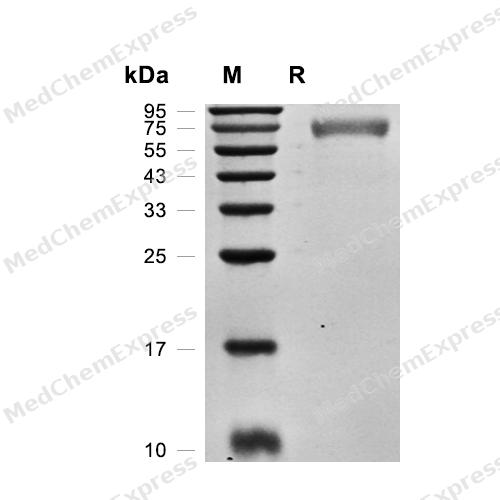
Purity - SDS-PAGE
-
Bioactivity - ELISA
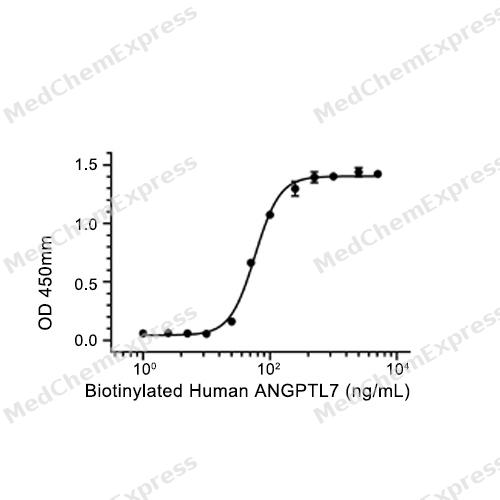
Bioactivity - ELISA
-
Bioactivity - BLI
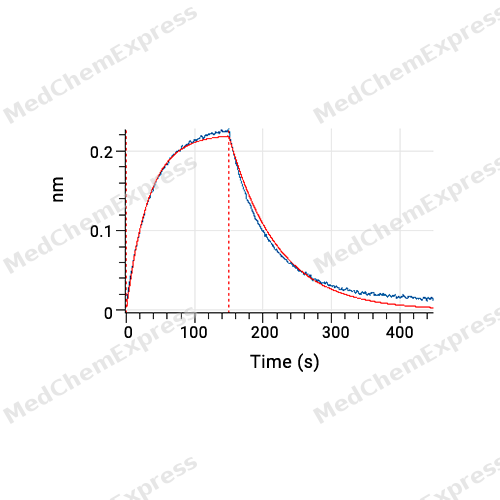
Bioactivity - BLI


Technical Parameters
-
Species Human
-
Source HEK293
-
Tag C-His
-
Accession
P59901-1 (E24-N446)
-
Molecular Construction
-
N-term
-
LILRA4 (E24-N446)
Accession # P59901 -
His
-
C-term
-
-
Protein Length
Extracellular Domain
-
Synonyms
LILRA4; CD85 Antigen-Like Family Member G; Leukocyte Immunoglobulin Like Receptor A4; Immunoglobulin-Like Transcript 7; ILT7; Leucocyte Ig-Like Receptor A4; CD85g; Leukocyte Immunoglobulin-Like Receptor, Subfamily A (Without TM Domain), Member 4; Leukocyt
-
AA Sequence
ENLLKPILWAEPGPVITWHNPVTIWCQGTLEAQGYRLDKEGNSMSRHILKTLESENKVKLSIPSMMWEHAGRYHCYYQSPAGWSEPSDPLELVVTAYSRPTLSALPSPVVTSGVNVTLRCASRLGLGRFTLIEEGDHRLSWTLNSHQHNHGKFQALFPMGPLTFSNRGTFRCYGYENNTPYVWSEPSDPLQLLVSGVSRKPSLLTLQGPVVTPGENLTLQCGSDVGYIRYTLYKEGADGLPQRPGRQPQAGLSQANFTLSPVSRSYGGQYRCYGAHNVSSEWSAPSDPLDILIAGQISDRPSLSVQPGPTVTSGEKVTLLCQSWDPMFTFLLTKEGAAHPPLRLRSMYGAHKYQAEFPMSPVTSAHAGTYRCYGSRSSNPYLLSHPSEPLELVVSGATETLNPAQKKSDSKTAPHLQDYTVEN
-
Molecular Weight
Approximately 60-75 kDa, based on SDS-PAGE under reducing conditions, due to the glycosylation.
-
Glycosylation
Yes
-
Purity
≥ 95%, as determined by reducing SDS-PAGE.


Product Properties
Lyophilized powder.
Lyophilized from a 0.22 μm filtered solution of PBS, pH 7.4.
<1 EU/μg, determined by LAL method.
It is not recommended to reconstitute to a concentration less than 100 μg/mL in ddH2O. For long term storage it is recommended to add a carrier protein (0.1% BSA, 5% HSA, 10% FBS or 5% Trehalose).
Stored at -20°C for 2 years from date of receipt. After reconstitution, it is stable at 4°C for 1 week or -20°C for longer (with carrier protein). It is recommended to freeze aliquots at -20°C or -80°C for extended storage.
Room temperature in continental US; may vary elsewhere.


Documentation
-
Data Sheet (239 KB)
-
SDS (251 KB)
- English - EN (251 KB)
- Français - FR (251 KB)
- Deutsch - DE (251 KB)
- Norwegian - NO (251 KB)
- Español - ES (251 KB)
- Swedish - SV (251 KB)
- Italian - IT (251 KB)
- Korean - KR (251 KB)
- Portuguese - PT (251 KB)
-
Handling Instructions (2659 KB)

Calculators
Concentration (start) × Volume (start) = Concentration (final) × Volume (final)


 Powered by Bioz

