



MBL1 Protein, Mouse (HEK293, His)

Based on 1 Customer Validation
MBL1, a calcium-dependent lectin, recognizes microbial moieties, activating the lectin complement pathway.It also binds apoptotic and necrotic cells, aiding uptake by macrophages.As a homotrimer, MBL1 forms higher oligomeric complexes in the endoplasmic reticulum.MBL1's interaction with MASP1 and MASP2 enhances its role in immune response modulation and cellular recognition.MBL1 Protein, Mouse (HEK293, His) is the recombinant mouse-derived MBL1 protein, expressed by HEK293 , with N-His, N-6*His labeled tag.
- Species: Mouse
- Source: HEK293
-
Storage:Stored at -20°C for 2 years from date of receipt. After reconstitution, it is stable at 4°C for 1 week or -20°C for longer (with carrier protein). It is recommended to freeze aliquots at -20°C or -80°C for extended storage.


To place orders, for customer services and technical support, please contact: MedChemExpress USA
Tel: 609-228-6898 E-mail: [email protected] [email protected]


-
 Biological Activity
-
Technical Parameters
-
Product Properties
- Documentation
- Help & FAQs




Biological Activity
Description
MBL1, a calcium-dependent lectin, recognizes microbial moieties, activating the lectin complement pathway.It also binds apoptotic and necrotic cells, aiding uptake by macrophages.As a homotrimer, MBL1 forms higher oligomeric complexes in the endoplasmic reticulum.MBL1's interaction with MASP1 and MASP2 enhances its role in immune response modulation and cellular recognition.MBL1 Protein, Mouse (HEK293, His) is the recombinant mouse-derived MBL1 protein, expressed by HEK293 , with N-His, N-6*His labeled tag.
Background
MBL1, a calcium-dependent lectin, plays a crucial role in the innate immune response by recognizing mannose, fucose, and N-acetylglucosamine moieties on various microorganisms, thereby activating the lectin complement pathway. Beyond its microbial interactions, MBL1 also binds to late apoptotic cells, apoptotic blebs, and necrotic cells, facilitating their uptake by macrophages. Existing as a homotrimer, MBL1 further assembles into higher oligomeric complexes through the association of two, three, or more homotrimers, a process occurring in the endoplasmic reticulum. Additionally, MBL1 interacts with MASP1 and MASP2, further contributing to its involvement in immune response modulation and cellular recognition processes.
Verified Bioactivity
Measured by its binding ability in a functional ELISA. Immobilized Mannan (HY-W145667) at 50 μg/mL (100 μL/well) can bind Biotinylated MBL1. The ED50 for this effect is 0.653 μg/mL.
MCE Validation Data
-
Purity - SDS-PAGE
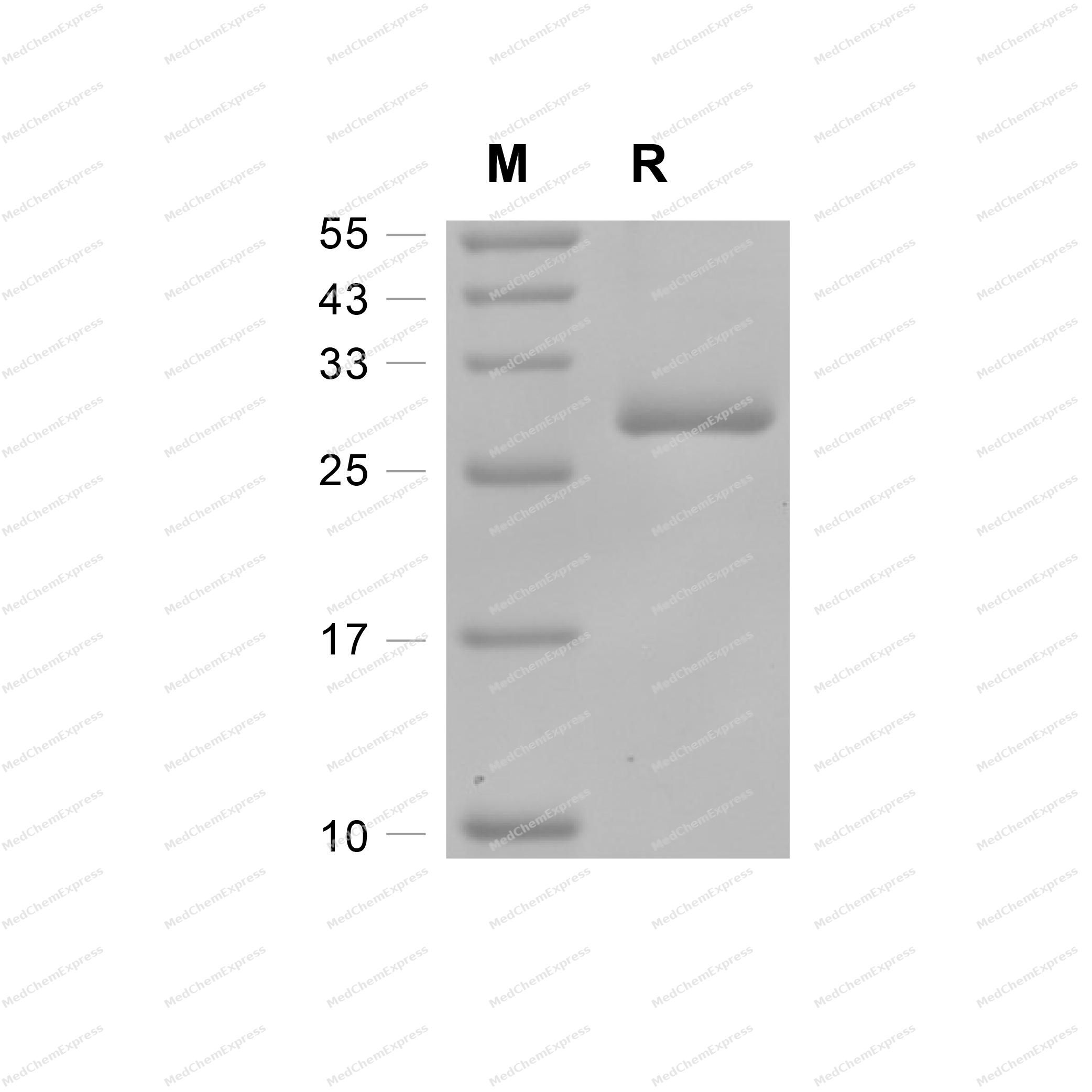
Purity - SDS-PAGE


Technical Parameters
-
Species Mouse
-
Source HEK293
-
Tag N-6*His
-
Accession
P39039-1/NP_034905.1 (S21-A239)
-
Gene ID17194 [NCBI]
-
Molecular Construction
-
N-term
-
6*His
-
MBL1 (S21-A239)
Accession # P39039-1/NP_034905.1 -
C-term
-
-
Protein Length
Full Length of Mannose-binding protein A Chain
-
Synonyms
Mannose-binding protein A; Mannan-binding protein; MBP-A; Ra-reactive factor polysaccharide-binding component p28B; RaRF p28B; Mbl1
-
AA Sequence
SQTCEDTLKTCSVIACGRDGRDGPKGEKGEPGQGLRGLQGPPGKLGPPGSVGSPGSPGPKGQKGDHGDNRAIEEKLANMEAEIRILKSKLQLTNKLHAFSMGKKSGKKLFVTNHEKMPFSKVKSLCTELQGTVAIPRNAEENKAIQEVATGIAFLGITDEATEGQFMYVTGGRLTYSNWKKDEPNNHGSGEDCVIILDNGLWNDISCQASFKAVCEFPA
-
Predicted Molecular Mass
24.2 kDa
-
Molecular Weight
Approximately 30 kDa, based on SDS-PAGE under reducing conditions, due to the glycosylation.
-
Glycosylation
Yes
-
Purity
≥ 90%, as determined by reducing SDS-PAGE.


Product Properties
Lyophilized powder.
1.Lyophilized from a 0.22 μm filtered solution of PBS, pH 7.4.
2.Lyophilized from a 0.22 μm filtered solution of PBS, pH 7.4, 8% trehalose.
Please refer to the lot-specific COA for specific buffer information.
<1 EU/μg, determined by LAL method.
It is not recommended to reconstitute to a concentration less than 100 μg/mL in ddH2O.
Stored at -20°C for 2 years from date of receipt. After reconstitution, it is stable at 4°C for 1 week or -20°C for longer (with carrier protein). It is recommended to freeze aliquots at -20°C or -80°C for extended storage.
Room temperature in continental US; may vary elsewhere.


Documentation
-
Data Sheet (261 KB)
-
SDS (252 KB)
- English - EN (252 KB)
- Français - FR (252 KB)
- Deutsch - DE (252 KB)
- Norwegian - NO (252 KB)
- Español - ES (252 KB)
- Swedish - SV (252 KB)
- Italian - IT (252 KB)
- Korean - KR (252 KB)
- Portuguese - PT (252 KB)
-
Handling Instructions (2659 KB)

Calculators
Concentration (start) × Volume (start) = Concentration (final) × Volume (final)


 Powered by Bioz

