



Melanoma antigen preferentially/PRAME, Human (His)

Based on 1 Customer Validation
PRAME is located in the CRL2 E3 ubiquitin-protein ligase complex and directs ubiquitination and degradation, specifically targeting the truncated MSRB1/SEPX1 selenoprotein.It is recruited to active promoter regions and is involved in chromatin regulation.Melanoma antigen preferentially/PRAME, Human (His) is the recombinant human-derived Melanoma antigen preferentially/PRAME, expressed by E.coli , with N-6*His labeled tag.
- Species: Human
- Source: E. coli
-
Storage:Stored at -20°C for 2 years from date of receipt. After reconstitution, it is stable at 4°C for 1 week or -20°C for longer (with carrier protein). It is recommended to freeze aliquots at -20°C or -80°C for extended storage.


To place orders, for customer services and technical support, please contact: MedChemExpress USA
Tel: 609-228-6898 E-mail: [email protected] [email protected]


-
 Biological Activity
-
Technical Parameters
-
Product Properties
- Documentation
- Help & FAQs




Biological Activity
Description
PRAME is located in the CRL2 E3 ubiquitin-protein ligase complex and directs ubiquitination and degradation, specifically targeting the truncated MSRB1/SEPX1 selenoprotein.It is recruited to active promoter regions and is involved in chromatin regulation.Melanoma antigen preferentially/PRAME, Human (His) is the recombinant human-derived Melanoma antigen preferentially/PRAME, expressed by E.coli , with N-6*His labeled tag.
Background
PRAME serves as the substrate-recognition component within the Cul2-RING (CRL2) E3 ubiquitin-protein ligase complex, orchestrating the ubiquitination and subsequent degradation of target proteins. The CRL2(PRAME) complex specifically mediates the ubiquitination and degradation of truncated MSRB1/SEPX1 selenoproteins generated by failed UGA/Sec decoding. In the nucleus, this complex is recruited to epigenetically and transcriptionally active promoter regions bound by nuclear transcription factor Y (NFY), suggesting its involvement in chromatin regulation. PRAME functions as a transcriptional repressor, inhibiting the signaling of retinoic acid through the retinoic acid receptors RARA, RARB, and RARG. This repression activity prevents retinoic acid-induced cell proliferation arrest, differentiation, and apoptosis. The multifaceted role of PRAME highlights its significance in protein modification, particularly in the context of protein ubiquitination and cellular regulatory processes.
MCE Validation Data
-
Purity - SDS-PAGE
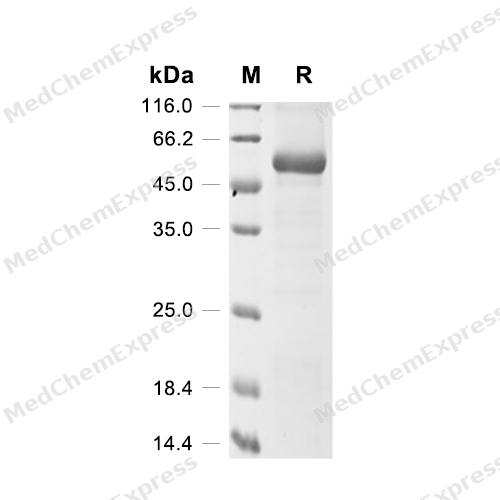
Purity - SDS-PAGE


Technical Parameters
-
Species Human
-
Source E. coli
-
Tag N-6*His
-
Accession
P78395 (M1-N509)
-
Molecular Construction
-
N-term
-
6*His
-
PRAME (M1-N509)
Accession # P78395 -
C-term
-
-
Protein Length
Full Length
-
Synonyms
PRAME; Preferentially Expressed Antigen Of Melanoma; Prev. MAPE; Opa-Interacting Protein 4; CT130; OIP-4; Melanoma Antigen Preferentially Expressed In Tumors; OIP4; Preferentially Expressed Antigen In Melanoma; Opa-Interacting Protein OIP4; PRAME Nuclear Receptor Transcriptional Regulator; Cancer/Testis Antigen 130
-
AA Sequence
MERRRLWGSIQSRYISMSVWTSPRRLVELAGQSLLKDEALAIAALELLPRELFPPLFMAAFDGRHSQTLKAMVQAWPFTCLPLGVLMKGQHLHLETFKAVLDGLDVLLAQEVRPRRWKLQVLDLRKNSHQDFWTVWSGNRASLYSFPEPEAAQPMTKKRKVDGLSTEAEQPFIPVEVLVDLFLKEGACDELFSYLIEKVKRKKNVLRLCCKKLKIFAMPMQDIKMILKMVQLDSIEDLEVTCTWKLPTLAKFSPYLGQMINLRRLLLSHIHASSYISPEKEEQYIAQFTSQFLSLQCLQALYVDSLFFLRGRLDQLLRHVMNPLETLSITNCRLSEGDVMHLSQSPSVSQLSVLSLSGVMLTDVSPEPLQALLERASATLQDLVFDECGITDDQLLALLPSLSHCSQLTTLSFYGNSISISALQSLLQHLIGLSNLTHVLYPVPLESYEDIHGTLHLERLAYLHARLRELLCELGRPSMVWLSANPCPHCGDRTFYDPEPILCPCFMPN
-
Predicted Molecular Mass
61.9 kDa
-
Purity
≥ 90%, as determined by reducing SDS-PAGE.


Product Properties
Lyophilized powder.
Lyophilized from a 0.22 μm filtered solution of PBS, 6% trehalose, pH 7.4.
<1 EU/μg, determined by LAL method.
It is not recommended to reconstitute to a concentration less than 100 μg/mL in ddH2O.
Stored at -20°C for 2 years from date of receipt. After reconstitution, it is stable at 4°C for 1 week or -20°C for longer (with carrier protein). It is recommended to freeze aliquots at -20°C or -80°C for extended storage.
Room temperature in continental US; may vary elsewhere.


Documentation
-
Data Sheet (238 KB)
-
SDS (251 KB)
- English - EN (251 KB)
- Français - FR (251 KB)
- Deutsch - DE (251 KB)
- Norwegian - NO (251 KB)
- Español - ES (251 KB)
- Swedish - SV (251 KB)
- Italian - IT (251 KB)
- Korean - KR (251 KB)
- Portuguese - PT (251 KB)
-
Handling Instructions (2659 KB)

Calculators
Concentration (start) × Volume (start) = Concentration (final) × Volume (final)


 Powered by Bioz

