



MERS-CoV Spike/S1 Protein (CHO, hFc)

Based on 1 Customer Validation
MERS-CoV Spike/S1 Proteinas, a crucial component of the Middle East Respiratory Syndrome Coronavirus (MERS-CoV), mediates viral entry into host cells by binding to the host receptor DPP4. The Spike/S1 protein initiates the infection process and is a key target for antiviral strategies. Understanding its structure and interactions is vital for developing effective interventions against MERS-CoV. MERS-CoV Spike/S1 Protein (CHO, hFc) is the recombinant Virus-derived MERS-CoV Spike/S1 protein, expressed by CHO , with C-hFc labeled tag.
- Species: Virus
- Source: CHO
-
Storage:Stored at -20°C for 2 years from date of receipt. After reconstitution, it is stable at 4°C for 1 week or -20°C for longer (with carrier protein). It is recommended to freeze aliquots at -20°C or -80°C for extended storage.


To place orders, for customer services and technical support, please contact: MedChemExpress USA
Tel: 609-228-6898 E-mail: [email protected] [email protected]


-
 Biological Activity
-
Technical Parameters
-
Product Properties
- Documentation
- Help & FAQs




Biological Activity
Description
MERS-CoV Spike/S1 Proteinas, a crucial component of the Middle East Respiratory Syndrome Coronavirus (MERS-CoV), mediates viral entry into host cells by binding to the host receptor DPP4. The Spike/S1 protein initiates the infection process and is a key target for antiviral strategies. Understanding its structure and interactions is vital for developing effective interventions against MERS-CoV. MERS-CoV Spike/S1 Protein (CHO, hFc) is the recombinant Virus-derived MERS-CoV Spike/S1 protein, expressed by CHO , with C-hFc labeled tag.
Background
ABCD2, an ATP-dependent transporter belonging to the ATP-binding cassette (ABC) family, plays a crucial role in facilitating the transport of very long-chain fatty acid (VLCFA)-CoA from the cytosol to the peroxisome lumen. Similar to ABCD1, ABCD2 exhibits fatty acyl-CoA thioesterase (ACOT) and ATPase activities. According to the proposed model, VLCFA-CoA is transported in an ATP-dependent manner into peroxisomes after the hydrolysis of VLCFA-CoA, mediated by ABCD2's ACOT activity (probable). Notably, ABCD2 shares overlapping substrate specificities with ABCD1, particularly towards saturated fatty acids (FA) and monounsaturated FA (MUFA). However, ABCD2 demonstrates a distinct substrate preference for shorter VLCFA (C22:0) and polyunsaturated fatty acids (PUFA) such as C22:6-CoA and C24:6-CoA, as observed in vitro. This substrate specificity suggests a potential regulatory role for ABCD2 in very long-chain fatty acids (VLCFAs) and energy metabolism, particularly in the degradation and biosynthesis of fatty acids through beta-oxidation.
Verified Bioactivity
Measured by its binding ability in a functional ELISA. When Recombinant Human DPPIV/CD26 (HY-P72975) is present at 5 μg/mL can bind Recombinant MERS-CoV Spike/S1. The ED50 for this effect is 0.4222 μg/mL.
MCE Validation Data
-
Purity - SDS-PAGE
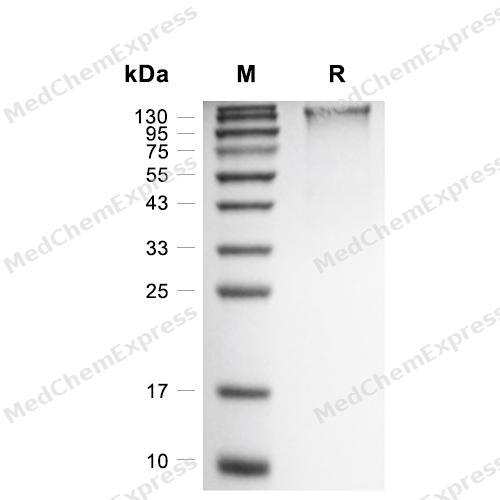
Purity - SDS-PAGE
-
Bioactivity - ELISA
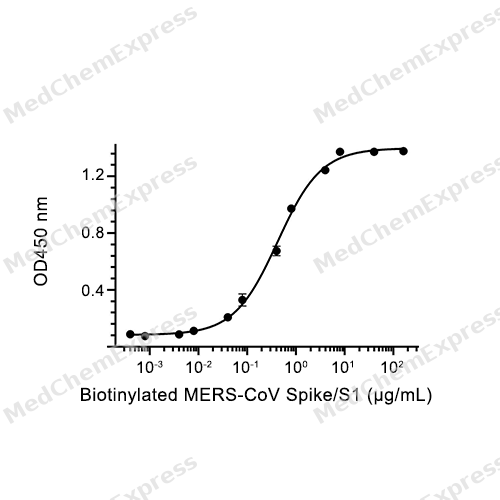
Bioactivity - ELISA


Technical Parameters
-
Species Virus
-
Source CHO
-
Tag C-hFc
-
Accession
K9N5Q8 (Y18-P747)
-
Gene ID1489668
-
Molecular Construction
-
N-term
-
MERS-CoV S1 (Y18-P747)
Accession # K9N5Q8 -
hFc
-
C-term
-
-
Protein Length
Partial Extracellular Domain
-
Synonyms
Spike glycoprotein; S; S glycoprotein; E2; Peplomer protein; Spike Protein, S1 Subunit
-
AA Sequence
YVDVGPDSVKSACIEVDIQQTFFDKTWPRPIDVSKADGIIYPQGRTYSNITITYQGLFPYQGDHGDMYVYSAGHATGTTPQKLFVANYSQDVKQFANGFVVRIGAAANSTGTVIISPSTSATIRKIYPAFMLGSSVGNFSDGKMGRFFNHTLVLLPDGCGTLLRAFYCILEPRSGNHCPAGNSYTSFATYHTPATDCSDGNYNRNASLNSFKEYFNLRNCTFMYTYNITEDEILEWFGITQTAQGVHLFSSRYVDLYGGNMFQFATLPVYDTIKYYSIIPHSIRSIQSDRKAWAAFYVYKLQPLTFLLDFSVDGYIRRAIDCGFNDLSQLHCSYESFDVESGVYSVSSFEAKPSGSVVEQAEGVECDFSPLLSGTPPQVYNFKRLVFTNCNYNLTKLLSLFSVNDFTCSQISPAAIASNCYSSLILDYFSYPLSMKSDLSVSSAGPISQFNYKQSFSNPTCLILATVPHNLTTITKPLKYSYINKCSRFLSDDRTEVPQLVNANQYSPCVSIVPSTVWEDGDYYRKQLSPLEGGGWLVASGSTVAMTEQLQMGFGITVQYGTDTNSVCPKLEFANDTKIASQLGNCVEYSLYGVSGRGVFQNCTAVGVRQQRFVYDAYQNLVGYYSDDGNYYCLRACVSVPVSVIYDKETKTHATLFGSVACEHISSTMSQYSRSTRSMLKRRDSTYGPLQTPVGCVLGLVNSSLFVEDCKLPLGQSLCALPDTPSTLTP
-
Molecular Weight
Approximately 115-135 kDa, based on SDS-PAGE under reducing conditions.
-
Glycosylation
Yes
-
Purity
≥ 95%, as determined by reducing SDS-PAGE.


Product Properties
Lyophilized powder.
Lyophilized from a 0.22 μm filtered solution of PBS, pH 7.4, 8% trehalose.
<1 EU/μg, determined by LAL method.
It is not recommended to reconstitute to a concentration less than 100 μg/mL in ddH2O.
Stored at -20°C for 2 years from date of receipt. After reconstitution, it is stable at 4°C for 1 week or -20°C for longer (with carrier protein). It is recommended to freeze aliquots at -20°C or -80°C for extended storage.
Room temperature in continental US; may vary elsewhere.


Documentation
-
Data Sheet (240 KB)
-
SDS (251 KB)
- English - EN (251 KB)
- Français - FR (251 KB)
- Deutsch - DE (251 KB)
- Norwegian - NO (251 KB)
- Español - ES (251 KB)
- Swedish - SV (251 KB)
- Italian - IT (251 KB)
- Korean - KR (251 KB)
- Portuguese - PT (251 KB)
-
Handling Instructions (2659 KB)

Calculators
Concentration (start) × Volume (start) = Concentration (final) × Volume (final)


 Powered by Bioz

