



CD26/Dipeptidyl Peptidase 4 Protein, Human (HEK293)
Based on 5 publication(s) in Google Scholar
The CD26/dipeptidyl peptidase 4 protein is a cell surface glycoprotein receptor that induces T cell proliferation and NF-kappa-B activation. CD26 also works with FAP to promote pericellular proteolysis, endothelial cell migration, and invasion of the extracellular matrix. CD26/Dipeptidyl Peptidase 4 Protein, Human (HEK293) is the recombinant human-derived CD26/Dipeptidyl Peptidase 4 protein, expressed by HEK293 , with tag free.
- Species: Human
- Source: HEK293
-
Storage:Stored at -20°C for 2 years from date of receipt. After reconstitution, it is stable at 4°C for 1 week or -20°C for longer (with carrier protein). It is recommended to freeze aliquots at -20°C or -80°C for extended storage.


To place orders, for customer services and technical support, please contact: MedChemExpress USA
Tel: 609-228-6898 E-mail: [email protected] [email protected]


-
 Biological Activity
-
Technical Parameters
-
Product Properties
- Documentation
- Help & FAQs


-
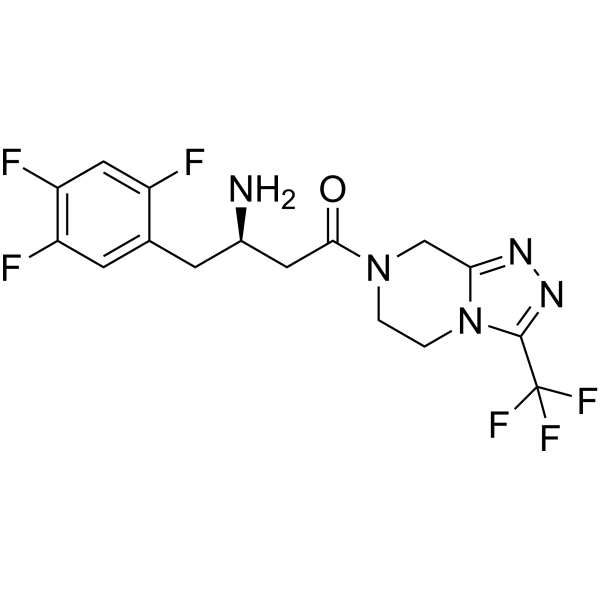
HY-13749
Sitagliptin -
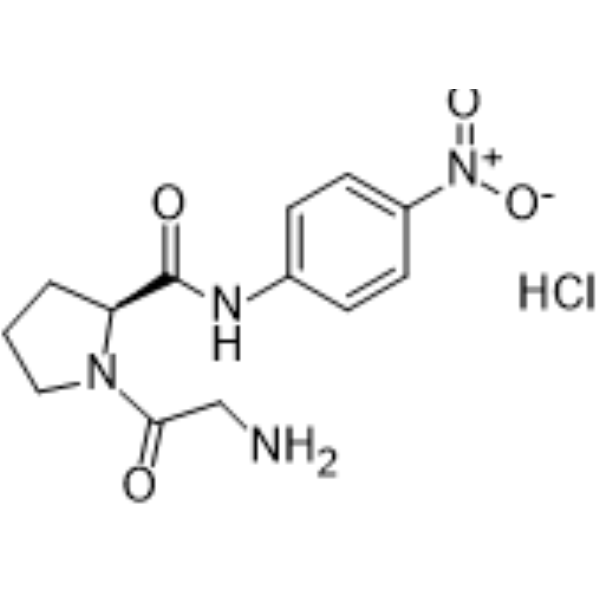
HY-119244
Gly-Pro-pNA hydrochloride -
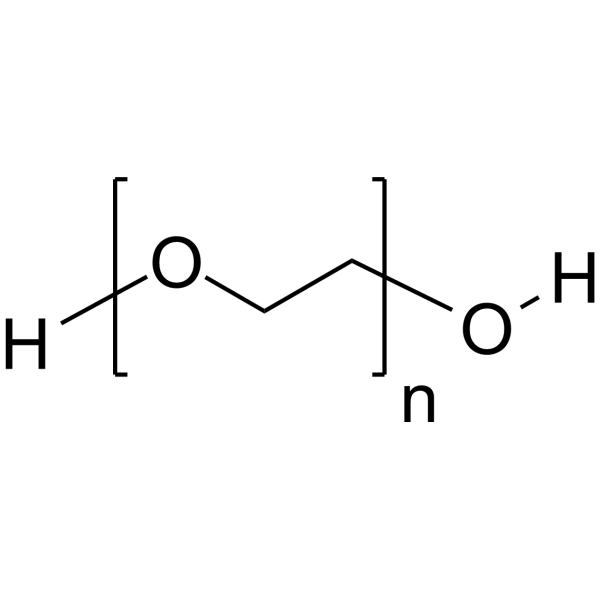
HY-Y0873
PEG300 -

HY-P73300
MMP-9 Protein, Human (HEK293) -
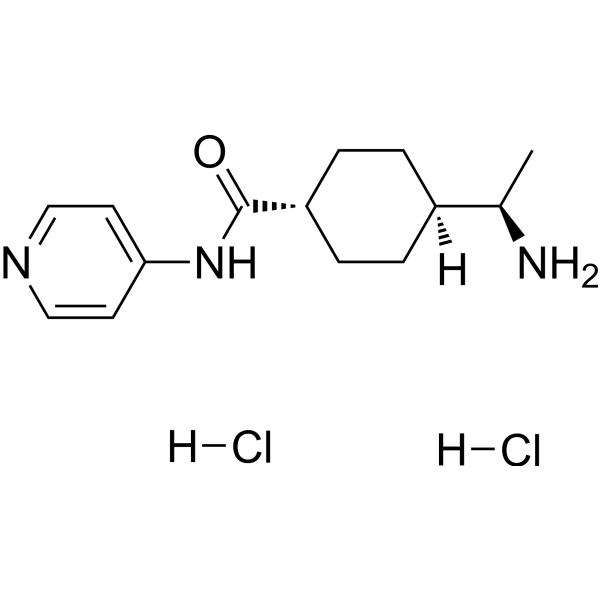
HY-10583
Y-27632 dihydrochloride -

HY-NP010
Type I Collagen, from rat tail -
HY-P703641
DPP9 Protein, Human (sf9) -
HY-K0208
Streptavidin Magnetic Beads -
HY-P703584
Prolyl Endopeptidase/PREP Protein, Human -
HY-P70291
Insulysin/IDE Protein, Human (HEK293, His) -
HY-P701874
DPP8 Protein, Human (sf9, His)


Biological Activity
Description
The CD26/dipeptidyl peptidase 4 protein is a cell surface glycoprotein receptor that induces T cell proliferation and NF-kappa-B activation. CD26 also works with FAP to promote pericellular proteolysis, endothelial cell migration, and invasion of the extracellular matrix. CD26/Dipeptidyl Peptidase 4 Protein, Human (HEK293) is the recombinant human-derived CD26/Dipeptidyl Peptidase 4 protein, expressed by HEK293 , with tag free.
Background
CD26/Dipeptidyl Peptidase 4 protein, a cell surface glycoprotein receptor, plays a pivotal role in the costimulatory signal essential for T-cell receptor (TCR)-mediated T-cell activation. Functioning as a positive regulator of T-cell coactivation, CD26 interacts with ADA, CAV1, IGF2R, and PTPRC, leading to T-cell proliferation and NF-kappa-B activation in a T-cell receptor/CD3-dependent manner. Its binding to CAV1 and CARD11 induces T-cell proliferation, while its interaction with ADA regulates lymphocyte-epithelial cell adhesion. In association with FAP, CD26 is involved in pericellular proteolysis of the extracellular matrix, contributing to the migration and invasion of endothelial cells. Additionally, it may play a role in promoting lymphatic endothelial cell adhesion, migration, and tube formation. Acting as a serine exopeptidase with dipeptidyl peptidase activity, CD26 regulates various physiological processes by cleaving peptides in the circulation, including chemokines, mitogenic growth factors, neuropeptides, and peptide hormones. Notably, CD26 acts as a receptor for the human coronavirus MERS-CoV-2 during microbial infection.
Verified Bioactivity
Measured by its ability to cleave the fluorogenic peptide substrate Gly-Pro-7-amido-4-methylcoumarin (GP-AMC) and the specific activity is > 2,500 pmol/min/μg.
MCE Validation Data
-
Purity - SDS-PAGE
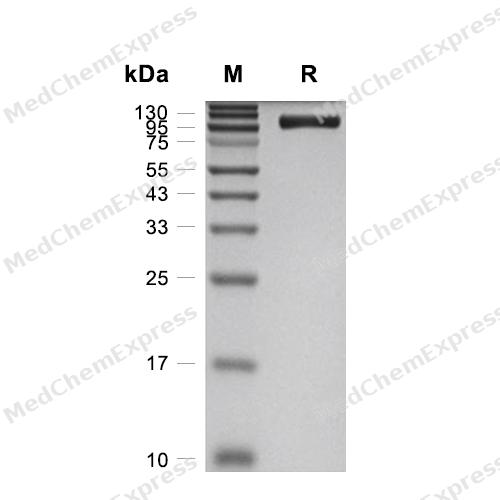
Purity - SDS-PAGE

Assay Procedure
Materials
Assay buffer: 25 mM Tris, pH 8.0
Test protein: CD26/Dipeptidyl Peptidase 4 Protein, Human (HEK293) (HY-P72975)
Substrate: H-Gly-Pro-AMC (HY-137834)
Standard: 7-Amino-4-methylcoumarin (AMC, HY-D0027)
Procedure
1. Standard Curve: Dilute standard in assay buffer to concentrations of 0, 0.09765625, 0.1953125, 0.390625, 0.78125, 1.5625, 3.125, 6.25, 12.5, 25, 50, and 100 μM. Add 100 μL of each dilution to a black microplate well. Measure fluorescence in kinetic mode for 5 minutes at excitation and emission wavelengths of 380 nm and 460 nm, respectively. Plot the measured RFU values on the y-axis and the standard concentrations on the x-axis to generate a standard curve and obtain the curve equation.
2. Dilute Human CD26 to 0.2 μg/mL in assay buffer.
3. Dilute the substrate to 200 μM in assay buffer.
4. Add 50 μL of 0.2 μg/mL Human CD26 to the plate, then add 50 μL of 200 μM substrate to initiate the reaction. For the substrate blank, load 50 μL of assay buffer and 50 μL of substrate.
5. Read in kinetic mode for 5 minutes at excitation wavelength 380 nm and emission wavelength 460 nm.
6. Calculate the specific activity:
Specific Activity (pmol/min/μg) = | Adjusted Vmax* (RFU/min) x Conversion Factor ** (pmol/RFU) |
| amount of enzyme (μg) |
*Adjusted for Substrate Blank.
**Derived using calibration standard AMC


Publications (5)
-
Journal Impact Factor
-
Most Recent
-
Gut Microbes
Dual-source DPP4 drives intestinal fibrosis in Crohn's disease: synergistic therapeutic targeting of host and microbiota pathways. [Abstract]2025 Dec 31;17(1):2593119. PMID: 41334589
CD26/Dipeptidyl Peptidase 4 Protein, Human (HEK293) purchased from MedChemExpress. Usage Cited in: Gut Microbes. 2025 Dec 31;17(1):2593119. [Abstract]
Scratch wound healing assay evaluating HIMF migration at 0 and 24 hours following sDPP4 (CD26/Dipeptidyl Peptidase 4 Protein; 200 ng/mL) stimulation, with or without DPP4 inhibitor. sDPP4 enhanced HIMF migration and increased wound closure rates, which was suppressed by DPP4 inhibition.
-
-
J Agric Food Chem
Virtual Hydrolysis-Based Screening of Wheat-Derived DPP-IV Inhibitory Peptides: A Mechanistic Analysis Integrating Cell Experiments and Molecular Dynamics Simulations. [Abstract]2025 Aug 6;73(31):19410-19426. PMID: 40623964
CD26/Dipeptidyl Peptidase 4 Protein, Human (HEK293) purchased from MedChemExpress. Usage Cited in: J Agric Food Chem. 2025 Aug 6;73(31):19410-19426. [Abstract]
Inhibitory effects of the four peptides on DPP-IV (CD26/Dipeptidyl Peptidase 4 Protein; 100 ng/mL; 30 min). All four peptides exhibited DPP-IV inhibitory activity.
-
BMC Biol
Deep learning-based dipeptidyl peptidase IV inhibitor screening, experimental validation, and GaMD/LiGaMD analysis. [Abstract]2025 Jul 1;23(1):173. PMID: 40597132
CD26/Dipeptidyl Peptidase 4 Protein, Human (HEK293) purchased from MedChemExpress. Usage Cited in: BMC Biol. 2025 Jul 1;23(1):173. [Abstract]
The inhibitor constant of Isavuconazonium on DPP4 (CD26/Dipeptidyl Peptidase 4 Protein; 100 ng/mL; 15 min). Isavuconazonium had a strong affinity for the catalytic site of the DPP4 enzyme.
-
J Dairy Sci
Virtual Screening and Validation of DPP-4 Inhibitory Peptides from Goat Milk: Insights from Molecular Dynamics Simulations and In vitro Experiment. [Abstract]2026 Mar 24:S0022-0302(26)00271-7. PMID: 41887527
CD26/Dipeptidyl Peptidase 4 Protein, Human (HEK293) purchased from MedChemExpress. Usage Cited in: J Dairy Sci. 2026 Mar 24:S0022-0302(26)00271-7. [Abstract]
Inhibitory effects of MMSF, MPFPK, and GPFPIL on DPP-4, and IC50 values of MMSF, MPFPK, and GPFPIL against DPP-4 (CD26/Dipeptidyl Peptidase 4 Protein; 100 ng/mL; 15 min). All 3 peptides exhibited significant DPP-4 inhibitory activity.


Technical Parameters
-
Species Human
-
Source HEK293
-
Tag Tag Free
-
Accession
P27487 (N29-P766)
-
Molecular Construction
-
N-term
-
CD26 (N29-P766)
Accession # P27487 -
C-term
-
-
Protein Length
Extracellular Domain
-
Synonyms
DPP4; DPP IV; Prev. ADCP2; TP103; Prev. CD26; Post-Proline Dipeptidyl Aminopeptidase IV; Adenosine Deaminase Complexing Protein 2; Xaa-Pro-Dipeptidylaminopeptidase; T-Cell Activation Antigen CD26; Gly-Pro Naphthylamidase; Dipeptidyl Peptidase IV; Dipeptid
-
AA Sequence
NKGTDDATADSRKTYTLTDYLKNTYRLKLYSLRWISDHEYLYKQENNILVFNAEYGNSSVFLENSTFDEFGHSINDYSISPDGQFILLEYNYVKQWRHSYTASYDIYDLNKRQLITEERIPNNTQWVTWSPVGHKLAYVWNNDIYVKIEPNLPSYRITWTGKEDIIYNGITDWVYEEEVFSAYSALWWSPNGTFLAYAQFNDTEVPLIEYSFYSDESLQYPKTVRVPYPKAGAVNPTVKFFVVNTDSLSSVTNATSIQITAPASMLIGDHYLCDVTWATQERISLQWLRRIQNYSVMDICDYDESSGRWNCLVARQHIEMSTTGWVGRFRPSEPHFTLDGNSFYKIISNEEGYRHICYFQIDKKDCTFITKGTWEVIGIEALTSDYLYYISNEYKGMPGGRNLYKIQLSDYTKVTCLSCELNPERCQYYSVSFSKEAKYYQLRCSGPGLPLYTLHSSVNDKGLRVLEDNSALDKMLQNVQMPSKKLDFIILNETKFWYQMILPPHFDKSKKYPLLLDVYAGPCSQKADTVFRLNWATYLASTENIIVASFDGRGSGYQGDKIMHAINRRLGTFEVEDQIEAARQFSKMGFVDNKRIAIWGWSYGGYVTSMVLGSGSGVFKCGIAVAPVSRWEYYDSVYTERYMGLPTPEDNLDHYRNSTVMSRAENFKQVEYLLIHGTADDNVHFQQSAQISKALVDVGVDFQAMWYTDEDHGIASSTAHQHIYTHMSHFIKQCFSLP
-
Molecular Weight
Approximately 90-116 kDa, based on SDS-PAGE under reducing conditions, due to the glycosylation.
-
Glycosylation
Yes
-
Purity
≥ 85%, as determined by reducing SDS-PAGE.


Product Properties
Lyophilized powder
1.Lyophilized from a 0.22 μm filtered solution of 25 mM MES, 150 mM NaCl, pH 6.5, 5% trehalose, 5% mannitol, 0.01% Tween 80.
2.Lyophilized from a 0.22 μm filtered solution of 50 mM HEPES, 150 mM NaCl, pH 7.5, 8% trehalose.
Please refer to the lot-specific COA for specific buffer information.
<1 EU/μg, determined by LAL method.
It is not recommended to reconstitute to a concentration less than 100 μg/mL in ddH2O.
Stored at -20°C for 2 years from date of receipt. After reconstitution, it is stable at 4°C for 1 week or -20°C for longer (with carrier protein). It is recommended to freeze aliquots at -20°C or -80°C for extended storage.
Room temperature in continental US; may vary elsewhere.


Documentation
-
Data Sheet (240 KB)
-
SDS (251 KB)
- English - EN (251 KB)
- Français - FR (251 KB)
- Deutsch - DE (251 KB)
- Norwegian - NO (251 KB)
- Español - ES (251 KB)
- Swedish - SV (251 KB)
- Italian - IT (251 KB)
- Korean - KR (251 KB)
- Portuguese - PT (251 KB)
-
Handling Instructions (2659 KB)

Calculators
Concentration (start) × Volume (start) = Concentration (final) × Volume (final)


 Powered by Bioz

