



METRNL/Meteorin-like Protein, Human (His-SUMO)

Based on 1 Customer Validation
METRNL/meteorin-like protein is caused by hormonal changes caused by exercise or cold exposure, which increases energy expenditure. After exercise, it is expressed in skeletal muscle, whereas during cold exposure, it is expressed in adipose tissue. METRNL/Meteorin-like Protein, Human (His-SUMO) is the recombinant human-derived METRNL/Meteorin-like protein, expressed by E. coli , with N-SUMO, N-6*His labeled tag.
- Species: Human
- Source: E. coli
-
Storage:Stored at -20°C for 2 years from date of receipt. After reconstitution, it is stable at 4°C for 1 week or -20°C for longer (with carrier protein). It is recommended to freeze aliquots at -20°C or -80°C for extended storage.


To place orders, for customer services and technical support, please contact: MedChemExpress USA
Tel: 609-228-6898 E-mail: [email protected] [email protected]


-
 Biological Activity
-
Technical Parameters
-
Product Properties
- Documentation
- Help & FAQs




Biological Activity
Description
METRNL/meteorin-like protein is caused by hormonal changes caused by exercise or cold exposure, which increases energy expenditure. After exercise, it is expressed in skeletal muscle, whereas during cold exposure, it is expressed in adipose tissue. METRNL/Meteorin-like Protein, Human (His-SUMO) is the recombinant human-derived METRNL/Meteorin-like protein, expressed by E. coli , with N-SUMO, N-6*His labeled tag.
Background
METRNL/Meteorin-like protein is induced in response to hormonal changes triggered by exercise or exposure to cold, contributing to enhanced energy expenditure. Its expression is observed in skeletal muscle post-exercise and adipose tissue during cold exposure, and it circulates in the bloodstream. METRNL/Meteorin-like protein facilitates energy expenditure by promoting the browning of white fat depots and improving glucose tolerance. Interestingly, its thermogenic effects are not directly exerted on adipocytes but involve the stimulation of various immune cell subtypes. It induces an eosinophil-dependent increase in IL4 expression and facilitates the alternative activation of adipose tissue macrophages, crucial for the enhanced expression of thermogenic and anti-inflammatory gene programs in fat. METRNL/Meteorin-like protein is essential for certain cold-induced thermogenic responses, highlighting its role in metabolic adaptations to low temperatures.
MCE Validation Data
-
Purity - SDS-PAGE
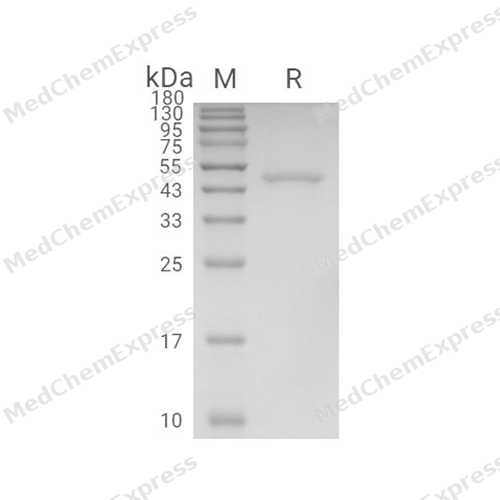
Purity - SDS-PAGE


Technical Parameters
-
Species Human
-
Source E. coli
-
Tag N-SUMO;N-6*His
-
Accession
Q641Q3-1 (Q46-D311)
-
Molecular Construction
-
N-term
-
6*His-SUMO
-
METRNL (Q46-D311)
Accession # Q641Q3-1 -
C-term
-
-
Protein Length
Full Length of Isoform-1
-
Synonyms
METRNL; Cometin; Meteorin Like, Glial Cell Differentiation Regulator; Meteorin, Glial Cell Differentiation Regulator-Like; Meteorin-Like Protein; METRNL Protein; Subfatin
-
AA Sequence
QYSSDRCSWKGSGLTHEAHRKEVEQVYLRCAAGAVEWMYPTGALIVNLRPNTFSPARHLTVCIRSFTDSSGANIYLEKTGELRLLVPDGDGRPGRVQCFGLEQGGLFVEATPQQDIGRRTTGFQYELVRRHRASDLHELSAPCRPCSDTEVLLAVCTSDFAVRGSIQQVTHEPERQDSAIHLRVSRLYRQKSRVFEPVPEGDGHWQGRVRTLLECGVRPGHGDFLFTGHMHFGEARLGCAPRFKDFQRMYRDAQERGLNPCEVGTD
-
Molecular Weight
Approximately 45 kDa, based on SDS-PAGE under reducing conditions.
-
Purity
≥ 90%, as determined by reducing SDS-PAGE.


Product Properties
Lyophilized powder
1.Lyophilized from a 0.22 μm filtered solution of 10 mM Tris-HCl, 1 mM EDTA, 6% trehalose, pH 8.0.
2.Lyophilized from a 0.22 μm filtered solution of PBS, 6% Trehalose, pH 7.4.
Please refer to the lot-specific COA for specific buffer information.
Note: For SPR assay, please replace the buffer. Primary amine components (e.g., Tris, imidazole) can affect protein-coupled chips.
<1 EU/μg, determined by LAL method.
It is not recommended to reconstitute to a concentration less than 100 μg/mL in ddH2O.
Stored at -20°C for 2 years from date of receipt. After reconstitution, it is stable at 4°C for 1 week or -20°C for longer (with carrier protein). It is recommended to freeze aliquots at -20°C or -80°C for extended storage.
Room temperature in continental US; may vary elsewhere.


Documentation
-
Data Sheet (237 KB)
-
SDS (251 KB)
- English - EN (251 KB)
- Français - FR (251 KB)
- Deutsch - DE (251 KB)
- Norwegian - NO (251 KB)
- Español - ES (251 KB)
- Swedish - SV (251 KB)
- Italian - IT (251 KB)
- Korean - KR (251 KB)
- Portuguese - PT (251 KB)
-
Handling Instructions (2659 KB)

Calculators
Concentration (start) × Volume (start) = Concentration (final) × Volume (final)


 Powered by Bioz

