



MIP-1 alpha/CCL3 Protein, Mouse (His)
Based on 1 publication(s) in Google Scholar
MIP-1 alpha/CCL3 Protein, Mouse (His), an important chemokine, is a key regulator of immune microenvironment and primarily mediates the trafficking of immune cells in both inflammation and cancer. MIP-1 alpha/CCL3 Protein, Mouse (His) is a recombinant mouse CCL3 (A24-A92) expressed by E.coil with a N-6*His tag.
- Species: Mouse
- Source: E. coli
-
Storage:Stored at -20°C for 2 years from date of receipt. After reconstitution, it is stable at 4°C for 1 week or -20°C for longer (with carrier protein). It is recommended to freeze aliquots at -20°C or -80°C for extended storage.


To place orders, for customer services and technical support, please contact: MedChemExpress USA
Tel: 609-228-6898 E-mail: [email protected] [email protected]


-
 Biological Activity
-
Technical Parameters
-
Product Properties
- Documentation
- References
- Help & FAQs




Biological Activity
Description
MIP-1 alpha/CCL3 Protein, Mouse (His), an important chemokine, is a key regulator of immune microenvironment and primarily mediates the trafficking of immune cells in both inflammation and cancer. MIP-1 alpha/CCL3 Protein, Mouse (His) is a recombinant mouse CCL3 (A24-A92) expressed by E.coil with a N-6*His tag[1].
Background
CCL3 also known as macrophage inflammatory protein 1-a, is a member of the CC subfamily. It’s known that CCL3 is produced by monocytes/macrophages, lymphocytes, neutrophils as well as immune cells such as basophils, mast cells, fibroblasts, and dendritic cells. Meanwhile, CCL3 exerts various biological effects by binding to its three cell surface receptors, including CCR1, CCR3, and CCR5. MIP-1a induces a variety of pro-inflammatory activities such as leukocyte chemotaxis, and promotes the entry of T cells into the inflammatory tissue region from blood circulation. Chemotactic CD4+ cells, CD8+ cells, natural killer cells, and dendritic cells bind to the corresponding receptors and coordinate the occurrence of immune reactions in the immune response site by migrating through vascular endothelial cells. In addition, MIP-1a is considered as a key inflammatory mediator in granuloma, asthma, T1D as well as other autoimmune diseases[1].
Verified Bioactivity
Measured by its ability to chemoattract BaF3 mouse proB cells transfected with mouse CCR5. The ED50 for this effect is <3.0 ng/mL.
MCE Validation Data
-
Purity - SDS-PAGE
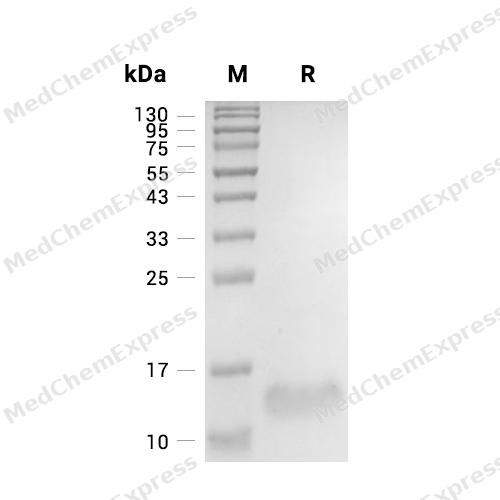
Purity - SDS-PAGE
-
Bioactivity - Cell-Based Assay
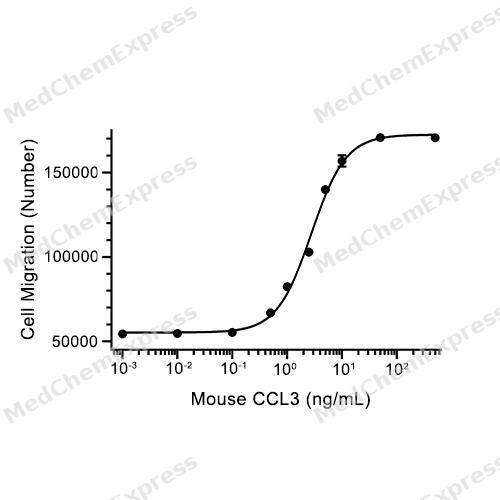
Bioactivity - Cell-Based Assay


Publications (1)
-
Journal Impact Factor
-
Most Recent
-
J Exp Clin Cancer Res
Augmented ERO1α upon mTORC1 activation induces ferroptosis resistance and tumor progression via upregulation of SLC7A11. [Abstract]2024 Apr 13;43(1):112. PMID: 38610018


Technical Parameters
-
Species Mouse
-
Source E. coli
-
Tag N-6*His
-
Accession
P10855/Q5SVU3 (A24-A92)
-
Molecular Construction
-
N-term
-
6*His
-
MIP-1 alpha/CCL3 (A24-A92)
Accession # P10855/Q5SVU3 -
C-term
-
-
Protein Length
Full Length of Mature Protein
-
Synonyms
CCL3; Tonsillar Lymphocyte LD78 Alpha Protein; Prev. SCYA3; C-C Motif Chemokine 3; MIP-1-Alpha; PAT 464.1; G0S19-1; SIS-Beta; LD78ALPHA; MIP1A; LD78; Macrophage Inflammatory Protein 1 Alpha; SCI; Chemokine (C-C Motif) Ligand 3; Small Inducible Cytokine A3
-
AA Sequence
APYGADTPTACCFSYSRKIPRQFIVDYFETSSLCSQPGVIFLTKRNRQICADSKETWVQEYITDLELNA
-
Predicted Molecular Mass
8.7 kDa
-
Molecular Weight
Approximately 15 kDa, based on SDS-PAGE under reducing conditions.
-
Purity
≥ 95%, as determined by reducing SDS-PAGE.


Product Properties
Lyophilized powder
Lyophilized from a 0.22 μm filtered solution of 20 mM Tris/Tris-HCl, 150 mM NaCl, 5% Trehalose, 1 mM EDTA, pH 8.0.
Note: For SPR assay, please replace the buffer. Primary amine components (e.g., Tris, imidazole) can affect protein-coupled chips.
<1 EU/μg, determined by LAL method.
It is not recommended to reconstitute to a concentration less than 100 μg/mL in ddH2O.
Stored at -20°C for 2 years from date of receipt. After reconstitution, it is stable at 4°C for 1 week or -20°C for longer (with carrier protein). It is recommended to freeze aliquots at -20°C or -80°C for extended storage.
Room temperature in continental US; may vary elsewhere.


Documentation
-
Data Sheet (263 KB)
-
SDS (254 KB)
- English - EN (254 KB)
- Français - FR (254 KB)
- Deutsch - DE (254 KB)
- Norwegian - NO (254 KB)
- Español - ES (254 KB)
- Swedish - SV (254 KB)
- Italian - IT (254 KB)
- Korean - KR (254 KB)
- Portuguese - PT (254 KB)
-
Handling Instructions (2659 KB)


References
[1]. Zhang G, et al. CCL3 participates in the development of rheumatoid arthritis by activating AKT. Eur Rev Med Pharmacol Sci. 2018 Oct;22(20):6625-6632. [Content Brief]
[2]. Ioannis Ntanasis-Stathopoulos, et al. CCL3 Signaling in the Tumor Microenvironment. Adv Exp Med Biol. 2020;1231:13-21. [Content Brief]
[3]. Giovanni Bernardini, et al. CCL3 and CXCL12 regulate trafficking of mouse bone marrow NK cell subsets. Blood. 2008 Apr 1;111(7):3626-34. [Content Brief]

Calculators
Concentration (start) × Volume (start) = Concentration (final) × Volume (final)


 Powered by Bioz

