



MUSK Protein, Human (P.pastoris, His)

Based on 1 Customer Validation
MUSK protein is a receptor tyrosine kinase that plays a crucial role in the formation and maintenance of the neuromuscular junction (NMJ). After LRP4 recruits AGRIN, MUSK phosphorylates and activates, affecting gene expression, coordinating actin cytoskeletal reorganization, and clustering acetylcholine receptors (AChR) in the postsynaptic membrane. MUSK Protein, Human (P.pastoris, His) is the recombinant human-derived MUSK protein, expressed by P. pastoris , with N-6*His labeled tag.
- Species: Human
- Source: P. pastoris
-
Storage:Stored at -20°C for 2 years from date of receipt. After reconstitution, it is stable at 4°C for 1 week or -20°C for longer (with carrier protein). It is recommended to freeze aliquots at -20°C or -80°C for extended storage.


To place orders, for customer services and technical support, please contact: MedChemExpress USA
Tel: 609-228-6898 E-mail: [email protected] [email protected]


-
 Biological Activity
-
Technical Parameters
-
Product Properties
- Documentation
- Help & FAQs




Biological Activity
Description
MUSK protein is a receptor tyrosine kinase that plays a crucial role in the formation and maintenance of the neuromuscular junction (NMJ). After LRP4 recruits AGRIN, MUSK phosphorylates and activates, affecting gene expression, coordinating actin cytoskeletal reorganization, and clustering acetylcholine receptors (AChR) in the postsynaptic membrane. MUSK Protein, Human (P.pastoris, His) is the recombinant human-derived MUSK protein, expressed by P. pastoris , with N-6*His labeled tag.
Background
The MUSK protein, a receptor tyrosine kinase, holds a pivotal role in the formation and maintenance of the neuromuscular junction (NMJ), the synapse connecting motor neurons to skeletal muscles. Upon AGRIN recruitment by LRP4 to the MUSK signaling complex, MUSK undergoes phosphorylation and activation, regulating NMJ formation by influencing gene expression in subsynaptic nuclei, orchestrating actin cytoskeleton reorganization, and clustering acetylcholine receptors (AChR) in the postsynaptic membrane. ABL1 and Src family kinases, activated by MUSK, may further regulate AChR phosphorylation and clustering. The ternary complex formed by MUSK, DVL1, and PAK1 is crucial for AChR clustering regulation. Additionally, MUSK positively regulates Rho family GTPases through FNTA, mediating the phosphorylation of FNTA and promoting the activation of RAC1, a key regulator of the actin cytoskeleton and gene expression. DNAJA3, acting downstream of MUSK, is another effector in the MUSK signaling pathway. Beyond the neuromuscular junction, MUSK may also contribute to cholinergic responses, synaptic plasticity, and memory formation within the central nervous system.
Verified Bioactivity
1.This product does not contain protein kinase domain.
2.Measured by its binding ability in a functional ELISA.In the presence of Recombinant Human Agrin, immobilized Recombinant Human MuSK (2 µg/mL at 100 µL/well) binds Recombinant Human LRP-4 The ED50 for this effect is 1.145 μg/mL.
MCE Validation Data
-
Purity - SDS-PAGE
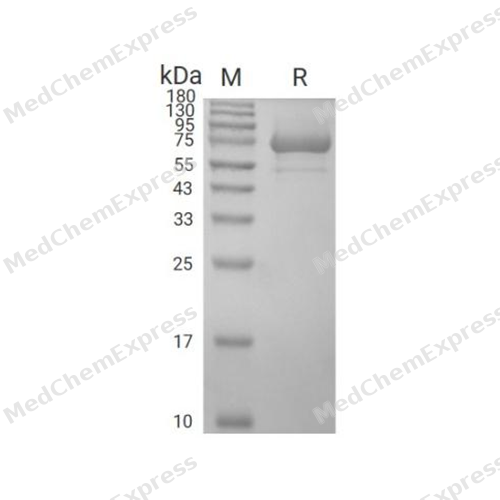
Purity - SDS-PAGE
-
Bioactivity - ELISA
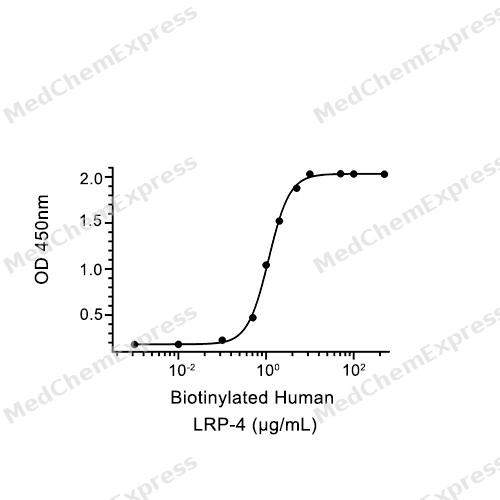
Bioactivity - ELISA


Technical Parameters
-
Species Human
-
Source P. pastoris
-
Tag N-6*His
-
Accession
O15146-2 (L24-I495)
-
Molecular Construction
-
N-term
-
6*His
-
MUSK (L24-I495)
Accession # O15146-2 -
C-term
-
-
Protein Length
Extracellular Domain
-
Synonyms
MUSK; Muscle-Specific Kinase Receptor; Muscle Associated Receptor Tyrosine Kinase; Receptor Protein-Tyrosine Kinase; Muscle, Skeletal Receptor Tyrosine-Protein Kinase; CMS9; Muscle-Specific Tyrosine-Protein Kinase Receptor; FADS; Muscle, Skeletal, Recepto
-
AA Sequence
LPKAPVITTPLETVDALVEEVATFMCAVESYPQPEISWTRNKILIKLFDTRYSIRENGQLLTILSVEDSDDGIYCCTANNGVGGAVESCGALQVKMKPKITRPPINVKIIEGLKAVLPCTTMGNPKPSVSWIKGDSPLRENSRIAVLESGSLRIHNVQKEDAGQYRCVAKNSLGTAYSKVVKLEVEEESEPEQDTKVFARILRAPESHNVTFGSFVTLHCTATGIPVPTITWIENGNAVSSGSIQESVKDRVIDSRLQLFITKPGLYTCIATNKHGEKFSTAKAAATISIAEWREYCLAVKELFCAKEWLVMEEKTHRGLYRSEMHLLSVPECSKLPSMHWDPTACARLPHLAFPPMTSSKPSVDIPNLPSSSSSSFSVSPTYSMTVIISIMSSFAIFVLLTITTLYCCRRRKQWKNKKRESAAVTLTTLPSELLLDRLHPNPMYQRMPLLLNPKLLSLEYPRNNIEYVRDI
-
Predicted Molecular Mass
53.9 kDa
-
Molecular Weight
Approximately 55-66 kDa, based on SDS-PAGE under reducing conditions, due to the glycosylation.
-
Glycosylation
Yes
-
Purity
≥ 90%, as determined by reducing SDS-PAGE.


Product Properties
Lyophilized powder
1.Lyophilized from a 0.22 μm filtered solution of 20 mM Tris-HCl, 0.5 M NaCl, 3% trehalose, pH 8.0.
2.Lyophilized from a 0.22 μm filtered solution of PBS, 6% trehalose, pH 7.4.
Please refer to the lot-specific COA for specific buffer information.
Note: For SPR assay, please replace the buffer. Primary amine components (e.g., Tris, imidazole) can affect protein-coupled chips.
<1.0 EU/μg, determined by LAL method.
It is not recommended to reconstitute to a concentration less than 100 μg/mL in ddH2O.
Stored at -20°C for 2 years from date of receipt. After reconstitution, it is stable at 4°C for 1 week or -20°C for longer (with carrier protein). It is recommended to freeze aliquots at -20°C or -80°C for extended storage.
Room temperature in continental US; may vary elsewhere.


Documentation
-
Data Sheet (239 KB)
-
SDS (254 KB)
- English - EN (254 KB)
- Français - FR (254 KB)
- Deutsch - DE (254 KB)
- Norwegian - NO (254 KB)
- Español - ES (254 KB)
- Swedish - SV (254 KB)
- Italian - IT (254 KB)
- Korean - KR (254 KB)
- Portuguese - PT (254 KB)
-
Handling Instructions (2659 KB)

Calculators
Concentration (start) × Volume (start) = Concentration (final) × Volume (final)


 Powered by Bioz

