



NCAM-1/CD56 Protein, Human (HEK293, His)

Based on 1 Customer Validation
Neural cell adhesion molecule 1 (NCAM1) is a cell adhesion molecule which enables LRR domain binding activity and phosphatase binding activity. NCAM1 plays a role in the cell development and differentiation as well as immune surveillance. NCAM1 plays a role in signal transduction by interacting with fibroblast growth factor receptors, N-cadherin and activating FAK, MAPK and PI3K. NCAM-1/CD56 Protein, Human (HEK293, His) is the recombinant human-derived NCAM-1/CD56 protein, expressed by HEK293 , with C-6*His labeled tag.
- Species: Human
- Source: HEK293
-
Storage:Stored at -20°C for 2 years from date of receipt. After reconstitution, it is stable at 4°C for 1 week or -20°C for longer (with carrier protein). It is recommended to freeze aliquots at -20°C or -80°C for extended storage.


To place orders, for customer services and technical support, please contact: MedChemExpress USA
Tel: 609-228-6898 E-mail: [email protected] [email protected]


-
 Biological Activity
-
Technical Parameters
-
Product Properties
- Documentation
- Help & FAQs




Biological Activity
Description
Neural cell adhesion molecule 1 (NCAM1) is a cell adhesion molecule which enables LRR domain binding activity and phosphatase binding activity. NCAM1 plays a role in the cell development and differentiation as well as immune surveillance. NCAM1 plays a role in signal transduction by interacting with fibroblast growth factor receptors, N-cadherin and activating FAK, MAPK and PI3K. NCAM-1/CD56 Protein, Human (HEK293, His) is the recombinant human-derived NCAM-1/CD56 protein, expressed by HEK293 , with C-6*His labeled tag.
Background
Neural cell adhesion molecule 1 (NCAM1) is a cell adhesion molecule which is a member of the immunoglobulin superfamily and enables LRR domain binding activity and phosphatase binding activity, participating homotypic cell-cell adhesion, positive regulation of calcium-mediated signaling, and regulation of exocyst assembly.
NCAM1 is involved in cell-to-cell interactions as well as cell-matrix interactions during development and differentiation, playing a role in the development of the nervous system by regulating neurogenesis, neurite outgrowth, and cell migration. NCAM1 is also involved in commissural neuron axon guidance and regulation of semaphorin-plexin signaling pathway. Moreover, NCAM1 is associated with the expansion of T lymphocytes, B lymphocytes and natural killer (NK) cells which play an important role in immune surveillance. NCAM1 plays a role in signal transduction by interacting with fibroblast growth factor receptors, N-cadherin and other components of the extracellular matrix and by triggering signalling cascades involving FYN-focal adhesion kinase (FAK), mitogen-activated protein kinase (MAPK), and phosphatidylinositol 3-kinase (PI3K).
NCAM1 gene has multiple protein isoforms through alternative splicing. One prominent isoform of NCAM1 is cell surface molecule CD56, which plays a role in several myeloproliferative disorders such as acute myeloid leukemia and differential expression of CD56 is associated with differential disease progression. For example, increased expression of CD56 is correlated with lower survival in acute myeloid leukemia patients whereas increased severity of COVID-19 is correlated with decreased abundance of CD56-expressing NK cells in peripheral blood.
NCAM1 also acts as a receptor for rabies virus and Zika virus[1][2].
Verified Bioactivity
Measured by the ability of the immobilized protein to support the adhesion of Neuro-2a cells. The ED50 for this effect is 0.7605 μg/mL, corresponding to a specific activity is 1314.924 units/mg.
MCE Validation Data
-
Purity - SDS-PAGE
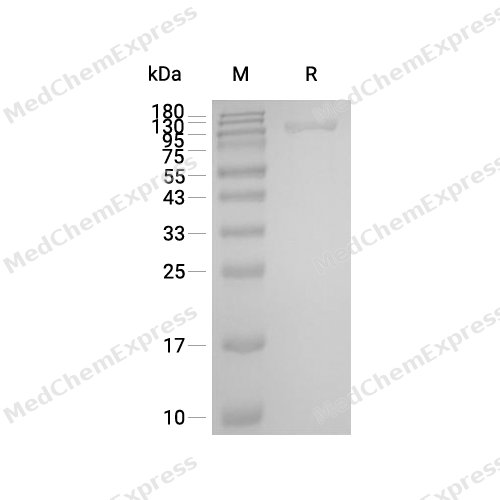
Purity - SDS-PAGE
-
Bioactivity - Cell-Based Assay
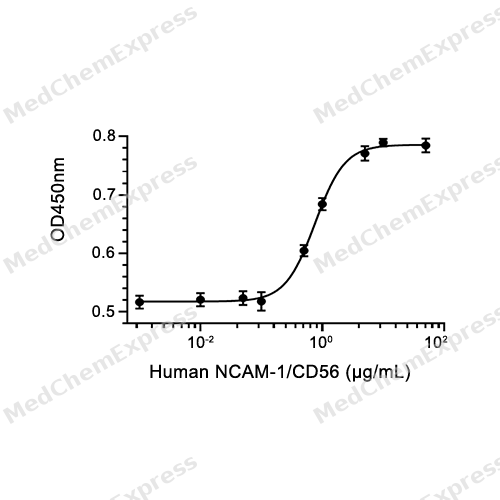
Bioactivity - Cell-Based Assay


Technical Parameters
-
Species Human
-
Source HEK293
-
Tag C-6*His
-
Accession
P13591-3 (L20-P603)
-
Molecular Construction
-
N-term
-
NCAM-1 (L20-P603)
Accession # P13591-3 -
6*His
-
C-term
-
-
Protein Length
Partial Extracellular Domain
-
Synonyms
NCAM1; Alternative Protein NCAM1; Neural Cell Adhesion Molecule 1; CD56 Antigen; NCAM; N-CAM-1; CD56; NCAM-1; Antigen Recognized By Monoclonal Antibody 5.1H11; MSK39; Neural Cell Adhesion Molecule, NCAM
-
AA Sequence
LQVDIVPSQGEISVGESKFFLCQVAGDAKDKDISWFSPNGEKLTPNQQRISVVWNDDSSSTLTIYNANIDDAGIYKCVVTGEDGSESEATVNVKIFQKLMFKNAPTPQEFREGEDAVIVCDVVSSLPPTIIWKHKGRDVILKKDVRFIVLSNNYLQIRGIKKTDEGTYRCEGRILARGEINFKDIQVIVNVPPTIQARQNIVNATANLGQSVTLVCDAEGFPEPTMSWTKDGEQIEQEEDDEKYIFSDDSSQLTIKKVDKNDEAEYICIAENKAGEQDATIHLKVFAKPKITYVENQTAMELEEQVTLTCEASGDPIPSITWRTSTRNISSEEKTLDGHMVVRSHARVSSLTLKSIQYTDAGEYICTASNTIGQDSQSMYLEVQYAPKLQGPVAVYTWEGNQVNITCEVFAYPSATISWFRDGQLLPSSNYSNIKIYNTPSASYLEVTPDSENDFGNYNCTAVNRIGQESLEFILVQADTPSSPSIDQVEPYSSTAQVQFDEPEATGGVPILKYKAEWRAVGEEVWHSKWYDAKEASMEGIVTIVGLKPETTYAVRLAALNGKGLGEISAASEFKTQPVHSPPP
-
Predicted Molecular Mass
65.5 kDa
-
Molecular Weight
Approximately 90-120 kDa, based on SDS-PAGE under reducing conditions.
-
Glycosylation
Yes
-
Purity
≥ 95%, as determined by reducing SDS-PAGE.


Product Properties
Lyophilized powder
Lyophilized from a 0.22 μm filtered solution of PBS, pH 7.4.
<1 EU/μg, determined by LAL method.
It is not recommended to reconstitute to a concentration less than 100 μg/mL in ddH2O. For long term storage it is recommended to add a carrier protein (0.1% BSA, 5% HSA, 10% FBS or 5% Trehalose).
Stored at -20°C for 2 years from date of receipt. After reconstitution, it is stable at 4°C for 1 week or -20°C for longer (with carrier protein). It is recommended to freeze aliquots at -20°C or -80°C for extended storage.
Room temperature in continental US; may vary elsewhere.


Documentation
-
Data Sheet (240 KB)
-
SDS (251 KB)
- English - EN (251 KB)
- Français - FR (251 KB)
- Deutsch - DE (251 KB)
- Norwegian - NO (251 KB)
- Español - ES (251 KB)
- Swedish - SV (251 KB)
- Italian - IT (251 KB)
- Korean - KR (251 KB)
- Portuguese - PT (251 KB)
-
Handling Instructions (2659 KB)

Calculators
Concentration (start) × Volume (start) = Concentration (final) × Volume (final)


 Powered by Bioz

