



Nectin-1 Protein, Rat (HEK293, His)

Based on 1 Customer Validation
Nectin-1 Protein, with carbohydrate and virion binding activities, plays pivotal roles in axon guidance, synapse assembly, and viral entry. Located in dendrites, growth cone membranes, and synapses, Nectin-1 is implicated in human conditions like cleft lip and ectodermal dysplasia. Its biased expression, especially in Kidney (RPKM 45.4) and Brain (RPKM 31.3), underscores its significance in diverse physiological contexts. Nectin-1 Protein, Rat (HEK293, His) is the recombinant rat-derived Nectin-1 protein, expressed by HEK293 , with C-His labeled tag.
- Species: Rat
- Source: HEK293
-
Storage:Stored at -20°C for 2 years from date of receipt. After reconstitution, it is stable at 4°C for 1 week or -20°C for longer (with carrier protein). It is recommended to freeze aliquots at -20°C or -80°C for extended storage.


To place orders, for customer services and technical support, please contact: MedChemExpress USA
Tel: 609-228-6898 E-mail: [email protected] [email protected]


-
 Biological Activity
-
Technical Parameters
-
Product Properties
- Documentation
- Help & FAQs




Biological Activity
Description
Nectin-1 Protein, with carbohydrate and virion binding activities, plays pivotal roles in axon guidance, synapse assembly, and viral entry. Located in dendrites, growth cone membranes, and synapses, Nectin-1 is implicated in human conditions like cleft lip and ectodermal dysplasia. Its biased expression, especially in Kidney (RPKM 45.4) and Brain (RPKM 31.3), underscores its significance in diverse physiological contexts. Nectin-1 Protein, Rat (HEK293, His) is the recombinant rat-derived Nectin-1 protein, expressed by HEK293 , with C-His labeled tag.
Background
Nectin-1 Protein, characterized by its carbohydrate binding and virion binding activities, plays pivotal roles in axon guidance, regulation of synapse assembly, and viral entry into host cells. Distributed across various cellular components, including dendrites, growth cone membranes, and synapses, Nectin-1 is implicated in human conditions such as cleft lip, cleft lip-palate-ectodermal dysplasia syndrome, cleft palate, and ectodermal dysplasia. The biased expression pattern, notably in the Kidney (RPKM 45.4), Brain (RPKM 31.3), and nine other tissues, underscores its significance in diverse physiological contexts.
Verified Bioactivity
Measured by its binding ability in a functional ELISA. When Recombinant Human Nectin-3 is present at 1 μg/mL, can bind Recombinant Rat Nectin-1. The ED50 for this effect is 125.7 ng/mL.
MCE Validation Data
-
Purity - SDS-PAGE
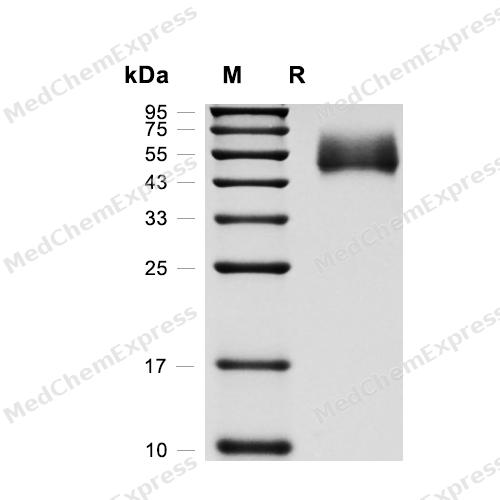
Purity - SDS-PAGE
-
Bioactivity - ELISA
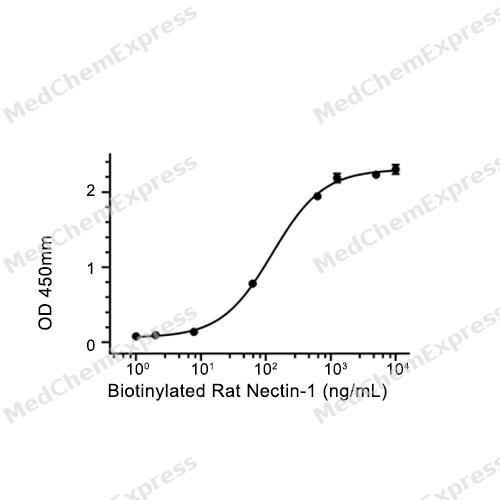
Bioactivity - ELISA


Technical Parameters
-
Species Rat
-
Source HEK293
-
Tag C-His
-
Accession
F1LNP8/NP_001093946 (Q31-A354)
-
Molecular Construction
-
N-term
-
Nectin-1 (Q31-A354)
Accession # F1LNP8/NP_001093946 -
His
-
C-term
-
-
Protein Length
Partial
-
Synonyms
NECTIN1; OFC7; Prev. PVRL1; Poliovirus Receptor-Related 1 (Herpesvirus Entry Mediator C); Prev. HVEC; Herpesvirus Ig-Like Receptor; Prev. ED4; Ectodermal Dysplasia 4 (Margarita Island Type); Nectin-1; Herpes Simplex Virus Type 1 Sensitivity; PRR1; Herpesv
-
AA Sequence
QVVQVNDSMYGFIGTDVILHCSFANPLPTVKITQVTWQKASNGSKQNMAIYNPTMGVSVLPPYEKRVEFLRPSFIDGTIRLSHLELEDEGMYICEFATFPTGNRESQLNLTVMAKPTNWIEGTQAVLRARKGQDDKVLVATCTSANGKPPSVVSWETRLKGEAEYQEIRNPNGTVTVISRYRLVPSREAHRQSLACIVNYHLDRFRESLTLNVQYEPEVTIEGFDGNWYLQRTDVKLTCKADANPPATEYHWTTLNGSLPKGVEAQNRTLFFRGPINYSLAGTYICEATNPIGTRSGQVEVNITEFPYTPTPEHGRRAGQMPTA
-
Molecular Weight
Approximately 55-60 kDa, based on SDS-PAGE under reducing conditions, due to the glycosylation.
-
Glycosylation
Yes
-
Purity
≥ 95%, as determined by reducing SDS-PAGE.


Product Properties
Lyophilized powder.
Lyophilized from a 0.22 μm filtered solution of PBS, pH 7.4.
<1 EU/μg, determined by LAL method.
It is not recommended to reconstitute to a concentration less than 100 μg/mL in ddH2O. For long term storage it is recommended to add a carrier protein (0.1% BSA, 5% HSA, 10% FBS or 5% Trehalose).
Stored at -20°C for 2 years from date of receipt. After reconstitution, it is stable at 4°C for 1 week or -20°C for longer (with carrier protein). It is recommended to freeze aliquots at -20°C or -80°C for extended storage.
Room temperature in continental US; may vary elsewhere.


Documentation
-
Data Sheet (237 KB)
-
SDS (251 KB)
- English - EN (251 KB)
- Français - FR (251 KB)
- Deutsch - DE (251 KB)
- Norwegian - NO (251 KB)
- Español - ES (251 KB)
- Swedish - SV (251 KB)
- Italian - IT (251 KB)
- Korean - KR (251 KB)
- Portuguese - PT (251 KB)
-
Handling Instructions (2659 KB)

Calculators
Concentration (start) × Volume (start) = Concentration (final) × Volume (final)


 Powered by Bioz

