



NFE2L2 Protein, Human (sf9, GST)

Based on 1 Customer Validation
NFE2L2 is a key transcription factor that activates cytoprotective genes in response to oxidative stress by binding to the antioxidant response element (ARE). Normally, the BCR(KEAP1) complex degrades NFE2L2 in the cytoplasm. NFE2L2 Protein, Human (sf9, GST) is the recombinant human-derived NFE2L2 protein, expressed by Sf9 insect cells with N-GST labeled tag.
- Species: Human
- Source: Sf9 insect cells
-
Storage:Stored at -80°C for 1 year from date of receipt. It is stable at -20°C for 3 months after opening. It is recommended to freeze aliquots at -80°C for extended storage. Avoid repeated freeze-thaw cycles.


To place orders, for customer services and technical support, please contact: MedChemExpress USA
Tel: 609-228-6898 E-mail: [email protected] [email protected]


-
 Biological Activity
-
Technical Parameters
-
Product Properties
- Documentation
- References
- Help & FAQs




Biological Activity
Description
NFE2L2 is a key transcription factor that activates cytoprotective genes in response to oxidative stress by binding to the antioxidant response element (ARE). Normally, the BCR(KEAP1) complex degrades NFE2L2 in the cytoplasm. NFE2L2 Protein, Human (sf9, GST) is the recombinant human-derived NFE2L2 protein, expressed by Sf9 insect cells with N-GST labeled tag[1][2][3][4].
Background
NFE2L2 is a pivotal transcription factor that plays a central role in cellular response to oxidative stress. NFE2L2 binds to the antioxidant response elements in the promoter regions of various cytoprotective genes. NFE2L2 is ubiquitinated and degraded by the BCR(KEAP1) complex in the cytoplasm under normal physiological conditions. NFE2L2 accumulates in the nucleus when electrophilic metabolites inhibit the BCR(KEAP1) complex during oxidative stress, then forms heterodimers with small Maf proteins and combines with antioxidant response elements of cytoprotective target genes. NFE2L2 can also be activated by selective autophagy, as autophagy enhances the interaction between KEAP1 and SQSTM1/p62 to inactivate the BCR(KEAP1) complex and facilitate its nuclear accumulation. NFE2L2 contributes to the transcriptional activation of genes in the β-globin cluster beyond regulating oxidative stress. NFE2L2 acts as a key regulator of innate immunity and antiviral cytoplasmic DNA sensing, and modulates redox homeostasis and aberrant pro-inflammatory signaling during sepsis. NFE2L2 suppresses inflammatory responses in macrophages and restrains the transcription and induction of pro-inflammatory cytokines such as IL6. NFE2L2 inhibits the expression of adaptor STING1 to block antiviral cytoplasmic DNA sensing and reduce the release of pro-inflammatory cytokines triggered by SARS-CoV-2 and other pathogenic viruses. NFE2L2 can be activated by cell-derived metabolites such as itaconic acid and fumaric acid[1][2][3][4].
In Vitro
NFE2L2 Protein, Human (co-incubation) directly interacts with recombinant SETD7 protein in cell-free system[4].
MCE Validation Data
-
Purity - SDS-PAGE
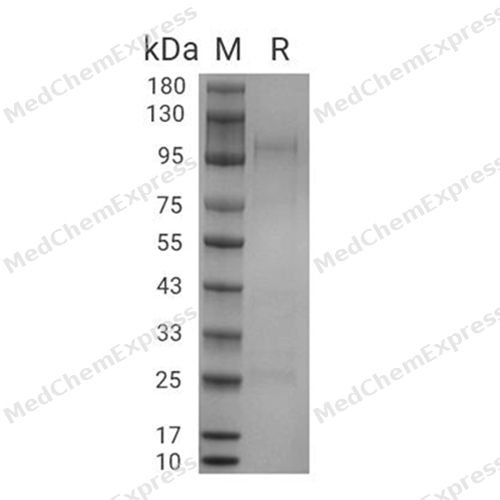
Purity - SDS-PAGE


Technical Parameters
-
Species Human
-
Source Sf9 insect cells
-
Tag N-GST
-
Accession
Q16236-1 (M1-N605)
-
Gene ID4780
-
Molecular Construction
-
N-term
-
GST
-
(M1-N605)
Accession # Q16236-1 -
C-term
-
-
Protein Length
Full Length of Isoform-1
-
Synonyms
NFE2L2; Nuclear Factor (Erythroid-Derived 2)-Like 2; NFE2 Like BZIP Transcription Factor 2; Nuclear Factor, Erythroid Derived 2, Like 2; NRF2; Nuclear Factor Erythroid-Derived 2-Like 2; Nuclear Factor Erythroid 2-Related Factor 2; Nuclear Factor, Erythroi
-
AA Sequence
MMDLELPPPGLPSQQDMDLIDILWRQDIDLGVSREVFDFSQRRKEYELEKQKKLEKERQEQLQKEQEKAFFAQLQLDEETGEFLPIQPAQHIQSETSGSANYSQVAHIPKSDALYFDDCMQLLAQTFPFVDDNEVSSATFQSLVPDIPGHIESPVFIATNQAQSPETSVAQVAPVDLDGMQQDIEQVWEELLSIPELQCLNIENDKLVETTMVPSPEAKLTEVDNYHFYSSIPSMEKEVGNCSPHFLNAFEDSFSSILSTEDPNQLTVNSLNSDATVNTDFGDEFYSAFIAEPSISNSMPSPATLSHSLSELLNGPIDVSDLSLCKAFNQNHPESTAEFNDSDSGISLNTSPSVASPEHSVESSSYGDTLLGLSDSEVEELDSAPGSVKQNGPKTPVHSSGDMVQPLSPSQGQSTHVHDAQCENTPEKELPVSPGHRKTPFTKDKHSSRLEAHLTRDELRAKALHIPFPVEKIINLPVVDFNEMMSKEQFNEAQLALIRDIRRRGKNKVAAQNCRKRKLENIVELEQDLDHLKDEKEKLLKEKGENDKSLHLLKKQLSTLYLEVFSMLRDEDGKPYSPSEYSLQQTRDGNVFLVPKSKKPDVKKN
-
Predicted Molecular Mass
93 kDa
-
Molecular Weight
Approximately 96-110 kDa, based on SDS-PAGE under reducing conditions.
-
Purity
≥ 90%, as determined by reducing SDS-PAGE.


Product Properties
Solution
Supplied as a 0.22 μm filtered solution of 50mM Tris-HCl, pH 7.5, 150mM NaCl, 10mM glutathione, 0.1mM EDTA, 0.25mM DTT, 25% Glycerol.
Note: For SPR assay, please replace the buffer. Primary amine components (e.g., Tris, imidazole) can affect protein-coupled chips.
Stored at -80°C for 1 year from date of receipt. It is stable at -20°C for 3 months after opening. It is recommended to freeze aliquots at -80°C for extended storage. Avoid repeated freeze-thaw cycles.
Shipping with dry ice.


Documentation
-
Data Sheet (265 KB)
-
SDS (252 KB)
- English - EN (252 KB)
- Français - FR (252 KB)
- Deutsch - DE (252 KB)
- Norwegian - NO (252 KB)
- Español - ES (252 KB)
- Swedish - SV (252 KB)
- Italian - IT (252 KB)
- Korean - KR (252 KB)
- Portuguese - PT (252 KB)
-
Handling Instructions (2659 KB)


References
[1]. Cuadrado A, et al. Therapeutic targeting of the NRF2 and KEAP1 partnership in chronic diseases. Nat Rev Drug Discov. 2019 Apr;18(4):295-317. [Content Brief]
[2]. Hyttinen JMT, et al. The Regulation of NFE2L2 (NRF2) Signalling and Epithelial-to-Mesenchymal Transition in Age-Related Macular Degeneration Pathology. Int J Mol Sci. 2019 Nov 18;20(22):5800. [Content Brief]
[3]. Hellyer JA, et al. Clinical Implications of KEAP1-NFE2L2 Mutations in NSCLC. J Thorac Oncol. 2021 Mar;16(3):395-403. [Content Brief]

Calculators
Concentration (start) × Volume (start) = Concentration (final) × Volume (final)


 Powered by Bioz

