



NOTCH1 Protein, Mouse (CHO, mFc)

Based on 1 Customer Validation
NOTCH1 protein is a receptor for the ligands JAG1, JAG2 and DLL1 and is critical for cell fate decisions. Upon ligand activation, NICD forms a transcriptional activator complex with RBPJ/RBPSUH and activates genes in the cleavage site enhancer. NOTCH1 Protein, Mouse (CHO, mFc) is the recombinant mouse-derived NOTCH1 protein, expressed by CHO , with C-mFc labeled tag.
- Species: Mouse
- Source: CHO
-
Storage:Stored at -20°C for 2 years from date of receipt. After reconstitution, it is stable at 4°C for 1 week or -20°C for longer (with carrier protein). It is recommended to freeze aliquots at -20°C or -80°C for extended storage.


To place orders, for customer services and technical support, please contact: MedChemExpress USA
Tel: 609-228-6898 E-mail: [email protected] [email protected]


-
 Biological Activity
-
Technical Parameters
-
Product Properties
- Documentation
- Help & FAQs




Biological Activity
Description
NOTCH1 protein is a receptor for the ligands JAG1, JAG2 and DLL1 and is critical for cell fate decisions. Upon ligand activation, NICD forms a transcriptional activator complex with RBPJ/RBPSUH and activates genes in the cleavage site enhancer. NOTCH1 Protein, Mouse (CHO, mFc) is the recombinant mouse-derived NOTCH1 protein, expressed by CHO , with C-mFc labeled tag.
Background
NOTCH1 protein serves as a receptor for membrane-bound ligands, including Jagged-1 (JAG1), Jagged-2 (JAG2), and Delta-1 (DLL1), exerting critical regulatory functions in cell-fate determination. Upon ligand activation, the released Notch intracellular domain (NICD) forms a transcriptional activator complex with RBPJ/RBPSUH, orchestrating the activation of genes within the enhancer of split locus. NOTCH1 significantly influences cellular differentiation, proliferation, and apoptotic programs. Beyond its role in angiogenesis, where it negatively regulates endothelial cell proliferation and migration, NOTCH1 is involved in thymic maturation, follicular differentiation, and cell fate selection within the follicle. Additionally, it plays a crucial role in cerebellar development by acting as a receptor for neuronal DNER, contributing to the differentiation of Bergmann glia. NOTCH1 also plays roles in postimplantation development, mesoderm development, somite formation, and neurogenesis. It interacts with various proteins, including DNER, DTX1, DTX2, RBPJ/RBPSUH, MAML1, MAML2, MAML3, SNW1, AAK1, FBXW7, SGK1, HIF1AN, SNAI1, MDM2A, BCL6, THBS4, CCN3, DLL4, ZMIZ1, MEGF10, PRAG1, PSEN1, and ZFP64, forming a complex network that modulates diverse cellular processes and regulatory pathways.
Verified Bioactivity
Measured by its binding ability in a functional ELISA. Immobilized Mouse Notch-1 at 2 μg/mL (100 μL/mL) can bind Rat Jagged 1 with an apparent KD < 2 nM.
MCE Validation Data
-
Purity - SDS-PAGE
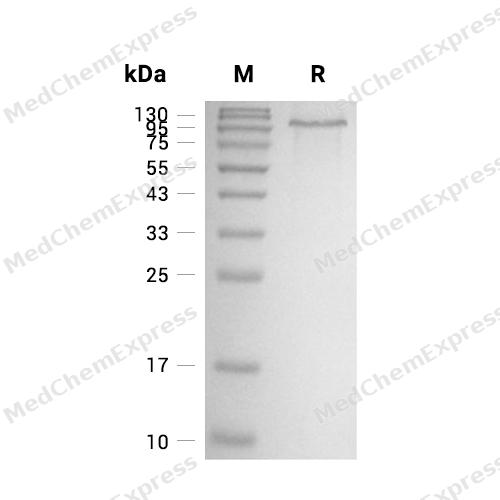
Purity - SDS-PAGE
-
Bioactivity - ELISA
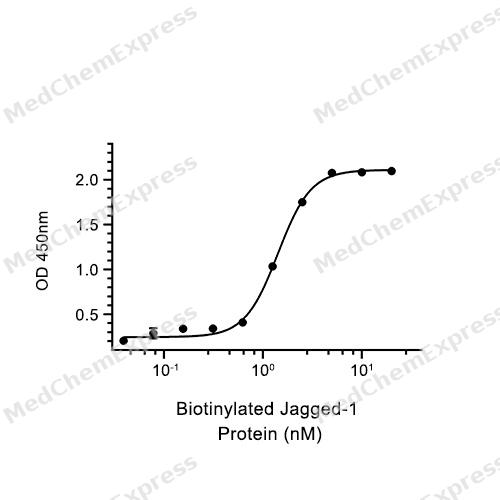
Bioactivity - ELISA


Technical Parameters
-
Species Mouse
-
Source CHO
-
Tag C-mFc
-
Accession
AAM28905 (A19-Q526)
-
Gene ID/
-
Molecular Construction
-
N-term
-
NOTCH1 (A19-Q526)
Accession # AAM28905 -
mFc
-
C-term
-
-
Protein Length
Partial
-
Synonyms
NOTCH1; Notch Homolog 1, Translocation-Associated; Prev. TAN1; Truncated NOTCH1; Notch 1; NOTCH1 Variant; Neurogenic Locus Notch Homolog Protein 1; NOTCH1 Protein; Translocation-Associated Notch Protein TAN-1; Mutant Notch 1; HN1; AOVD1; Notch (Drosophila
-
AA Sequence
ARGLRCSQPSGTCLNGGRCEVASGTEACVCSGAFVGQRCQDSNPCLSTPCKNAGTCHVVDHGGTVDYACSCPLGFSGPLCLTPLDNACLANPCRNGGTCDLLTLTEYKCRCPPGWSGKSCQQADPCASNPCANGGQCLPFESSYICRCPPGFHGPTCRQDVNECSQNPGLCRHGGTCHNEIGSYRCACRATHTGPHCELPYVPCSPSPCQNGGTCRPTGDTTHECACLPGFAGQNCEENVDDCPGNNCKNGGACVDGVNTYNCRCPPEWTGQYCTEDVDECQLMPNACQNGGTCHNTHGGYNCVCVNGWTGEDCSENIDDCASAACFQGATCHDRVASFYCECPHGRTGLLCHLNDACISNPCNEGSNCDTNPVNGKAICTCPSGYTGPACSQDVDECALGANPCEHAGKCLNTLGSFECQCLQGYTGPRCEIDVNECISNPCQNDATCLDQIGEFQCICMPGYEGVYCEINTDECASSPCLHNGHCMDKINEFQCQCPKGFNGHLCQ
-
Predicted Molecular Mass
79.2 kDa (monomer)
-
Molecular Weight
Approximately 100 kDa band in SDS-PAGE under reducing conditions due to the glycosylation.
-
Glycosylation
Yes
-
Structure/Form
Disulfide-linked homodimer
-
Purity
≥ 90%, as determined by reducing SDS-PAGE.


Product Properties
Lyophilized powder.
Lyophilized from a 0.22 μm filtered solution of PBS, pH 7.4, 2 mM EDTA.
<1 EU/μg, determined by LAL method.
It is not recommended to reconstitute to a concentration less than 200 μg/mL in ddH2O. For long term storage it is recommended to add a carrier protein (0.1% BSA, 5% HSA, 10% FBS or 5% Trehalose).
Stored at -20°C for 2 years from date of receipt. After reconstitution, it is stable at 4°C for 1 week or -20°C for longer (with carrier protein). It is recommended to freeze aliquots at -20°C or -80°C for extended storage.
Room temperature in continental US; may vary elsewhere.


Documentation
-
Data Sheet (238 KB)
-
SDS (252 KB)
- English - EN (252 KB)
- Français - FR (252 KB)
- Deutsch - DE (252 KB)
- Norwegian - NO (252 KB)
- Español - ES (252 KB)
- Swedish - SV (252 KB)
- Italian - IT (252 KB)
- Korean - KR (252 KB)
- Portuguese - PT (252 KB)
-
Handling Instructions (2659 KB)

Calculators
Concentration (start) × Volume (start) = Concentration (final) × Volume (final)


 Powered by Bioz

