



OGT Protein, Human (His)
Based on 1 publication(s) in Google Scholar
OGT Protein, Human (His) is the recombinant human-derived OGT protein, expressed by E. coli, with N-6*His & N-SUMO tag.
- Species: Human
- Source: E. coli
-
Storage:Stored at -20°C for 2 years from date of receipt. After reconstitution, it is stable at 4°C for 1 week or -20°C for longer (with carrier protein). It is recommended to freeze aliquots at -20°C or -80°C for extended storage.


To place orders, for customer services and technical support, please contact: MedChemExpress USA
Tel: 609-228-6898 E-mail: [email protected] [email protected]


-
 Biological Activity
-
Technical Parameters
-
Product Properties
- Documentation
- Help & FAQs




Biological Activity
Description
OGT Protein, Human (His) is the recombinant human-derived OGT protein, expressed by E. coli, with N-6*His & N-SUMO tag.
Background
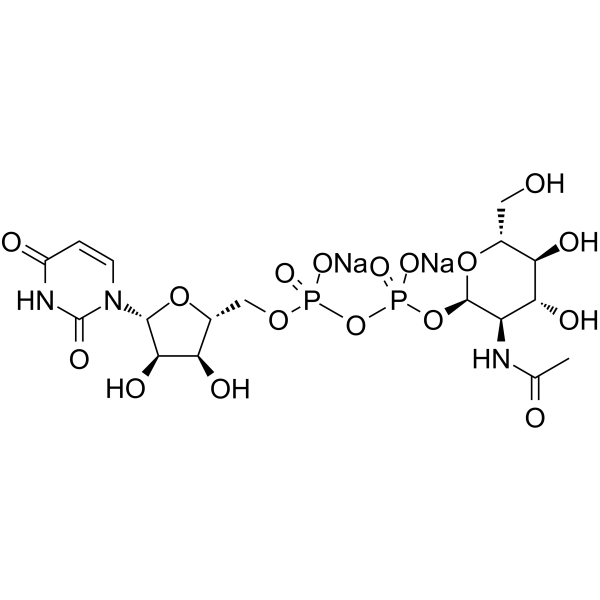
OGT is an enzyme that catalyzes the transfer of a single N-acetylglucosamine from UDP-GlcNAc to serine or threonine residues in cytoplasmic and nuclear proteins, modifying them with a beta-linked N-acetylglucosamine (O-GlcNAc). It glycosylates a wide range of proteins, including histone H2B, AKT1, AMPK, ATG4B, CAPRIN1, EZH2, and others, regulating their cellular functions through crosstalk between glycosylation and phosphorylation or by affecting proteolytic processing. In muscle and adipocyte cells, OGT contributes to insulin resistance by glycosylating insulin signaling components and inhibiting AKT1 phosphorylation at 'Thr-308' (by similarity). Additionally, OGT regulates glycolysis by mediating the glycosylation of 6-phosphofructokinase PFKL, thereby inhibiting its activity. In chromatin structure, OGT plays a crucial role by mediating O-GlcNAcylation of histone H2B at 'Ser-112' and is recruited to CpG-rich transcription start sites of active genes via interaction with TET proteins (TET1, TET2, or TET3). The mitochondrial isoform (mOGT) exhibits cytotoxicity and induces apoptosis in various cell types, including the insulinoma cell line INS1.


Publications (1)
-
Journal Impact Factor
-
Most Recent
-
Dev Cell
A pathological role of O-GlcNAcylation-driven TR11B production and function in lung adenocarcinoma. [Abstract]2025 Sep 3:S1534-5807(25)00530-1. PMID: 40930100


Technical Parameters
-
Species Human
-
Source E. coli
-
Tag N-6*His;N-SUMO
-
Accession
O15294-1 (M606-Q1022)
-
Gene ID8473
-
Protein Length
Partial
-
Synonyms
OGT; MGC22921; O-Linked N-Acetylglucosamine (GlcNAc) Transferase; FLJ23071; UDP-N-Acetylglucosamine--Peptide N-Acetylglucosaminyltransferase 110 KDa Subunit; CDNA FLJ61388, Highly Similar To UDP-N-Acetylglucosamine--PeptideN-Acetylglucosaminyltransferase
-
AA Sequence
MAEANHFIDLSQIPCNGKAADRIHQDGIHILVNMNGYTKGARNELFALRPAPIQAMWLGYPGTSGALFMDYIITDQETSPAEVAEQYSEKLAYMPHTFFIGDHANMFPHLKKKAVIDFKSNGHIYDNRIVLNGIDLKAFLDSLPDVKIVKMKCPDGGDNADSSNTALNMPVIPMNTIAEAVIEMINRGQIQITINGFSISNGLATTQINNKAATGEEVPRTIIVTTRSQYGLPEDAIVYCNFNQLYKIDPSTLQMWANILKRVPNSVLWLLRFPAVGEPNIQQYAQNMGLPQNRIIFSPVAPKEEHVRRGQLADVCLDTPLCNGHTTGMDVLWAGTPMVTMPGETLASRVAASQLTCLGCLELIAKNRQEYEDIAVKLGTDLEYLKKVRGKVWKQRISSPLFNTKQYTMELERLYLQ
-
Molecular Weight
Approximately 68 kDa, based on SDS-PAGE under reducing conditions.
-
Purity
≥ 90%, as determined by reducing SDS-PAGE.


Product Properties
Lyophilized powder
Lyophilized from a 0.22 μm filtered solution of 20 mM Tris-HCl, 0.5 M NaCl, 6% trehalose, pH8.0.
Note: For SPR assay, please replace the buffer. Primary amine components (e.g., Tris, imidazole) can affect protein-coupled chips.
<1 EU/μg, determined by LAL method.
It is not recommended to reconstitute to a concentration less than 100 μg/mL in ddH2O.
Stored at -20°C for 2 years from date of receipt. After reconstitution, it is stable at 4°C for 1 week or -20°C for longer (with carrier protein). It is recommended to freeze aliquots at -20°C or -80°C for extended storage.
Room temperature in continental US; may vary elsewhere.


Documentation
-
Data Sheet (238 KB)
-
SDS (252 KB)
- English - EN (252 KB)
- Français - FR (252 KB)
- Deutsch - DE (252 KB)
- Norwegian - NO (252 KB)
- Español - ES (252 KB)
- Swedish - SV (252 KB)
- Italian - IT (252 KB)
- Korean - KR (252 KB)
- Portuguese - PT (252 KB)
-
Handling Instructions (2659 KB)

Calculators
Concentration (start) × Volume (start) = Concentration (final) × Volume (final)


 Powered by Bioz

