



PDGF-CC Protein, Cynomolgus (HEK293, hFc)

Based on 1 Customer Validation
Platelet derived growth factor C (PDGF-CC) is a growth factor that plays an essential role in the regulation of cell proliferation, cell migration, survival and chemotaxis. PDGF-CC is a potent mitogen and chemoattractant for cells of mesenchymal origin which plays an important roll in normal skeleton formation and normal skin morphogenesis during embryonic development, wound healing, angiogenesis and blood vessel development as well as being involved in fibrotic processes. PDGF-CC Protein, Cynomolgus (HEK293, hFc) is the recombinant cynomolgus-derived PDGF-CC protein, expressed by HEK293 , with N-hFc labeled tag.
- Species: Cynomolgus
- Source: HEK293
-
Storage:Stored at -20°C for 2 years from date of receipt. After reconstitution, it is stable at 4°C for 1 week or -20°C for longer (with carrier protein). It is recommended to freeze aliquots at -20°C or -80°C for extended storage.


To place orders, for customer services and technical support, please contact: MedChemExpress USA
Tel: 609-228-6898 E-mail: [email protected] [email protected]


-
 Biological Activity
-
Technical Parameters
-
Product Properties
- Documentation
- Help & FAQs




Biological Activity
Description
Platelet derived growth factor C (PDGF-CC) is a growth factor that plays an essential role in the regulation of cell proliferation, cell migration, survival and chemotaxis. PDGF-CC is a potent mitogen and chemoattractant for cells of mesenchymal origin which plays an important roll in normal skeleton formation and normal skin morphogenesis during embryonic development, wound healing, angiogenesis and blood vessel development as well as being involved in fibrotic processes. PDGF-CC Protein, Cynomolgus (HEK293, hFc) is the recombinant cynomolgus-derived PDGF-CC protein, expressed by HEK293 , with N-hFc labeled tag.
Background
Platelet derived growth factor C (PDGF-CC) is a growth factor that plays an essential role in the regulation of embryonic development, cell proliferation, cell migration, survival and chemotaxis. PDGF-CC is a potent mitogen and chemoattractant for cells of mesenchymal origin which is required for normal skeleton formation during embryonic development, especially for normal development of the craniofacial skeleton and for normal development of the palate. PDGF-CC is also required for normal skin morphogenesis during embryonic development. PDGF-CC plays an important role in wound healing, where it appears to be involved in three stages: inflammation, proliferation and remodeling. PDGF-CC plays an important role in angiogenesis and blood vessel development and is involved in fibrotic processes, in which transformation of interstitial fibroblasts into myofibroblasts plus collagen deposition occurs. The CUB domain of PDGF-CC has mitogenic activity in coronary artery smooth muscle cells[1][2][3].
Verified Bioactivity
Measured in a cell proliferation assay using NIH/3T3 cells. The ED50 for this effect is 15.09 ng/mL, corresponding to a specific activity is 66269.052 units/mg.
MCE Validation Data
-
Purity - SDS-PAGE
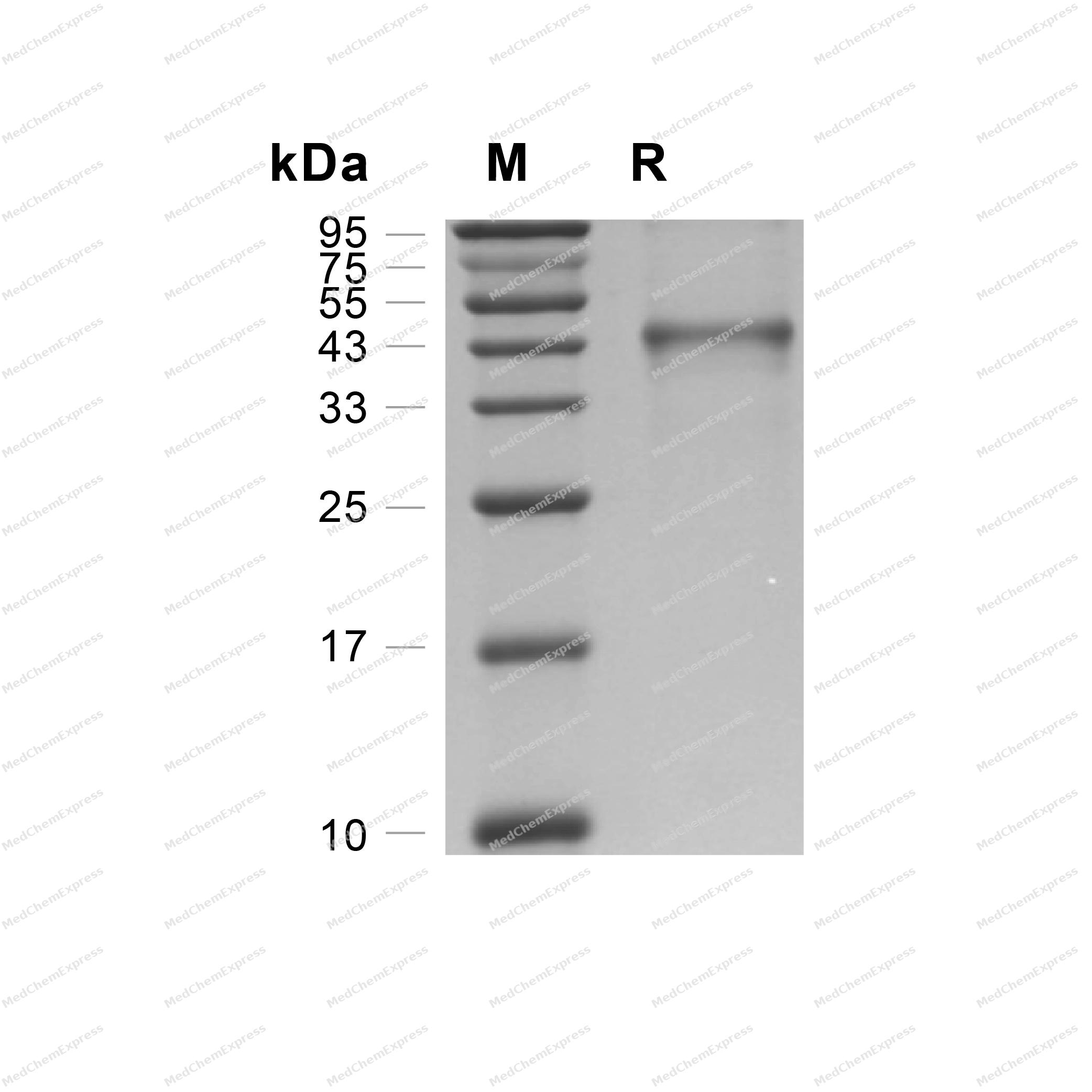
Purity - SDS-PAGE
-
Bioactivity - Cell-Based Assay
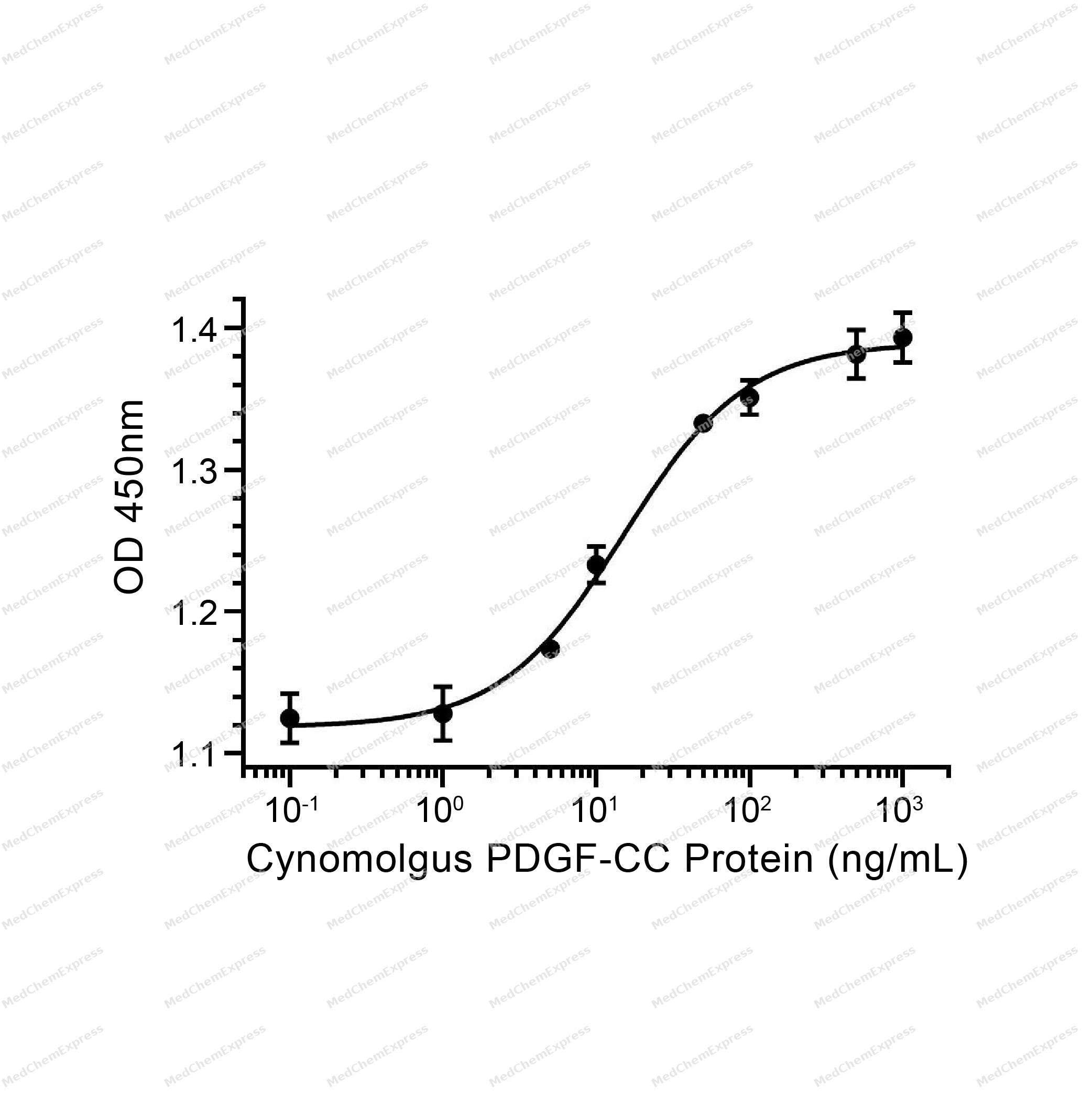
Bioactivity - Cell-Based Assay


Technical Parameters
-
Species Cynomolgus
-
Source HEK293
-
Tag N-hFc
-
Accession
EHH54037 (V196-G306)
-
Gene ID/
-
Molecular Construction
-
N-term
-
hFc
-
PDGF-CC (V196-G306)
Accession # EHH54037 -
C-term
-
-
Protein Length
Partial
-
Synonyms
PDGFC; Platelet-Derived Growth Factor C; Platelet Derived Growth Factor C; PDGF-C; Fallotein; VEGF-E; SCDGF; Secretory Growth Factor-Like Protein; Spinal Cord-Derived Growth Factor
-
AA Sequence
VVDLNLLTEEVRLYSCTPRNFSVSIREELKRTDTIFWPGCLLVKRCGGNCACCLHNCNECQCVPSKVTKKYHEVLQLRPKTGVRGLHKSLTDVALEHHEECDCVCRGSTGG
-
Predicted Molecular Mass
40.9 kDa
-
Molecular Weight
Approximately 45-50 kDa, based on SDS-PAGE under reducing conditions.
-
Purity
≥ 90%, as determined by reducing SDS-PAGE.


Product Properties
Lyophilized powder.
Lyophilized from a 0.2 μm filtered solution of PBS, pH 7.4. Normally 5 % - 8 % trehalose, mannitol and 0.01% Tween 80 are added as protectants before lyophilization.
<1 EU/μg, determined by LAL method.
It is not recommended to reconstitute to a concentration less than 100 μg/mL in ddH2O.
Stored at -20°C for 2 years from date of receipt. After reconstitution, it is stable at 4°C for 1 week or -20°C for longer (with carrier protein). It is recommended to freeze aliquots at -20°C or -80°C for extended storage.
Room temperature in continental US; may vary elsewhere.


Documentation
-
Data Sheet (236 KB)
-
SDS (251 KB)
- English - EN (251 KB)
- Français - FR (251 KB)
- Deutsch - DE (251 KB)
- Norwegian - NO (251 KB)
- Español - ES (251 KB)
- Swedish - SV (251 KB)
- Italian - IT (251 KB)
- Korean - KR (251 KB)
- Portuguese - PT (251 KB)
-
Handling Instructions (2659 KB)

Calculators
Concentration (start) × Volume (start) = Concentration (final) × Volume (final)


 Powered by Bioz

