



PDGF-CC Protein, Human (HEK293)
Based on 2 publication(s) in Google Scholar
PDGF-CC Protein, Human (HEK293) is a member of the PDGF family, binds to PDGFR-α and PDGFR-β and acts as potent angiogenic factor.
- Species: Human
- Source: HEK293
-
Storage:Stored at -20°C for 2 years from date of receipt. After reconstitution, it is stable at 4°C for 1 week or -20°C for longer (with carrier protein). It is recommended to freeze aliquots at -20°C or -80°C for extended storage.


To place orders, for customer services and technical support, please contact: MedChemExpress USA
Tel: 609-228-6898 E-mail: [email protected] [email protected]


-
 Biological Activity
-
Technical Parameters
-
Product Properties
- Documentation
- References
- Help & FAQs




Biological Activity
Description
PDGF-CC Protein, Human (HEK293) is a member of the PDGF family, binds to PDGFR-α and PDGFR-β and acts as potent angiogenic factor.
Background
PDGF-CC is a relatively new member of the PDGF family, abundantly expressed by different types of cells, such as tumor cells, endothelial cells (ECs), vascular smooth muscle cells (VSMCs), pericytes, fibroblasts, and macrophages. PDGF-CC binds to PDGFR-α and PDGFR-β, which are also expressed by many different cell types, including tumor cells, VSMCs, pericytes, and fibroblasts, all of which play important roles in angiogenesis. PDGF-CC is a potent angiogenic factor[1].
Verified Bioactivity
Measured in a cell proliferation assay using Balb/3T3 cells. The ED50 for this effect is <1 ng/mL.
MCE Validation Data
-
Purity - SDS-PAGE
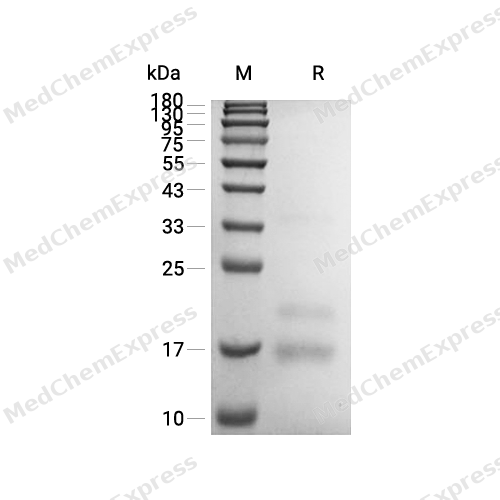
Purity - SDS-PAGE
-
Bioactivity - Cell-Based Assay
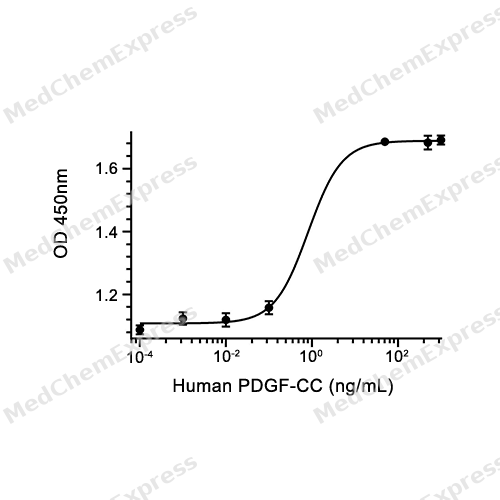
Bioactivity - Cell-Based Assay


Publications (2)
-
Journal Impact Factor
-
Most Recent
-
Cell Death Discov
NRG1/PDGFC loop between fibroblasts and cancer cells drives paclitaxel resistance via ferroptosis suppression in breast cancer. [Abstract]2025 Nov 10;11(1):520. PMID: 41213930 -
Anal Chem
Triblock PolyA-Mediated Protein Biosensor Based on a Size-Matching Proximity Hybridization Analysis. [Abstract]2024 Apr 30;96(17):6692-6699. PMID: 38632948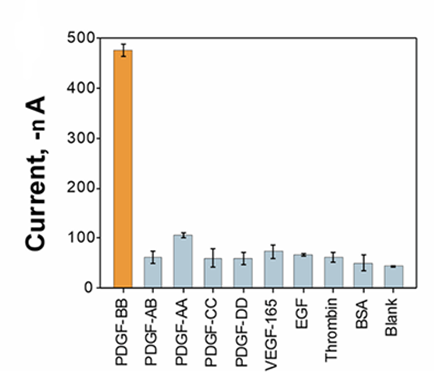
PDGF-CC Protein, Human (HEK293) purchased from MedChemExpress. Usage Cited in: Anal Chem. 2024 Apr 30;96(17):6692-6699. [Abstract]
Specificity investigation of the polyA-mediated PHA. The concentration of VEGF-165 was 5 μg/mL. Error bars represent the SDs (n = 3).


Technical Parameters
-
Species Human
-
Source HEK293
-
Tag Tag Free
-
Accession
Q9NRA1-1 (V235-G345)
-
Molecular Construction
-
N-term
-
PDGF-CC (V235-G345)
Accession # Q9NRA1-1 -
C-term
-
-
Protein Length
Partial
-
Synonyms
PDGFC; Platelet-Derived Growth Factor C; Platelet Derived Growth Factor C; PDGF-C; Fallotein; VEGF-E; SCDGF; Secretory Growth Factor-Like Protein; Spinal Cord-Derived Growth Factor
-
AA Sequence
VVDLNLLTEEVRLYSCTPRNFSVSIREELKRTDTIFWPGCLLVKRCGGNCACCLHNCNECQCVPSKVTKKYHEVLQLRPKTGVRGLHKSLTDVALEHHEECDCVCRGSTGG
-
Molecular Weight
Approximately 15-19 kDa, based on SDS-PAGE under reducing conditions, due to the glycosylation.
-
Glycosylation
Yes
-
Structure/Form
Disulfide-linked homodimer
-
Purity
≥ 95%, as determined by reducing SDS-PAGE.


Product Properties
Lyophilized powder
Lyophilized from a 0.22 μm filtered solution of PBS, pH 7.4.
<0.2 EU/μg, determined by LAL method.
It is not recommended to reconstitute to a concentration less than 100 μg/mL in ddH2O. For long term storage it is recommended to add a carrier protein (0.1% BSA, 5% HSA, 10% FBS or 5% Trehalose).
Stored at -20°C for 2 years from date of receipt. After reconstitution, it is stable at 4°C for 1 week or -20°C for longer (with carrier protein). It is recommended to freeze aliquots at -20°C or -80°C for extended storage.
Room temperature in continental US; may vary elsewhere.


Documentation
-
Data Sheet (261 KB)
-
SDS (251 KB)
- English - EN (251 KB)
- Français - FR (251 KB)
- Deutsch - DE (251 KB)
- Norwegian - NO (251 KB)
- Español - ES (251 KB)
- Swedish - SV (251 KB)
- Italian - IT (251 KB)
- Korean - KR (251 KB)
- Portuguese - PT (251 KB)
-
Handling Instructions (2659 KB)


References

Calculators
Concentration (start) × Volume (start) = Concentration (final) × Volume (final)


 Powered by Bioz

