



Pleiotrophin Protein, Human
Based on 1 Customer Validation
Pleiotrophin is a secreted growth factor that signals through cell surface proteoglycan and non-proteoglycan receptors to influence a variety of cellular processes. It binds to chondroitin sulfate (CS) groups, regulates proliferation, survival and differentiation, and inhibits long-term synaptic potentiation of neurons. Pleiotrophin Protein, Human is the recombinant human-derived Pleiotrophin protein, expressed by E. coli , with tag free. The total length of Pleiotrophin Protein, Human is 136 a.a., with molecular weight of ~15.3 kDa.
- Species: Human
- Source: E. coli
-
Storage:Stored at -20°C for 2 years from date of receipt. After reconstitution, it is stable at 4°C for 1 week or -20°C for longer (with carrier protein). It is recommended to freeze aliquots at -20°C or -80°C for extended storage.


To place orders, for customer services and technical support, please contact: MedChemExpress USA
Tel: 609-228-6898 E-mail: [email protected] [email protected]


-
 Biological Activity
-
Technical Parameters
-
Product Properties
- Documentation
- Help & FAQs




Biological Activity
Description
Pleiotrophin is a secreted growth factor that signals through cell surface proteoglycan and non-proteoglycan receptors to influence a variety of cellular processes. It binds to chondroitin sulfate (CS) groups, regulates proliferation, survival and differentiation, and inhibits long-term synaptic potentiation of neurons. Pleiotrophin Protein, Human is the recombinant human-derived Pleiotrophin protein, expressed by E. coli , with tag free. The total length of Pleiotrophin Protein, Human is 136 a.a., with molecular weight of ~15.3 kDa.
Background
Pleiotrophin Protein is a secreted growth factor that transduces its signal through both cell-surface proteoglycan and non-proteoglycan receptors. It binds to the chondroitin sulfate (CS) groups of cell-surface proteoglycan receptors, regulating processes such as cell proliferation, survival, growth, differentiation, and migration in various tissues, including neurons and bone. Pleiotrophin also plays a crucial role in synaptic plasticity and learning-related behavior by inhibiting long-term synaptic potentiation. Through binding to PTPRZ1, Pleiotrophin neutralizes the negative charges of the CS chains, inducing PTPRZ1 clustering and inactivation of its phosphatase activity, leading to increased tyrosine phosphorylation of PTPRZ1 substrates, such as ALK, CTNNB1, or AFAP1L2, activating the PI3K-AKT pathway. It forms complexes with PTPRZ1 and integrin alpha-V/beta-3, stimulating endothelial cell migration. In the adult hippocampus, Pleiotrophin promotes dendritic arborization, spine development, and functional integration of newborn granule neurons through ALK by activating the AKT signaling pathway. Additionally, it interacts with GPC2, SDC3, and other receptors, mediating diverse functions related to bone formation, neural stem cell proliferation and differentiation, hematopoietic regeneration, and various physiological processes in the female reproductive system and auditory response. The intricate network of interactions underscores the multifaceted role of Pleiotrophin in cellular and tissue-level regulatory mechanisms.
Verified Bioactivity
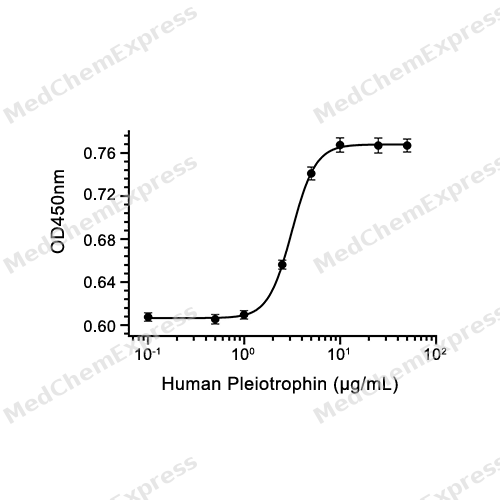
Measured by its ability to inhance proliferation of SH-SY5Y cells. The ED50 for this effect is 3.149 μg/mL, corresponding to a specific activity is 317.561 units/mg.
MCE Validation Data
-
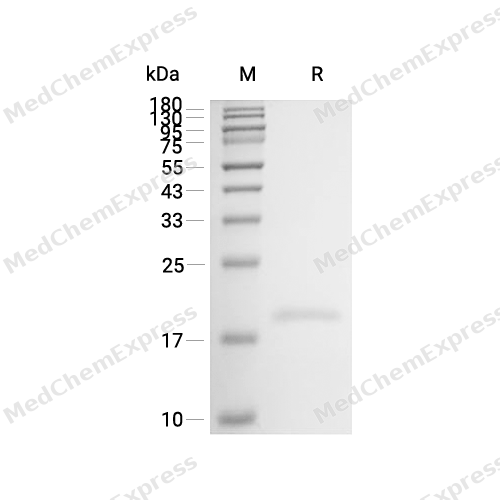
Purity - SDS-PAGE
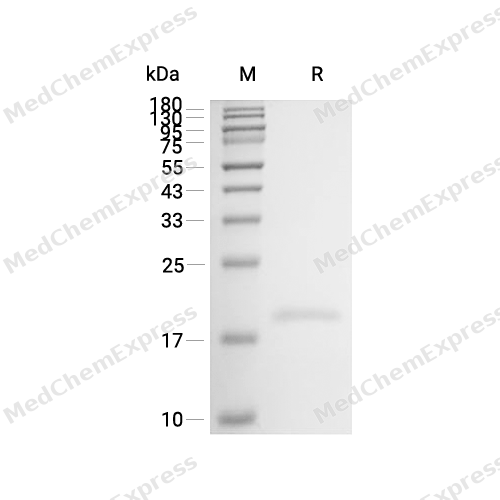
Purity - SDS-PAGE
-
Bioactivity - Cell-Based Assay
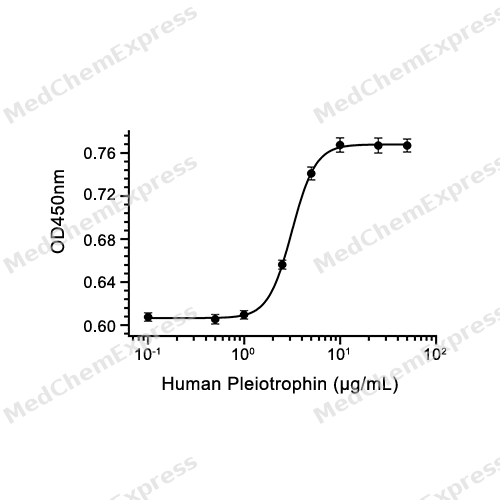
Bioactivity - Cell-Based Assay


Technical Parameters
-
Species Human
-
Source E. coli
-
Tag Tag Free
-
Accession
P21246 (G33-D168)
-
Molecular Construction
-
N-term
-
Pleiotrophin (G33-D168)
Accession # P21246 -
C-term
-
-
Protein Length
Full Length of Mature Protein
-
Synonyms
PTN; HBNF-1; Prev. NEGF1; HBBM; HBNF; Pleiotrophin (Heparin Binding Growth Factor 8, Neurite Growth-Promoting Factor 1); HBGF8; Heparin-Binding Neurite Outgrowth Promoting Factor; Heparin-Binding Neurite Outgrowth-Promoting Factor 1; Heparin-Binding Neuri
-
AA Sequence
GKKEKPEKKVKKSDCGEWQWSVCVPTSGDCGLGTREGTRTGAECKQTMKTQRCKIPCNWKKQFGAECKYQFQAWGECDLNTALKTRTGSLKRALHNAECQKTVTISKPCGKLTKPKPQAESKKKKKEGKKQEKMLD
-
Predicted Molecular Mass
15.3 kDa
-
Molecular Weight
Approximately 18 kDa, based on SDS-PAGE under reducing conditions.
-
Purity
≥ 95%, as determined by reducing SDS-PAGE.


Product Properties
Lyophilized powder.
Lyophilized from a 0.22 μm filtered solution of PBS, pH 7.4, 8% trehalose.
<1 EU/μg, determined by LAL method.
It is not recommended to reconstitute to a concentration less than 100 μg/mL in ddH2O.
Stored at -20°C for 2 years from date of receipt. After reconstitution, it is stable at 4°C for 1 week or -20°C for longer (with carrier protein). It is recommended to freeze aliquots at -20°C or -80°C for extended storage.
Room temperature in continental US; may vary elsewhere.


Documentation
-
Data Sheet (236 KB)
-
SDS (251 KB)
- English - EN (251 KB)
- Français - FR (251 KB)
- Deutsch - DE (251 KB)
- Norwegian - NO (251 KB)
- Español - ES (251 KB)
- Swedish - SV (251 KB)
- Italian - IT (251 KB)
- Korean - KR (251 KB)
- Portuguese - PT (251 KB)
-
Handling Instructions (2659 KB)

Calculators
Concentration (start) × Volume (start) = Concentration (final) × Volume (final)


 Powered by Bioz

