



PP1MG Protein, Human (His)

Based on 1 Customer Validation
PP1MG Protein, a member of PPM family of serine/threonine phosphatases, has an important role in controlling cell cycle progression. PP1MG Proteinregulates the phosphorylation of SRSF3 in hepatocellular carcinoma (HCC) and contributes to the proliferation, invasion, and metastasis of HCC. PP1MG Protein forms a distinct holoenzyme complex with the PP2A regulatory subunit B56δ. B56δ‐PPM1G dephosphorylates α‐catenin at serine 641, which is necessary for the appropriate assembly of adherens junctions and the prevention of aberrant cell migration. PP1MG Protein, Human (His) is the recombinant human-derived PP1MG protein, expressed by E. coli , with C-6*His labeled tag.
- Species: Human
- Source: E. coli
-
Storage:Stored at -80°C for 1 year from date of receipt. It is stable at -20°C for 3 months after opening. It is recommended to freeze aliquots at -80°C for extended storage. Avoid repeated freeze-thaw cycles.


To place orders, for customer services and technical support, please contact: MedChemExpress USA
Tel: 609-228-6898 E-mail: [email protected] [email protected]


-
 Biological Activity
-
Technical Parameters
-
Product Properties
- Documentation
- Help & FAQs




Biological Activity
Description
PP1MG Protein, a member of PPM family of serine/threonine phosphatases, has an important role in controlling cell cycle progression. PP1MG Proteinregulates the phosphorylation of SRSF3 in hepatocellular carcinoma (HCC) and contributes to the proliferation, invasion, and metastasis of HCC. PP1MG Protein forms a distinct holoenzyme complex with the PP2A regulatory subunit B56δ. B56δ‐PPM1G dephosphorylates α‐catenin at serine 641, which is necessary for the appropriate assembly of adherens junctions and the prevention of aberrant cell migration[1][2]. PP1MG Protein, Human (His) is the recombinant human-derived PP1MG protein, expressed by E. coli , with C-6*His labeled tag.
Background
PPM phosphatase family consists of at least 17 members. PPM phosphatases are dependent on Mg2+ or Mn2+ ions for their activity. PP1MG Protein, Human (His) forms a distinct holoenzyme complex with the PP2A regulatory subunit B56δ. B56δ promotes the re‐localization of PPM1G to the cytoplasm where the phosphatase can access a discrete set of substrates.α‐catenin, a component of adherens junction, as a new substrate for the PPM1G‐B56 phosphatase complex in the cytoplasm. B56δ‐PPM1G dephosphorylates α‐catenin at serine 641[1].
Overexpression of PPM1G promotes the dephosphorylation of SRSF3 and changes the alternative splicing patterns of genes related to the cell cycle, the transcriptional regulation in HCC cells. The knockdown of PPM1G inhibited tumor growth in vivo[2].
Verified Bioactivity
The enzyme activity of this recombinant protein is testing in progress, we cannot offer a guarantee yet.
MCE Validation Data
-
Purity - SDS-PAGE
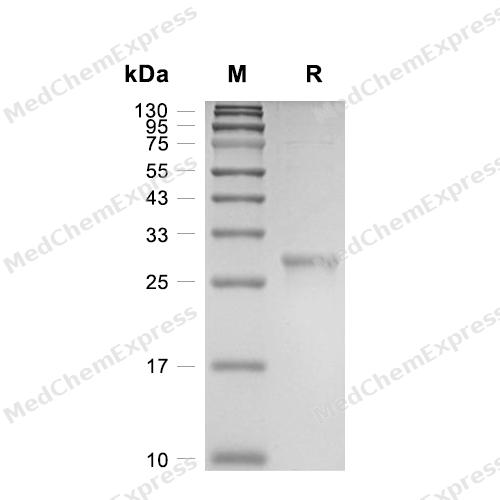
Purity - SDS-PAGE


Technical Parameters
-
Species Human
-
Source E. coli
-
Tag C-6*His
-
Accession
O15355 (M317-D546)
-
Molecular Construction
-
N-term
-
PP1MG (M317-D546)
Accession # O15355 -
6*His
-
C-term
-
-
Protein Length
Partial
-
Synonyms
PPM1G; Protein Phosphatase 1G (Formerly 2C), Magnesium-Dependent, Gamma Isoform; Protein Phosphatase, Mg2+/Mn2+ Dependent 1G; Protein Phosphatase, Mg2+/Mn2+ Dependent, 1G; Protein Phosphatase 1G; Protein Phosphatase 2C, Gamma Isoform; PP2Cgamma; Protein P
-
AA Sequence
MEGKEEPGSDSGTTAVVALIRGKQLIVANAGDSRCVVSEAGKALDMSYDHKPEDEVELARIKNAGGKVTMDGRVNGGLNLSRAIGDHFYKRNKNLPPEEQMISALPDIKVLTLTDDHEFMVIACDGIWNVMSSQEVVDFIQSKISQRDENGELRLLSSIVEELLDQCLAPDTSGDGTGCDNMTCIIICFKPRNTAELQPESGKRKLEEVLSTEGAEENGNSDKKKKAKRD
-
Predicted Molecular Mass
26.2 kDa
-
Molecular Weight
Approximately 30 kDa, based on SDS-PAGE under reducing conditions.
-
Purity
≥ 90%, as determined by reducing SDS-PAGE.


Product Properties
Solution
Supplied as a 0.22 μm filtered solution of 25 mM Tris-HCl, 1 mM DTT, 1 mM EDTA, 2 mM β-ME, 20% glycerol, pH 7.5.
Note: For SPR assay, please replace the buffer. Primary amine components (e.g., Tris, imidazole) can affect protein-coupled chips.
<1 EU/μg, determined by LAL method.
Stored at -80°C for 1 year from date of receipt. It is stable at -20°C for 3 months after opening. It is recommended to freeze aliquots at -80°C for extended storage. Avoid repeated freeze-thaw cycles.
Shipping with dry ice.


Documentation
-
Data Sheet (237 KB)
-
SDS (252 KB)
- English - EN (252 KB)
- Français - FR (252 KB)
- Deutsch - DE (252 KB)
- Norwegian - NO (252 KB)
- Español - ES (252 KB)
- Swedish - SV (252 KB)
- Italian - IT (252 KB)
- Korean - KR (252 KB)
- Portuguese - PT (252 KB)
-
Handling Instructions (2659 KB)

Calculators
Concentration (start) × Volume (start) = Concentration (final) × Volume (final)


 Powered by Bioz

