



PPAR gamma Protein, Human (His)
Based on 8 publication(s) in Google Scholar
PPAR gamma LBD Protein, Human (His) is a His-fused PPAR-gamma-LBD protein expressed by E. coli, approximately 32.6 kDa. PPAR gamma LBD Protein can be used in the ligand screening assays, western blotting, and ELISA, et al.
- Species: Human
- Source: E. coli
-
Storage:Stored at -20°C for 2 years from date of receipt. After reconstitution, it is stable at 4°C for 1 week or -20°C for longer (with carrier protein). It is recommended to freeze aliquots at -20°C or -80°C for extended storage.


To place orders, for customer services and technical support, please contact: MedChemExpress USA
Tel: 609-228-6898 E-mail: [email protected] [email protected]


-
 Biological Activity
-
Technical Parameters
-
Product Properties
- Documentation
- References
- Help & FAQs




Biological Activity
Description
PPAR gamma LBD Protein, Human (His) is a His-fused PPAR-gamma-LBD protein expressed by E. coli, approximately 32.6 kDa. PPAR gamma LBD Protein can be used in the ligand screening assays, western blotting, and ELISA, et al[1].
Background
The peroxisome proliferator-activated receptor (PPAR) belongs to the nuclear receptor superfamily and plays an important role in the regulation of the storage and catabolism of dietary fats. PPAR contains three subtypes, PPARα, PPARβand PPARγ[1]. Many naturally occurring molecules such as; polyunsaturated fatty acids like arachidonic acid and arachidonic acid metabolites such as; polyunsaturated fatty acids like arachidonic acid and arachidonic acid metabolites can bind and activate PPARgamma[2]. LBD is the ligand binding domain (LBD) of PPARgamma, His-taged LBD can be used for the study of ligand screening assays, western blotting, and ELISA, et al.
In Vitro
PPAR gamma Protein, Human (His) can be used in SPR assay or BLI assay for detection of molecules interactions[3][4].
Verified Bioactivity
1. PPAR gama immobilized on CM5 Chip can bind GW9662 (HY-16578) with an affinity constant of 18.56 μM as determined in SPR assay.
2. Measured by its binding ability in a functional ELISA. Immobilized GW9662 (HY-P16578) at 20 μg/mL (100 μ L/well) on the plate can bind Biotinylated Human PPAR gamma. The ED50 for this effect is 1.685 μg/mL.


Publications (8)
-
Journal Impact Factor
-
Most Recent
-
Cell Rep Med
Gut symbiont-derived ursodeoxycholic acid promotes fatty acid oxidation to protect against renal ischemia-reperfusion injury. [Abstract]2025 Sep 26:102373. PMID: 41015035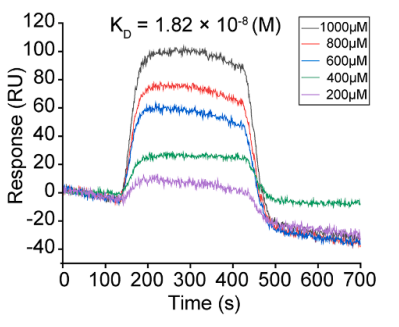
PPAR gamma Protein, Human (His) purchased from MedChemExpress. Usage Cited in: Cell Rep Med. 2025 Sep 26:102373. [Abstract]
The surface plasmon resonance (SPR) analysis of UDCA (200, 400, 600, 800, and 1,000 μM) binding to the recombinant human PPARγ protein (PPAR gamma Protein, Human (His), HY-P7999). The SPR analysis was performed using the PlexArray HT System and 3D Dextran sensor chip. The recombinant human PPARγ protein (PPAR gamma Protein, Human (His)) was immobilized on the chip surface and activated with 10 mM NiSO4. The results showed that the UDCA bound directly to the PPARγ protein with an equilibrium dissociation constant of 1.82 × 10 −8 M, exhibiting a strong binding affinity.
-
Phytomedicine
Quercetin ameliorates renal injury by promoting UCP1-mediated alleviation of lipid accumulation in diabetic kidney disease. [Abstract]2025 Nov:147:157213. PMID: 40907404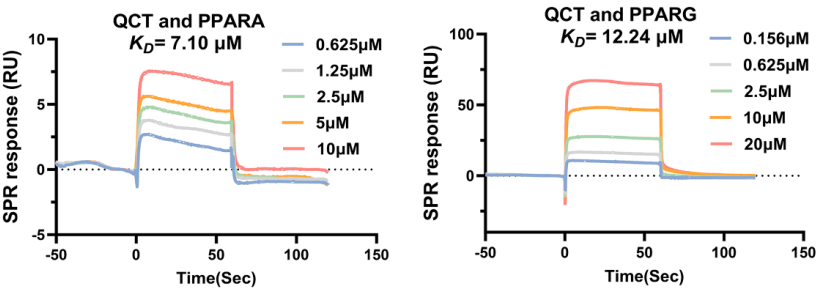
PPAR gamma Protein, Human (His) purchased from MedChemExpress. Usage Cited in: Phytomedicine. 2025 Nov:147:157213. [Abstract]
Surface plasmon resonance (SPR) results of QCT and PPARA (PPAR alpha Protein, Human (His), HY-P7996, 50 μg/mL)/PPARG(PPAR gamma Protein, Human (His), HY-P7999, 10 μg/mL) proteins. The results showed that the corresponding dissociation constant (KKD) of QCT binding to PPARA was 7.10 μM, and that of QCT binding to PPARG was 12.24 μM, confirming the binding interaction between QCT and PPARA/PPARG.
-
Phytomedicine
Astragaloside IV inhibits AOM/DSS-induced colitis-associated tumorigenesis via activation of PPARγ signaling in mice. [Abstract]2023 Dec:121:155116. PMID: 37776619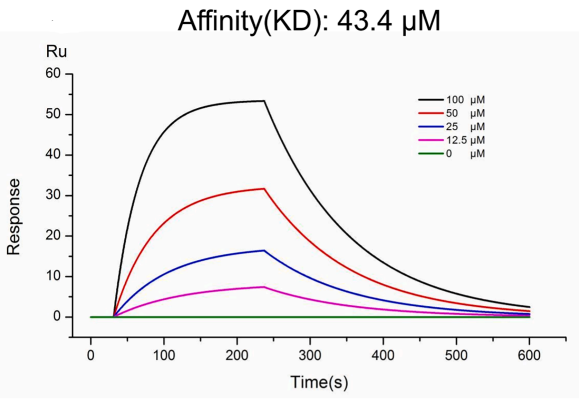
PPAR gamma Protein, Human (His) purchased from MedChemExpress. Usage Cited in: Phytomedicine. 2023 Dec:121:155116. [Abstract]
SPR assays for the interaction between astragaloside IV and PPARγ (PPAR alpha Protein, Human (His), HY-P7996).
-
Life Med
Natural flavonoid glycosides Chrysosplenosides I & A rejuvenate intestinal stem cell aging via activation of PPARγ signaling. [Abstract]2024 Jun 28;3(3):lnae025. PMID: 39871890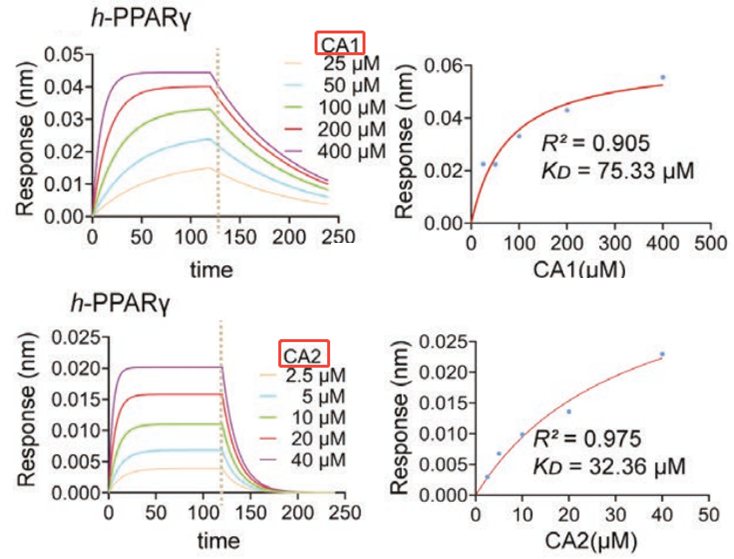
PPAR gamma Protein, Human (His) purchased from MedChemExpress. Usage Cited in: Life Med. 2024 Jun 28;3(3):lnae025. [Abstract]
Real-time kinetic binding sensorgrams and equilibrium binding signals of CA1 (25–400 µM) and CA2 (2.5–40 µM) were shown. Response (nm) indicates the optical thickness on the NTA biosensor layer. Tresults confirmed that CA1 and CA2 can interact directly and reversibly with PPARγ (PPAR gamma Protein, Human (His), HY-P7999, 50 mg/mL), with dissociation constants (KD) of 75.33 μM and 32.36 μM, respectively. This binding exhibits prominent concentration dependence, and the optical thickness (nm) of the sensing layer increases gradually with the rise in compound concentration.
-
Ecotoxicol Environ Saf
PPARγ-responsive luciferase reporter system for high-throughput screening of chemical toxins with potential pulmonary fibrosis effects. [Abstract]2025 Nov 15:307:119433. PMID: 41273832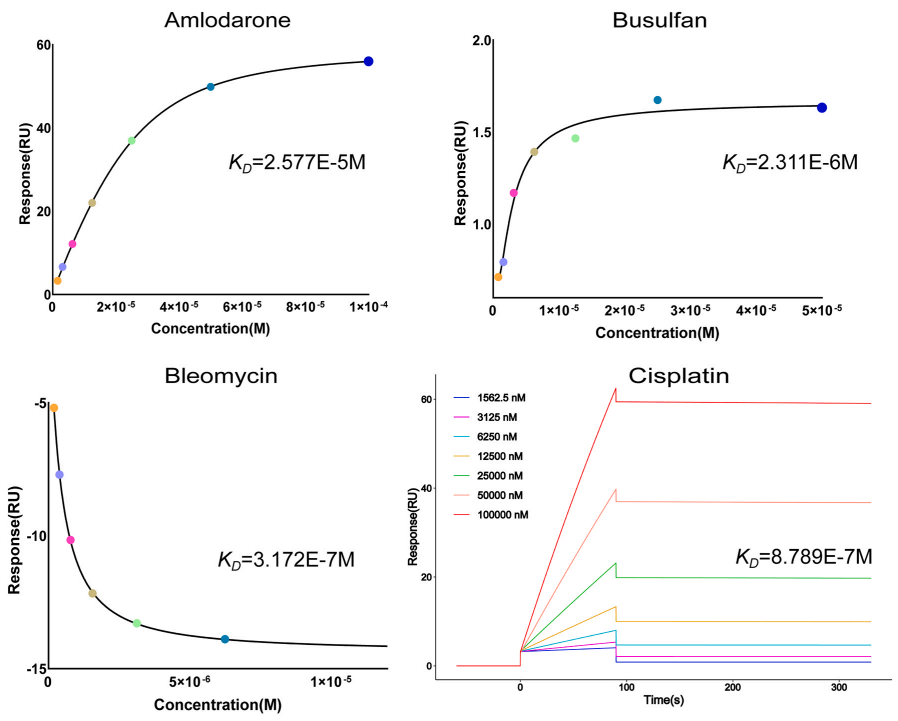
PPAR gamma Protein, Human (His) purchased from MedChemExpress. Usage Cited in: Ecotoxicol Environ Saf. 2025 Nov 15:307:119433. [Abstract]
In vitro, the interactions between recombinant PPARγ protein (PPAR gamma Protein, Human (His), HY-P7999, 100 μg/mL, immobilized on activated CM5 chip at 10 μL/min for 420 s) and four chemicals that induce pulmonary fibrosis were analyzed using surface plasmon resonance (SPR) under varying dose-time gradients. The results showed that the KD for PPARγ and amiodarone was 25.77 µM, whereas that of bleomycin was 317.2 nM, indicating concentration-dependent binding despite an observed negative response after subtraction. Busulfan exhibited a KD of 2.311 µM, and cisplatin displayed a KD of 878.9 nM, confirming their dose-dependent binding.
-
Eur J Pharmacol
Isoliquiritigenin ameliorates Pseudomonas aeruginosa-induced acute lung injury through inhibiting lung epithelial cell ferroptosis via PPARγ/Nrf2/GPX4 axis. [Abstract]2026 Jul 10:1029:179018. PMID: 42178009 -
FEBS J
GDH1 exacerbates renal fibrosis by inhibiting the transcriptional activity of peroxisome proliferator-activated receptor gamma. [Abstract]2024 Oct;291(20):4581-4601. PMID: 39136063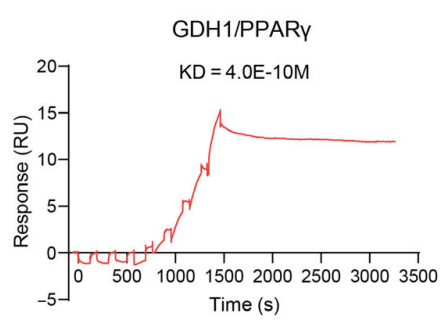
PPAR gamma Protein, Human (His) purchased from MedChemExpress. Usage Cited in: FEBS J. 2024 Oct;291(20):4581-4601. [Abstract]
The binding of GDH1 to PPARγ (PPAR gamma Protein, Human (His), HY-P7999) was measured using BIAcore system. The KD value of GDH1 with PPARγ was 4.0×10⁻¹⁰ M, which suggested a strong binding of GDH1 to PPARγ.
-
Biochem Biophys Res Commun
18:0 Lyso PC, a natural product with potential PPAR-γ agonistic activity, plays hypoglycemic effect with lower liver toxicity and cardiotoxicity in db/db mice. [Abstract]2021 Nov 19:579:168-174. PMID: 34607170


Technical Parameters
-
Species Human
-
Source E. coli
-
Tag N-6*His
-
Accession
P37231-1 (D238-D503)
-
Molecular Construction
-
N-term
-
6*His
-
PPAR gamma (D238-D503)
Accession # P37231-1 -
C-term
-
-
Protein Length
Full Length of NR LBD domain
-
Synonyms
PPARG; PPARG5; Peroxisome Proliferator Activated Receptor Gamma; Peroxisome Proliferator-Activated Receptor-Gamma Splicing; NR1C3; Peroxisome Proliferative Activated Receptor, Gamma; Peroxisome Proliferator-Activated Receptor Gamma; Peroxisome Proliferato
-
AA Sequence
DLRALAKHLYDSYIKSFPLTKAKARAILTGKTTDKSPFVIYDMNSLMMGEDKIKFKHITPLQEQSKEVAIRIFQGCQFRSVEAVQEITEYAKSIPGFVNLDLNDQVTLLKYGVHEIIYTMLASLMNKDGVLISEGQGFMTREFLKSLRKPFGDFMEPKFEFAVKFNALELDDSDLAIFIAVIILSGDRPGLLNVKPIEDIQDNLLQALELQLKLNHPESSQLFAKLLQKMTDLRQIVTEHVQLLQVIKKTETDMSLHPLLQEIYKD
-
Molecular Weight
Approximately 30-33 kDa, based on SDS-PAGE under reducing conditions.
-
Purity
≥ 90%, as determined by reducing SDS-PAGE.


Product Properties
Lyophilized powder
Lyophilized from a 0.2 μm filtered solution of PBS, pH 8.0 or PBS, pH 7.4, 8% trehalose.
<1 EU/μg, determined by LAL method.
It is not recommended to reconstitute to a concentration less than 100 μg/mL in ddH2O. For long term storage it is recommended to add a carrier protein (0.1% BSA, 5% HSA, 10% FBS or 5% Trehalose).
Stored at -20°C for 2 years from date of receipt. After reconstitution, it is stable at 4°C for 1 week or -20°C for longer (with carrier protein). It is recommended to freeze aliquots at -20°C or -80°C for extended storage.
Room temperature in continental US; may vary elsewhere.


Documentation
-
Data Sheet (264 KB)
-
SDS (252 KB)
- English - EN (252 KB)
- Français - FR (252 KB)
- Deutsch - DE (252 KB)
- Norwegian - NO (252 KB)
- Español - ES (252 KB)
- Swedish - SV (252 KB)
- Italian - IT (252 KB)
- Korean - KR (252 KB)
- Portuguese - PT (252 KB)
-
Handling Instructions (2659 KB)


References
[1]. Changying Yu, et al.Binding analyses between Human PPARgamma-LBD and ligands. Eur J Biochem. 2004 Jan;271(2):386-97 [Content Brief]
[2]. Jun Young Jang, et al. Structural Basis for the Enhanced Anti-Diabetic Efficacy of Lobeglitazone on PPARγ. Sci Rep. 2018 Jan 8;8(1):31. [Content Brief]
[3]. Ye J, et al., Natural flavonoid glycosides Chrysosplenosides I & A rejuvenate intestinal stem cell aging via activation of PPARγ signaling. Life Med. 2024 Jun 28;3(3):lnae025. [Content Brief]
[4]. Ma Y, et al., 18:0 Lyso PC, a natural product with potential PPAR-γ agonistic activity, plays hypoglycemic effect with lower liver toxicity and cardiotoxicity in db/db mice. Biochem Biophys Res Commun. 2021 Nov 19;579:168-174. [Content Brief]

Calculators
Concentration (start) × Volume (start) = Concentration (final) × Volume (final)


 Powered by Bioz

