



PPAR alpha Protein, Human (His)
Based on 2 publication(s) in Google Scholar
PPAR alpha Protein, human (His), a member of the nuclear receptor family, is a transcription factor that regulates the expression of genes related to lipid metabolism in a ligand-dependent manner.
- Species: Human
- Source: E. coli
-
Storage:Stored at 4°C for 6 months from date of receipt. Recommend aliquoting the protein into smaller quantities for optimal storage. Avoid repeated freeze-thaw cycles.


To place orders, for customer services and technical support, please contact: MedChemExpress USA
Tel: 609-228-6898 E-mail: [email protected] [email protected]


-
 Biological Activity
-
Technical Parameters
-
Product Properties
- Documentation
- References
- Help & FAQs


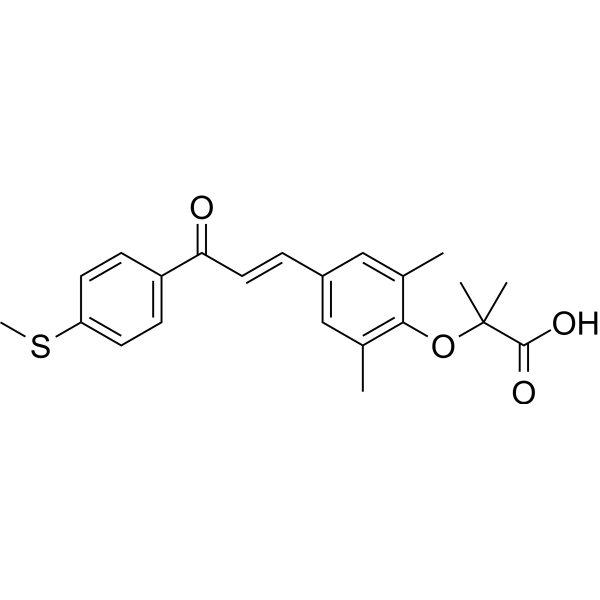


Biological Activity
Description
PPAR alpha Protein, human (His), a member of the nuclear receptor family, is a transcription factor that regulates the expression of genes related to lipid metabolism in a ligand-dependent manner.
Background
Peroxisome proliferator-activated receptors (PPARs) are ligand-dependent transcription factors that belong to the nuclear receptor superfamily comprising 48 members in human. PPARs include three subtypes, PPARα, PPARγ, and PPARδ. PPARα is involved in lipid homeostasis by regulating the transcription of sets of genes related to lipid metabolism and thereby reducing blood triglyceride levels. PPARα has attracted attention as a target for hypolipidemic drugs[1].
MCE Validation Data
-
Purity - SDS-PAGE
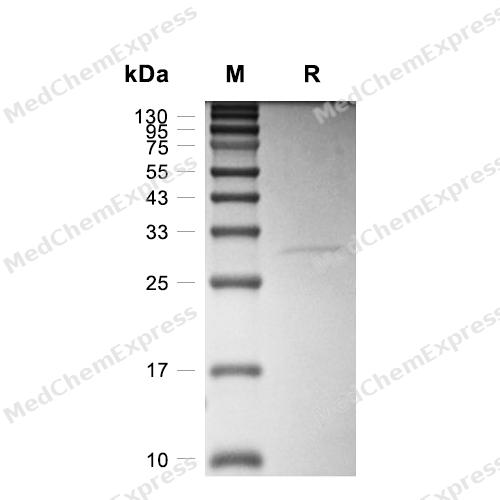
Purity - SDS-PAGE


Publications (2)
-
Journal Impact Factor
-
Most Recent
-
Phytomedicine
Quercetin ameliorates renal injury by promoting UCP1-mediated alleviation of lipid accumulation in diabetic kidney disease. [Abstract]2025 Nov:147:157213. PMID: 40907404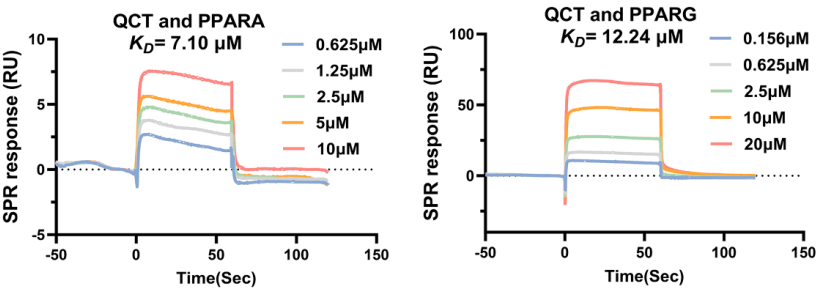
PPAR alpha Protein, Human (His) purchased from MedChemExpress. Usage Cited in: Phytomedicine. 2025 Nov:147:157213. [Abstract]
Surface plasmon resonance (SPR) results of QCT and PPARA (PPAR alpha Protein, Human (His), HY-P7996, 50 μg/mL)/PPARG(PPAR gamma Protein, Human (His), HY-P7999, 10 μg/mL) proteins. The results showed that the corresponding dissociation constant (KKD) of QCT binding to PPARA was 7.10 μM, and that of QCT binding to PPARG was 12.24 μM, confirming the binding interaction between QCT and PPARA/PPARG.
-
Phytomedicine
An integrated network pharmacology and cell metabolomics approach to reveal the role of rhein, a novel PPARα agonist, against renal fibrosis by activating the PPARα-CPT1A axis. [Abstract]2022 May 6;102:154147. PMID: 35567992


Technical Parameters
-
Species Human
-
Source E. coli
-
Tag N-6*His
-
Accession
Q07869-1 (D202-Y468)
-
Molecular Construction
-
N-term
-
6*His
-
PPAR alpha (D202-Y468)
Accession # Q07869-1 -
C-term
-
-
Protein Length
Partial
-
Synonyms
PPARA; HPPAR; Prev. PPAR; PPAR-Alpha; Peroxisome Proliferator-Activated Receptor Alpha; Alternative Protein PPARA; NR1C1; PPARalpha; Nuclear Receptor Subfamily 1 Group C Member 1; Peroxisome Proliferator Activated Receptor Alpha; Peroxisome Proliferative Activated Receptor, Alpha
-
AA Sequence
DLKSLAKRIYEAYLKNFNMNKVKARVILSGKASNNPPFVIHDMETLCMAEKTLVAKLVANGIQNKEAEVRIFHCCQCTSVETVTELTEFAKAIPGFANLDLNDQVTLLKYGVYEAIFAMLSSVMNKDGMLVAYGNGFITREFLKSLRKPFCDIMEPKFDFAMKFNALELDDSDISLFVAAIICCGDRPGLLNVGHIEKMQEGIVHVLRLHLQSNHPDDIFLFPKLLQKMADLRQLVTEHAQLVQIIKKTESDAALHPLLQEIYRDMY
-
Molecular Weight
Approximately 33 kDa, based on SDS-PAGE under reducing conditions.
-
Purity
≥ 90%, as determined by reducing SDS-PAGE.


Product Properties
Solution
Supplied as a 0.22 μm filtered solution of PBS, 2 M Urea.
<1 EU/μg, determined by LAL method.
Stored at 4°C for 6 months from date of receipt. Recommend aliquoting the protein into smaller quantities for optimal storage. Avoid repeated freeze-thaw cycles.
Shipping with blue ice.


Documentation
-
Data Sheet (262 KB)
-
SDS (252 KB)
- English - EN (252 KB)
- Français - FR (252 KB)
- Deutsch - DE (252 KB)
- Norwegian - NO (252 KB)
- Español - ES (252 KB)
- Swedish - SV (252 KB)
- Italian - IT (252 KB)
- Korean - KR (252 KB)
- Portuguese - PT (252 KB)
-
Handling Instructions (2659 KB)


References

Calculators
Concentration (start) × Volume (start) = Concentration (final) × Volume (final)


 Powered by Bioz

