



Prostatic acid phosphatase/ACPP Protein, Human (HEK293, His, solution)

Based on 1 Customer Validation
PPAP protein, a nonspecific tyrosine phosphatase, has anticancer and antiproliferative activities. The PPAP protein dephosphorylates a variety of substrates under acidic conditions (pH 4-6), resulting in the inactivation of lysophosphatidic acid in seminal plasma. The PPAP protein is also a common biomarker for prostate cancer and can inhibit tumor development. Prostatic acid phosphatase/ACPP Protein, Human (HEK293, His, solution) is the recombinant human-derived Prostatic acid phosphatase/ACPP protein, expressed by HEK293 , with C-6*His labeled tag.
- Species: Human
- Source: HEK293
-
Storage:Stored at -80°C for 1 year from date of receipt. It is stable at -20°C for 3 months after opening. It is recommended to freeze aliquots at -80°C for extended storage. Avoid repeated freeze-thaw cycles.


To place orders, for customer services and technical support, please contact: MedChemExpress USA
Tel: 609-228-6898 E-mail: [email protected] [email protected]


-
 Biological Activity
-
Technical Parameters
-
Product Properties
- Documentation
- Help & FAQs




Biological Activity
Description
PPAP protein, a nonspecific tyrosine phosphatase, has anticancer and antiproliferative activities. The PPAP protein dephosphorylates a variety of substrates under acidic conditions (pH 4-6), resulting in the inactivation of lysophosphatidic acid in seminal plasma. The PPAP protein is also a common biomarker for prostate cancer and can inhibit tumor development. Prostatic acid phosphatase/ACPP Protein, Human (HEK293, His, solution) is the recombinant human-derived Prostatic acid phosphatase/ACPP protein, expressed by HEK293 , with C-6*His labeled tag.
Background
PPAP protein (cPAcP), a nonspecific tyrosine phosphatase and prostate epithelial differentiation antigen, is involved in regulating prostate epithelial growth. PPAP dephosphorylates a variety of substrates under acidic conditions (pH 4-6) and leads to the inactivation of lysophosphatidic acid in seminal plasma. It interacts with and dephosphorylates ErbB-2 primarily at Tyr(1221/2), thereby blocking downstream signaling and resulting in reduced cell growth. It also functions as a negative growth regulator of prostate cancer (PCa) cells in part through dephosphorylation of ErbB-2. The PPAP protein is often used as a biomarker for prostate cancer. Inhibition of prostate cancer development through ERBB2 dephosphorylation and inactivation of MAPK-mediated signaling. Therefore, the occurrence of androgen-independent cell proliferation and tumorigenicity is closely related to the reduction of intracellular PPAP protein expression. Intratumoral injection of a PAcP cDNA expression vector inhibits xenograft tumor progression and reduces ErbB-2 tyrosyl phosphate. In prostate cancer and PCa cells with reduced cPAcP, reduced cPAcP leads to activation of ErbB-2 and ERK1/2 signaling.
Verified Bioactivity
Measured by its ability to cleave a substrate, p-Nitrophenyl phosphate (pNPP). Which can be measured by absorbance at 410 nm. The specific activity is 172921.3327 pmol/min/µg.
MCE Validation Data
-
Purity - SDS-PAGE
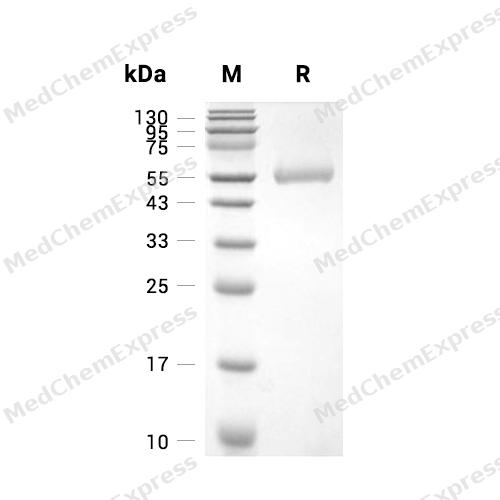
Purity - SDS-PAGE


Technical Parameters
-
Species Human
-
Source HEK293
-
Tag C-6*His
-
Accession
AAH16344.1 (K33-D386)
-
Molecular Construction
-
N-term
-
ACPP (K33-D386)
Accession # AAH16344.1 -
6*His
-
C-term
-
-
Protein Length
Full Length of Isoform-1
-
Synonyms
ACP3; Acid Phosphatase, Prostate; Prev. ACPP; Ecto-5'-Nucleotidase; Prostatic Acid Phosphatase; TMPase; TM-PAP; 5'-NT; ACP-3; Prostatic Acid Phosphotase; PAP; Acid Phosphatase; Protein Tyrosine Phosphatase ACP3; 5'-Nucleotidase; Acid Phosphatase 3; Thiami
-
AA Sequence
KELKFVTLVFRHGDRSPIDTFPTDPIKESSWPQGFGQLTQLGMEQHYELGEYIRKRYRKFLNESYKHEQVYIRSTDVDRTLMSAMTNLAALFPPEGVSIWNPILLWQPIPVHTVPLSEDQLLYLPFRNCPRFQELESETLKSEEFQKRLHPYKDFIATLGKLSGLHGQDLFGIWSKVYDPLYCESVHNFTLPSWATEDTMTKLRELSELSLLSLYGIHKQKEKSRLQGGVLVNEILNHMKRATQIPSYKKLIMYSAHDTTVSGLQMALDVYNGLLPPYASCHLTELYFEKGEYFVEMHYRNETQHEPYPLMLPGCSPSCPLERFAELVGPVIPQDWSTECMTTNSHQGTEDSTD
-
Predicted Molecular Mass
42 kDa
-
Molecular Weight
Approximately 50 kDa, based on SDS-PAGE under reducing conditions.
-
Glycosylation
Yes
-
Purity
≥ 95%, as determined by reducing SDS-PAGE.


Product Properties
Solution
Supplied as a 0.22 μm filtered solution of 20 mM PBS, pH 7.4.
<1 EU/μg, determined by LAL method.
Stored at -80°C for 1 year from date of receipt. It is stable at -20°C for 3 months after opening. It is recommended to freeze aliquots at -80°C for extended storage. Avoid repeated freeze-thaw cycles.
Shipping with dry ice.


Documentation
-
Data Sheet (238 KB)
-
SDS (252 KB)
- English - EN (252 KB)
- Français - FR (252 KB)
- Deutsch - DE (252 KB)
- Norwegian - NO (252 KB)
- Español - ES (252 KB)
- Swedish - SV (252 KB)
- Italian - IT (252 KB)
- Korean - KR (252 KB)
- Portuguese - PT (252 KB)
-
Handling Instructions (2659 KB)

Calculators
Concentration (start) × Volume (start) = Concentration (final) × Volume (final)


 Powered by Bioz

