



SARS-CoV-2 Nucleocapsid Protein (His)
Based on 1 publication(s) in Google Scholar
The SARS-CoV-2 nucleocapsid protein plays a crucial role in assembling the virion, forming the helical ribonucleocapsid (RNP), and interacting with the viral genome and membrane protein M. In addition to its structural function, it also enhances subgenomic viral RNA transcription and overall replication. SARS-CoV-2 Nucleocapsid Protein (His) is the recombinant SARS-CoV-2 Nucleocapsid protein, expressed by E. coli , with N-6*His labeled tag.
- Species: Virus
- Source: E. coli
-
Storage:Stored at -20°C for 2 years from date of receipt. After reconstitution, it is stable at 4°C for 1 week or -20°C for longer (with carrier protein). It is recommended to freeze aliquots at -20°C or -80°C for extended storage.


To place orders, for customer services and technical support, please contact: MedChemExpress USA
Tel: 609-228-6898 E-mail: [email protected] [email protected]


-
 Biological Activity
-
Technical Parameters
-
Product Properties
- Documentation
- Help & FAQs




Biological Activity
Description
The SARS-CoV-2 nucleocapsid protein plays a crucial role in assembling the virion, forming the helical ribonucleocapsid (RNP), and interacting with the viral genome and membrane protein M. In addition to its structural function, it also enhances subgenomic viral RNA transcription and overall replication. SARS-CoV-2 Nucleocapsid Protein (His) is the recombinant SARS-CoV-2 Nucleocapsid protein, expressed by E. coli , with N-6*His labeled tag.
Background
The SARS-CoV-2 Nucleocapsid Protein assumes a pivotal role in virion assembly, orchestrating the packaging of the positive-strand viral genome RNA into a helical ribonucleocapsid (RNP) and establishing crucial interactions with the viral genome and membrane protein M. Beyond its structural functions, this protein significantly contributes to the efficiency of subgenomic viral RNA transcription and overall viral replication. Notably, it exhibits an additional role in modulating host chemokine function, a mechanism that may favor viral replication and transmission. The Nucleocapsid Protein achieves this modulation by being secreted into the extracellular space, where it competes with host chemokines for binding to host glycosaminoglycans (GAG), thus potentially disrupting host defense mechanisms and supporting the viral life cycle.
Verified Bioactivity
1.Measured by its binding ability in a functional ELISA. Immobilized SARS-CoV-2-N at 2 μg/mL can bind SARS-CoV-2-N Antibody and the EC50 is 0.9081 -8.795 ng/mL.
2.Immobilized SARS-CoV-2 Nucleocapsid protein, His Tag at 1 μg/mL (100 μL/well) can bind Anti-SARS-CoV- 2 Nucleocapsid Antibody. The ED50 for this effect is 5.118 ng/mL.
MCE Validation Data
-
Purity - SDS-PAGE
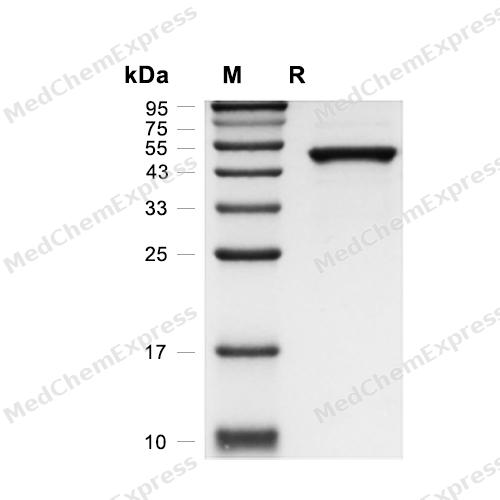
Purity - SDS-PAGE
-
Bioactivity - ELISA
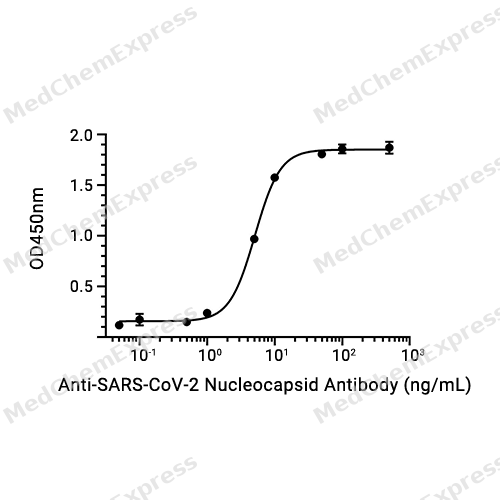
Bioactivity - ELISA


Publications (1)
-
Journal Impact Factor
-
Most Recent
-
Eur J Med Chem
Utilizing artificial intelligence for precision exploration of N protein targeting phenanthridine sars-cov-2 inhibitors: A novel approach. [Abstract]2024 Dec 5:279:116885. PMID: 39307103


Technical Parameters
-
Species Virus
-
Source E. coli
-
Tag N-6*His
-
Accession
YP_009724397.1 (M1-A419)
-
Gene ID43740575 [NCBI]
-
Molecular Construction
-
N-term
-
6*His
-
Nucleocapsid (M1-A419)
Accession # YP_009724397.1 -
C-term
-
-
Protein Length
Full Length
-
Synonyms
Nucleocapsid protein
-
AA Sequence
MSDNGPQNQRNAPRITFGGPSDSTGSNQNGERSGARSKQRRPQGLPNNTASWFTALTQHGKEDLKFPRGQGVPINTNSSPDDQIGYYRRATRRIRGGDGKMKDLSPRWYFYYLGTGPEAGLPYGANKDGIIWVATEGALNTPKDHIGTRNPANNAAIVLQLPQGTTLPKGFYAEGSRGGSQASSRSSSRSRNSSRNSTPGSSRGTSPARMAGNGGDAALALLLLDRLNQLESKMSGKGQQQQGQTVTKKSAAEASKKPRQKRTATKAYNVTQAFGRRGPEQTQGNFGDQELIRQGTDYKHWPQIAQFAPSASAFFGMSRIGMEVTPSGTWLTYTGAIKLDDKDPNFKDQVILLNKHIDAYKTFPPTEPKKDKKKKADETQALPQRQKKQQTVTLLPAADLDDFSKQLQQSMSSADSTQA
-
Molecular Weight
Approximately 48-50 kDa, based on SDS-PAGE under reducing conditions.
-
Purity
≥ 90%, as determined by reducing SDS-PAGE.


Product Properties
Lyophilized powder
1.Lyophilized from a 0.22 μm filtered solution of 20 mM Tris-HCl, 0.5 M NaCl, 6% trehalose, pH 8.0.
2.Lyophilized from a 0.22 μm filtered solution of 50 mM Tris-HCl, 300 mM NaCl, pH 8.0.
Please refer to the lot-specific COA for specific buffer information.
Note: For SPR assay, please replace the buffer. Primary amine components (e.g., Tris, imidazole) can affect protein-coupled chips.
<1 EU/μg, determined by LAL method.
It is not recommended to reconstitute to a concentration less than 100 μg/mL in ddH2O.
Stored at -20°C for 2 years from date of receipt. After reconstitution, it is stable at 4°C for 1 week or -20°C for longer (with carrier protein). It is recommended to freeze aliquots at -20°C or -80°C for extended storage.
Room temperature in continental US; may vary elsewhere.


Documentation
-
Data Sheet (238 KB)
-
SDS (252 KB)
- English - EN (252 KB)
- Français - FR (252 KB)
- Deutsch - DE (252 KB)
- Norwegian - NO (252 KB)
- Español - ES (252 KB)
- Swedish - SV (252 KB)
- Italian - IT (252 KB)
- Korean - KR (252 KB)
- Portuguese - PT (252 KB)
-
Handling Instructions (2659 KB)

Calculators
Concentration (start) × Volume (start) = Concentration (final) × Volume (final)


 Powered by Bioz

