



SPG3A/ATL1 Protein, Human (sf9, His)

Based on 1 Customer Validation
The SPG3A/ATL1 protein is a GTPase that promotes membrane tethering by forming trans homomers, thereby achieving homotypic fusion of the endoplasmic reticulum (ER) membrane. It makes a crucial contribution to the biogenesis of the endoplasmic reticulum tubular network and shaping the structural organization of cells. SPG3A/ATL1 Protein, Human (sf9, His) is the recombinant human-derived SPG3A/ATL1 protein, expressed by Sf9 insect cells , with N-His labeled tag.
- Species: Human
- Source: Sf9 insect cells
-
Storage:Stored at -80°C for 1 year from date of receipt. It is stable at -20°C for 3 months after opening. It is recommended to freeze aliquots at -80°C for extended storage. Avoid repeated freeze-thaw cycles.


To place orders, for customer services and technical support, please contact: MedChemExpress USA
Tel: 609-228-6898 E-mail: [email protected] [email protected]


-
 Biological Activity
-
Technical Parameters
-
Product Properties
- Documentation
- Help & FAQs




Biological Activity
Description
The SPG3A/ATL1 protein is a GTPase that promotes membrane tethering by forming trans homomers, thereby achieving homotypic fusion of the endoplasmic reticulum (ER) membrane. It makes a crucial contribution to the biogenesis of the endoplasmic reticulum tubular network and shaping the structural organization of cells. SPG3A/ATL1 Protein, Human (sf9, His) is the recombinant human-derived SPG3A/ATL1 protein, expressed by Sf9 insect cells , with N-His labeled tag.
Background
SPG3A/ATL1 Protein functions as a GTPase that plays a pivotal role in membrane tethering through the formation of trans-homooligomers, facilitating homotypic fusion of endoplasmic reticulum (ER) membranes. Its involvement extends to endoplasmic reticulum tubular network biogenesis, contributing to the intricate organization of this cellular structure. Beyond its primary function, SPG3A/ATL1 may also participate in the regulation of Golgi biogenesis and axonal development. In its monomeric state as an apoprotein and in the GDP-bound form, SPG3A/ATL1 transforms into a homodimer when bound to GTP, demonstrating a dynamic interplay between its different states. The protein engages in various interactions with key cellular components, including MAP4K4, REEP5, RTN3, RTN4, SPAST, TMED2, REEP1, CPT1C, and ARL6IP1, highlighting its involvement in a complex network of molecular associations. Additionally, SPG3A/ATL1 interacts with ZFYVE27, further expanding its regulatory repertoire.
MCE Validation Data
-
Purity - SDS-PAGE
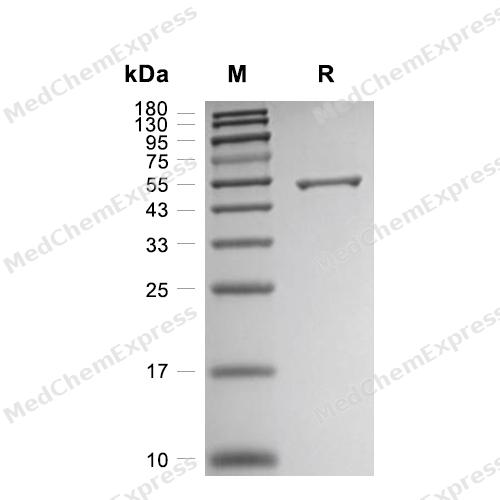
Purity - SDS-PAGE


Technical Parameters
-
Species Human
-
Source Sf9 insect cells
-
Tag N-10*His
-
Accession
Q8WXF7-1 (M1-T447)
-
Molecular Construction
-
N-term
-
GST
-
ATL1 (M1-T447)
Accession # Q8WXF7-1 -
C-term
-
-
Protein Length
Cytoplasmic Domain
-
Synonyms
ATL1; ATL1-Beta Zinc Finger Protein; Prev. SPG3A; Atlastin GTPase 1 Isoform 3; Prev. SPG3; ATL1 Zinc Finger Protein; Atlastin-1; GTP-Binding Protein 3; AD-FSP; Atlastin1; FSP1; ATL1-Beta; Spastic Paraplegia 3 Protein A; Atlastin; ATL-1; HSN1D; Spastic Par
-
AA Sequence
MAKNRRDRNSWGGFSEKTYEWSSEEEEPVKKAGPVQVLIVKDDHSFELDETALNRILLSEAVRDKEVVAVSVAGAFRKGKSFLMDFMLRYMYNQESVDWVGDYNEPLTGFSWRGGSERETTGIQIWSEIFLINKPDGKKVAVLLMDTQGTFDSQSTLRDSATVFALSTMISSIQVYNLSQNVQEDDLQHLQLFTEYGRLAMEETFLKPFQSLIFLVRDWSFPYEFSYGADGGAKFLEKRLKVSGNQHEELQNVRKHIHSCFTNISCFLLPHPGLKVATNPNFDGKLKEIDDEFIKNLKILIPWLLSPESLDIKEINGNKITCRGLVEYFKAYIKIYQGEELPHPKSMLQATAEANNLAAVATAKDTYNKKMEEICGGDKPFLAPNDLQTKHLQLKEESVKLFRGVKKMGGEEFSRRYLQQLESEIDELYIQYIKHNDSKNIFHAART
-
Molecular Weight
Approximately 66 kDa, based on SDS-PAGE under reducing conditions.
-
Purity
≥ 95%, as determined by reducing SDS-PAGE.


Product Properties
Solution
Supplied as a 0.22 μm filtered solution of 50 mM Tris-HCl, 500 mM NaCl, pH 8.0, 10% glycerol.
Note: For SPR assay, please replace the buffer. Primary amine components (e.g., Tris, imidazole) can affect protein-coupled chips.
<1 EU/μg, determined by LAL method.
Stored at -80°C for 1 year from date of receipt. It is stable at -20°C for 3 months after opening. It is recommended to freeze aliquots at -80°C for extended storage. Avoid repeated freeze-thaw cycles.
Shipping with dry ice.


Documentation
-
Data Sheet (238 KB)
-
SDS (252 KB)
- English - EN (252 KB)
- Français - FR (252 KB)
- Deutsch - DE (252 KB)
- Norwegian - NO (252 KB)
- Español - ES (252 KB)
- Swedish - SV (252 KB)
- Italian - IT (252 KB)
- Korean - KR (252 KB)
- Portuguese - PT (252 KB)
-
Handling Instructions (2659 KB)

Calculators
Concentration (start) × Volume (start) = Concentration (final) × Volume (final)


 Powered by Bioz

