



SSB Protein, Human

Based on 1 Customer Validation
The SSB protein critically binds to the 3' poly(U) terminus of RNA polymerase III transcripts, preventing exonuclease digestion and aiding in correct folding. In coxsackievirus B3 infection, SSB binds to the viral internal ribosome entry site (IRES) and enhances IRES-mediated translation. SSB Protein, Human is the recombinant human-derived SSB protein, expressed by E. coli , with tag free.
- Species: Human
- Source: E. coli
-
Storage:Stored at -20°C for 2 years from date of receipt. After reconstitution, it is stable at 4°C for 1 week or -20°C for longer (with carrier protein). It is recommended to freeze aliquots at -20°C or -80°C for extended storage.


To place orders, for customer services and technical support, please contact: MedChemExpress USA
Tel: 609-228-6898 E-mail: [email protected] [email protected]


-
 Biological Activity
-
Technical Parameters
-
Product Properties
- Documentation
- Help & FAQs




Biological Activity
Description
The SSB protein critically binds to the 3' poly(U) terminus of RNA polymerase III transcripts, preventing exonuclease digestion and aiding in correct folding. In coxsackievirus B3 infection, SSB binds to the viral internal ribosome entry site (IRES) and enhances IRES-mediated translation. SSB Protein, Human is the recombinant human-derived SSB protein, expressed by E. coli , with tag free.
Background
The SSB protein plays a crucial role by binding to the 3' poly(U) terminus of nascent RNA polymerase III transcripts, providing protection against exonuclease digestion and facilitating their proper folding and maturation, as evidenced by various studies. Additionally, in the context of Coxsackievirus B3 infection, SSB binds to the viral internal ribosome entry site (IRES), thereby stimulating IRES-mediated translation. The protein further engages in interactions with DDX15 and may potentially interact with RUFY1, indicating its involvement in diverse cellular processes and highlighting its multifunctional nature.
MCE Validation Data
-
Purity - SDS-PAGE
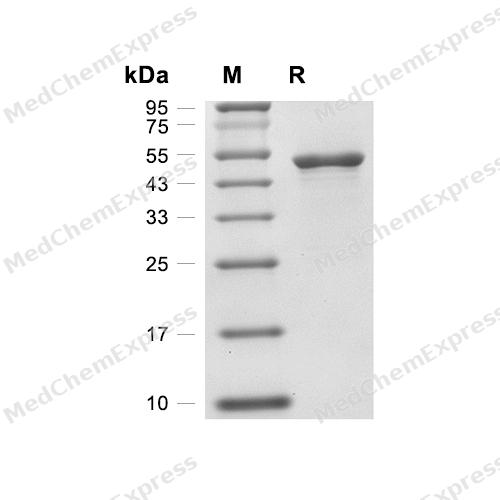
Purity - SDS-PAGE


Technical Parameters
-
Species Human
-
Source E. coli
-
Tag Tag Free
-
Accession
P05455 (M1-Q408)
-
Molecular Construction
-
N-term
-
SSB (M1-Q408)
Accession # P05455 -
C-term
-
-
Protein Length
Full Length
-
Synonyms
SSB; Sjoegren Syndrome Type B Antigen; Small RNA Binding Exonuclease Protection Factor La; Sjogren Syndrome Antigen B; Lupus La Protein; La Ribonucleoprotein; La Autoantigen; SS-B; La/SSB; Sjogren Syndrome Antigen B (Autoantigen La); LARP3; Lupus La Antig
-
AA Sequence
MAENGDNEKMAALEAKICHQIEYYFGDFNLPRDKFLKEQIKLDEGWVPLEIMIKFNRLNRLTTDFNVIVEALSKSKAELMEISEDKTKIRRSPSKPLPEVTDEYKNDVKNRSVYIKGFPTDATLDDIKEWLEDKGQVLNIQMRRTLHKAFKGSIFVVFDSIESAKKFVETPGQKYKETDLLILFKDDYFAKKNEERKQNKVEAKLRAKQEQEAKQKLEEDAEMKSLEEKIGCLLKFSGDLDDQTCREDLHILFSNHGEIKWIDFVRGAKEGIILFKEKAKEALGKAKDANNGNLQLRNKEVTWEVLEGEVEKEALKKIIEDQQESLNKWKSKGRRFKGKGKGNKAAQPGSGKGKVQFQGKKTKFASDDEHDEHDENGATGPVKRAREETDKEEPASKQQKTENGAGDQ
-
Predicted Molecular Mass
47.8 kDa
-
Molecular Weight
Approximately 50 kDa, based on SDS-PAGE under reducing conditions.
-
Purity
≥ 95%, as determined by reducing SDS-PAGE.


Product Properties
Lyophilized powder.
Lyophilized from a 0.22 μm filtered solution of PBS, 300 mM NaCl, pH 7.4.
<1 EU/μg, determined by LAL method.
It is not recommended to reconstitute to a concentration less than 100 μg/mL in ddH2O. For long term storage it is recommended to add a carrier protein (0.1% BSA, 5% HSA, 10% FBS or 5% Trehalose).
Stored at -20°C for 2 years from date of receipt. After reconstitution, it is stable at 4°C for 1 week or -20°C for longer (with carrier protein). It is recommended to freeze aliquots at -20°C or -80°C for extended storage.
Room temperature in continental US; may vary elsewhere.


Documentation
-
Data Sheet (237 KB)
-
SDS (251 KB)
- English - EN (251 KB)
- Français - FR (251 KB)
- Deutsch - DE (251 KB)
- Norwegian - NO (251 KB)
- Español - ES (251 KB)
- Swedish - SV (251 KB)
- Italian - IT (251 KB)
- Korean - KR (251 KB)
- Portuguese - PT (251 KB)
-
Handling Instructions (2659 KB)

Calculators
Concentration (start) × Volume (start) = Concentration (final) × Volume (final)


 Powered by Bioz

