



Latent TGF beta 1/TGFB1 Protein, Human (C33S, HEK293, His)
Based on 1 Customer Validation
Latent TGF beta 1/TGFB1 Protein is a large extracellular matrix protein and an associated ligand of fibrillinmicrofibrils. Latent TGF beta 1/TGFB1 Protein, Human (C33S, HEK293, His) is a recombinant Biotinylated protein (L30-S390) produced by HEK293 cells with His tag.
- Species: Human
- Source: HEK293
-
Storage:Stored at -20°C for 2 years from date of receipt. After reconstitution, it is stable at 4°C for 1 week or -20°C for longer (with carrier protein). It is recommended to freeze aliquots at -20°C or -80°C for extended storage.


To place orders, for customer services and technical support, please contact: MedChemExpress USA
Tel: 609-228-6898 E-mail: [email protected] [email protected]


-
 Biological Activity
-
Technical Parameters
-
Product Properties
- Documentation
- References
- Help & FAQs




Biological Activity
Description
Latent TGF beta 1/TGFB1 Protein is a large extracellular matrix protein and an associated ligand of fibrillinmicrofibrils. Latent TGF beta 1/TGFB1 Protein, Human (C33S, HEK293, His) is a recombinant Biotinylated protein (L30-S390) produced by HEK293 cells with His tag[1][2].
Background
Latent TGF beta 1/TGFB1 Protein promotes fibrillin-1 and -2 assembly downstream of fibronectin in mouse embryonic fibroblasts[3].
Latent TGF beta 1/TGFB1 Protein promotes esophageal squamous cell carcinoma progression through epithelial-mesenchymal transition and cancer-associated fbroblasts transformation.[4].
Latent TGF beta 1/TGFB1 Protein plays a potential bridge between depressive disorder and glioblastoma[5].
In Vitro
LTBP-1 fragments (30 µg/mL) inhibit the incorporation of native LTBP-1 into fibroblast matrix[2].
MCE Validation Data
-
Purity - SDS-PAGE
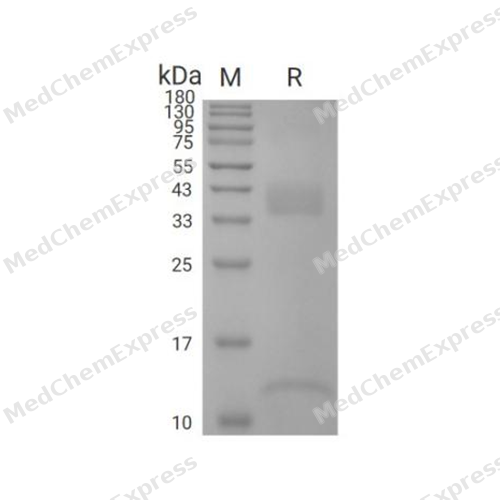
Purity - SDS-PAGE


Technical Parameters
-
Species Human
-
Source HEK293
-
Tag N-6*His
-
Accession
P01137 (L30-S390, C33S)
-
Molecular Construction
-
N-term
-
6*His
-
TGFB1 (L30-S390, C33S)
Accession # P01137 -
C-term
-
-
Protein Length
Full Length of Mature Protein
-
Synonyms
TGFB1; Transforming Growth Factor Beta1; Prev. TGFB; Camurati-Engelmann Disease; Prev. DPD1; Latency-Associated Peptide; TGFbeta; TGF-Beta-1; CED; TGF-Beta1; Transforming Growth Factor Beta-1 Proprotein; IBDIMDE; Prepro-Transforming Growth Factor Beta-1;
-
AA Sequence
LSTSKTIDMELVKRKRIEAIRGQILSKLRLASPPSQGEVPPGPLPEAVLALYNSTRDRVAGESAEPEPEPEADYYAKEVTRVLMVETHNEIYDKFKQSTHSIYMFFNTSELREAVPEPVLLSRAELRLLRLKLKVEQHVELYQKYSNNSWRYLSNRLLAPSDSPEWLSFDVTGVVRQWLSRGGEIEGFRLSAHCSCDSRDNTLQVDINGFTTGRRGDLATIHGMNRPFLLLMATPLERAQHLQSSRHRRALDTNYCFSSTEKNCCVRQLYIDFRKDLGWKWIHEPKGYHANFCLGPCPYIWSLDTQYSKVLALYNQHNPGASAAPCCVPQALEPLPIVYYVGRKPKVEQLSNMIVRSCKCS
-
Predicted Molecular Mass
29.3 kDa & 12.8 kDa
-
Molecular Weight
Approximately 38-55 kDa (LAP) & 13-15 kDa (TGFB1), based on SDS-PAGE under reducing conditions, due to the glycosylation.
-
Glycosylation
Yes
-
Purity
≥ 95%, as determined by reducing SDS-PAGE.


Product Properties
Lyophilized powder.
Lyophilized from a 0.22 μm filtered solution of PBS, pH 7.4.
<1 EU/μg, determined by LAL method.
It is not recommended to reconstitute to a concentration less than 100 μg/mL in ddH2O. For long term storage it is recommended to add a carrier protein (0.1% BSA, 5% HSA, 10% FBS or 5% Trehalose).
Stored at -20°C for 2 years from date of receipt. After reconstitution, it is stable at 4°C for 1 week or -20°C for longer (with carrier protein). It is recommended to freeze aliquots at -20°C or -80°C for extended storage.
Room temperature in continental US; may vary elsewhere.


Documentation
-
Data Sheet (264 KB)
-
SDS (252 KB)
- English - EN (252 KB)
- Français - FR (252 KB)
- Deutsch - DE (252 KB)
- Norwegian - NO (252 KB)
- Español - ES (252 KB)
- Swedish - SV (252 KB)
- Italian - IT (252 KB)
- Korean - KR (252 KB)
- Portuguese - PT (252 KB)
-
Handling Instructions (2659 KB)


References
[1]. J Taipale, et al. Latent transforming growth factor-beta 1 associates to fibroblast extracellular matrix via latent TGF-beta binding protein. J Cell Biol. 1994 Jan;124(1-2):171-81. [Content Brief]
[2]. C Unsöld, et al. Latent TGF-beta binding protein LTBP-1 contains three potential extracellular matrix interacting domains. J Cell Sci. 2001 Jan;114(Pt 1):187-197. [Content Brief]
[4]. Rui Cai, et al. LTBP1 promotes esophageal squamous cell carcinoma progression through epithelial-mesenchymal transition and cancer-associated fibroblasts transformation. J Transl Med. 2020 Mar 26;18(1):139. [Content Brief]
[5]. Xiaojun Fu, et al. LTBP1 plays a potential bridge between depressive disorder and glioblastoma. J Transl Med. 2020 Oct 15;18(1):391. [Content Brief]

Calculators
Concentration (start) × Volume (start) = Concentration (final) × Volume (final)


 Powered by Bioz

