



TMP21/p23 Protein, Human (HEK293, Fc)

Based on 1 Customer Validation
TMP21/p23 proteins act as cargo receptors in endoplasmic reticulum (ER) and Golgi vesicle trafficking, mediating quality control. TMP21/p23 Protein, Human (HEK293, Fc) is the recombinant human-derived TMP21/p23 protein, expressed by HEK293 , with C-mFc labeled tag.
- Species: Human
- Source: HEK293
-
Storage:Stored at -20°C for 2 years from date of receipt. After reconstitution, it is stable at 4°C for 1 week or -20°C for longer (with carrier protein). It is recommended to freeze aliquots at -20°C or -80°C for extended storage.


To place orders, for customer services and technical support, please contact: MedChemExpress USA
Tel: 609-228-6898 E-mail: [email protected] [email protected]


-
 Biological Activity
-
Technical Parameters
-
Product Properties
- Documentation
- Help & FAQs




Biological Activity
Description
TMP21/p23 proteins act as cargo receptors in endoplasmic reticulum (ER) and Golgi vesicle trafficking, mediating quality control. TMP21/p23 Protein, Human (HEK293, Fc) is the recombinant human-derived TMP21/p23 protein, expressed by HEK293 , with C-mFc labeled tag.
Background
TMP21/p23, a cargo receptor integral to protein vesicular trafficking and quality control in the endoplasmic reticulum (ER) and Golgi, plays a crucial role in coordinating vesicle coat formation and cargo transport. It functions primarily in the early secretory pathway, cycling between the ER, ER-Golgi intermediate compartment (ERGIC), and Golgi. Notably, TMP21/p23 acts in both anterograde and retrograde vesicle-mediated transport, participating in the transport of GPI-anchored proteins and influencing the biogenesis of COPI vesicles. Beyond its cargo receptor activity, TMP21/p23 may also function as a protein channel, facilitating the translocation of leaderless cytoplasmic cargo into the ERGIC. Additionally, it is involved in regulating the trafficking of various proteins, including G protein-coupled receptors, contributing to receptor resensitization. TMP21/p23 forms complexes with other p24 family members and interacts with multiple components of the vesicle coat machinery, highlighting its multifaceted role in intracellular protein transport.
MCE Validation Data
-
Purity - SDS-PAGE
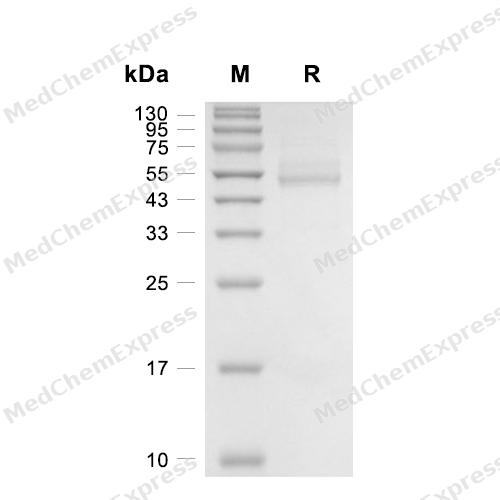
Purity - SDS-PAGE


Technical Parameters
-
Species Human
-
Source HEK293
-
Tag C-mFc
-
Accession
P49755/NP_006818.3 (I32-R185)
-
Molecular Construction
-
N-term
-
TMP21 (I32-R185)
Accession # P49755/NP_006818.3 -
mFc
-
C-term
-
-
Protein Length
Lumenal Domain
-
Synonyms
TMED10; S31III125; Transmembrane P24 Trafficking Protein 10; Tmp-21-I; P24delta1; P24delta; TMP21; S31I125; P23; Transmembrane Emp24-Like Trafficking Protein 10 (Yeast); P24(DELTA); Transmembrane Emp24-Like Trafficking Protein 10; P24d1; 21 KDa Transmembr
-
AA Sequence
ISFHLPINSRKCLREEIHKDLLVTGAYEISDQSGGAGGLRSHLKITDSAGHILYSKEDATKGKFAFTTEDYDMFEVCFESKGTGRIPDQLVILDMKHGVEAKNYEEIAKVEKLKPLEVELRRLEDLSESIVNDFAYMKKREEEMRDTNESTNTR
-
Predicted Molecular Mass
44 kDa
-
Molecular Weight
Approximately 45-55 kDa, based on SDS-PAGE under reducing conditions, due to the glycosylation.
-
Glycosylation
Yes
-
Purity
≥ 90%, as determined by reducing SDS-PAGE.


Product Properties
Lyophilized powder
1.Lyophilized from a 0.22 μm filtered solution of PBS, pH 7.4.
2.Lyophilized from a 0.22 μm filtered solution of PBS, pH 7.4, 8% trehalose.
<1 EU/μg, determined by LAL method.
It is not recommended to reconstitute to a concentration less than 100 μg/mL in ddH2O. For long term storage it is recommended to add a carrier protein (0.1% BSA, 5% HSA, 10% FBS or 5% Trehalose).
Stored at -20°C for 2 years from date of receipt. After reconstitution, it is stable at 4°C for 1 week or -20°C for longer (with carrier protein). It is recommended to freeze aliquots at -20°C or -80°C for extended storage.
Room temperature in continental US; may vary elsewhere.


Documentation
-
Data Sheet (236 KB)
-
SDS (251 KB)
- English - EN (251 KB)
- Français - FR (251 KB)
- Deutsch - DE (251 KB)
- Norwegian - NO (251 KB)
- Español - ES (251 KB)
- Swedish - SV (251 KB)
- Italian - IT (251 KB)
- Korean - KR (251 KB)
- Portuguese - PT (251 KB)
-
Handling Instructions (2659 KB)

Calculators
Concentration (start) × Volume (start) = Concentration (final) × Volume (final)


 Powered by Bioz

