



TrkA Protein, Mouse (HEK293, His)
Based on 1 publication(s) in Google Scholar
TrkA protein is a key receptor tyrosine kinase that guides the development and maturation of the nervous system and affects neuronal proliferation, differentiation, and survival. TrkA serves as a high-affinity receptor for NGF (its primary ligand) and also responds to NTF3/neurotropin-3. TrkA Protein, Mouse (HEK293, His) is the recombinant mouse-derived TrkA protein, expressed by HEK293 , with C-His, C-8*His labeled tag.
- Species: Mouse
- Source: HEK293
-
Storage:Stored at -20°C for 2 years from date of receipt. After reconstitution, it is stable at 4°C for 1 week or -20°C for longer (with carrier protein). It is recommended to freeze aliquots at -20°C or -80°C for extended storage.


To place orders, for customer services and technical support, please contact: MedChemExpress USA
Tel: 609-228-6898 E-mail: [email protected] [email protected]


-
 Biological Activity
-
Technical Parameters
-
Product Properties
- Documentation
- Help & FAQs




Biological Activity
Description
TrkA protein is a key receptor tyrosine kinase that guides the development and maturation of the nervous system and affects neuronal proliferation, differentiation, and survival. TrkA serves as a high-affinity receptor for NGF (its primary ligand) and also responds to NTF3/neurotropin-3. TrkA Protein, Mouse (HEK293, His) is the recombinant mouse-derived TrkA protein, expressed by HEK293 , with C-His, C-8*His labeled tag.
Background
TrkA Protein is a receptor tyrosine kinase that plays a crucial role in the development and maturation of the central and peripheral nervous systems by regulating the proliferation, differentiation, and survival of sympathetic and sensory neurons. It serves as a high-affinity receptor for NGF, which is its primary ligand, and can also be activated by NTF3/neurotrophin-3. While NTF3 only supports axonal extension through NTRK1, it does not have an impact on neuron survival. Upon binding to dimeric NGF ligands, TrkA undergoes homodimerization, autophosphorylation, and activation. This activation leads to the recruitment, phosphorylation, and/or activation of various downstream effectors such as SHC1, FRS2, SH2B1, SH2B2, and PLCG1, which in turn regulate distinct overlapping signaling pathways that drive cell survival and differentiation. Specifically, through SHC1 and FRS2, TrkA activates a GRB2-Ras-MAPK cascade that controls cell differentiation and survival. Additionally, through PLCG1, TrkA regulates NF-Kappa-B activation and the transcription of genes involved in cell survival. Moreover, TrkA also controls a Ras-PI3 kinase-AKT1 signaling cascade, mediated by SHC1 and SH2B1, which further contributes to cell survival. In the absence of ligand and activation, TrkA may promote cell death, making the survival of neurons dependent on trophic factors.
Verified Bioactivity
1.This product does not contain protein kinase domain.
2.Measured by its ability to inhibit NGF-induced proliferation of TF‑1 human erythroleukemic cells. The ED50 for this effect is 20.6 ng/mL in the presence of 10 ng/mL of beta‑NGF, corresponding to a specific activity is 4.854×10^4 U/mg.
MCE Validation Data
-
Purity - SDS-PAGE
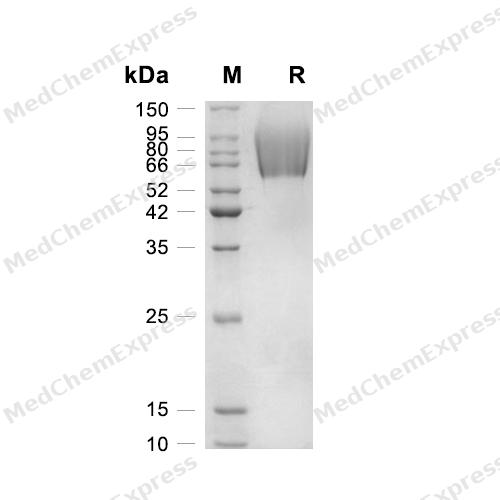
Purity - SDS-PAGE
-
Bioactivity - Cell-Based Assay
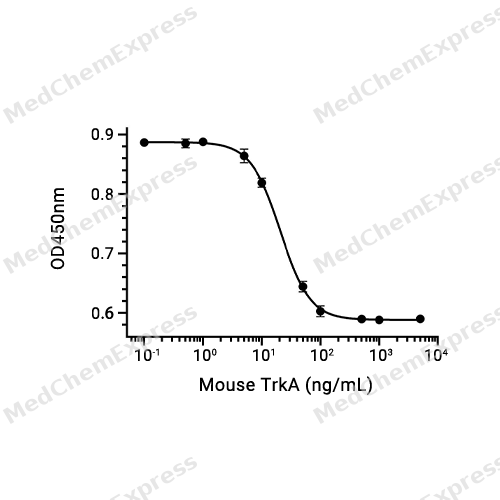
Bioactivity - Cell-Based Assay


Publications (1)
-
Journal Impact Factor
-
Most Recent


Technical Parameters
-
Species Mouse
-
Source HEK293
-
Tag C-8*His
-
Accession
Q3UFB7/NP_001028296.1 (A34-G420)
-
Molecular Construction
-
N-term
-
TrkA (A34-G420)
Accession # Q3UFB7/NP_001028296.1 -
8*His
-
C-term
-
-
Protein Length
Extracellular Domain
-
Synonyms
NTRK1; Tyrosine Kinase Receptor A; Neurotrophic Receptor Tyrosine Kinase 1; P140-TrkA; TRKA; Gp140trk; TRK; Trk-A; MTC; Neurotrophic Tyrosine Kinase Receptor Type 1; High Affinity Nerve Growth Factor Receptor; Tyrosine-Protein Kinase Receptor; Neurotrophi
-
AA Sequence
ASCREVCCPVGPSGLRCTRAGSLDTLRGLRGAGNLTELYVENQQHLQRLEFEDLQGLGELRSLTIVKSGLRFVAPDAFRFTPRLSHLNLSSNALESLSWKTVQGLSLQDLTLSGNPLHCSCALFWLQRWEQEGLCGVHTQTLHDSGPGDQFLPLGHNTSCGVPTVKIQMPNDSVEVGDDVFLQCQVEGLALQQADWILTELEGAATVKKFGDLPSLGLILVNVTSDLNKKNVTCWAENDVGRAEVSVQVSVSFPASVHLGLAVEQHHWCIPFSVDGQPAPSLRWLFNGSVLNETSFIFTQFLESALTNETMRHGCLRLNQPTHVNNGNYTLLAANPYGQAAASVMAAFMDNPFEFNPEDPIPVSFSPVDGNSTSRDPVEKKDETPFG
-
Molecular Weight
Approximately 69 kDa, based on SDS-PAGE under reducing conditions, due to the glycosylation.
-
Glycosylation
Yes
-
Purity
≥ 95%, as determined by reducing SDS-PAGE.


Product Properties
Lyophilized powder.
Lyophilized from a 0.2 μm filtered solution of 20 mM PB, 150 mM NaCl, pH 7.4.
<1 EU/μg, determined by LAL method.
It is not recommended to reconstitute to a concentration less than 100 μg/mL in ddH2O. For long term storage it is recommended to add a carrier protein (0.1% BSA, 5% HSA, 10% FBS or 5% Trehalose).
Stored at -20°C for 2 years from date of receipt. After reconstitution, it is stable at 4°C for 1 week or -20°C for longer (with carrier protein). It is recommended to freeze aliquots at -20°C or -80°C for extended storage.
Room temperature in continental US; may vary elsewhere.


Documentation
-
Data Sheet (238 KB)
-
SDS (251 KB)
- English - EN (251 KB)
- Français - FR (251 KB)
- Deutsch - DE (251 KB)
- Norwegian - NO (251 KB)
- Español - ES (251 KB)
- Swedish - SV (251 KB)
- Italian - IT (251 KB)
- Korean - KR (251 KB)
- Portuguese - PT (251 KB)
-
Handling Instructions (2659 KB)

Calculators
Concentration (start) × Volume (start) = Concentration (final) × Volume (final)


 Powered by Bioz

