



VE-Cadherin Protein, Mouse (HEK293, His)

Based on 1 Customer Validation
VE-cadherin is a calcium-dependent glycoprotein critical for mediating cell adhesion and coordinating morphogenetic events during development. Lack of VE-cadherin in mice leads to uterine death due to increased endothelial cell apoptosis leading to vascular insufficiency. VE-Cadherin Protein, Mouse (HEK293, His) is the recombinant mouse-derived VE-Cadherin protein, expressed by HEK293 , with C-10*His labeled tag.
- Species: Mouse
- Source: HEK293
-
Storage:Stored at -20°C for 2 years from date of receipt. After reconstitution, it is stable at 4°C for 1 week or -20°C for longer (with carrier protein). It is recommended to freeze aliquots at -20°C or -80°C for extended storage.


To place orders, for customer services and technical support, please contact: MedChemExpress USA
Tel: 609-228-6898 E-mail: [email protected] [email protected]


-
 Biological Activity
-
Technical Parameters
-
Product Properties
- Documentation
- Help & FAQs




Biological Activity
Description
VE-cadherin is a calcium-dependent glycoprotein critical for mediating cell adhesion and coordinating morphogenetic events during development. Lack of VE-cadherin in mice leads to uterine death due to increased endothelial cell apoptosis leading to vascular insufficiency. VE-Cadherin Protein, Mouse (HEK293, His) is the recombinant mouse-derived VE-Cadherin protein, expressed by HEK293 , with C-10*His labeled tag.
Background
VE-Cadherin, a member of the cadherin family, serves as a calcium-dependent glycoprotein crucial for mediating cell adhesion and orchestrating various morphogenetic events in development. The encoded preproprotein undergoes processing to generate a mature functional protein. In mice, the absence of VE-Cadherin leads to in utero mortality, primarily attributed to vascular insufficiency resulting from heightened endothelial apoptosis. Notably, multiple distinct genes within the cadherin family, including this gene, are situated on chromosome 8. The expression profile reveals bias towards certain tissues, with prominent levels observed in the lung and subcutaneous fat pad among others, underscoring its importance in tissue-specific functions.
Verified Bioactivity
Measured in a cell proliferation assay using HUVEC cells. The ED50 this effect is 7.704 μg/mL, corresponding to a specific activity is 1.298×10² units/mg.
MCE Validation Data
-
Purity - SDS-PAGE
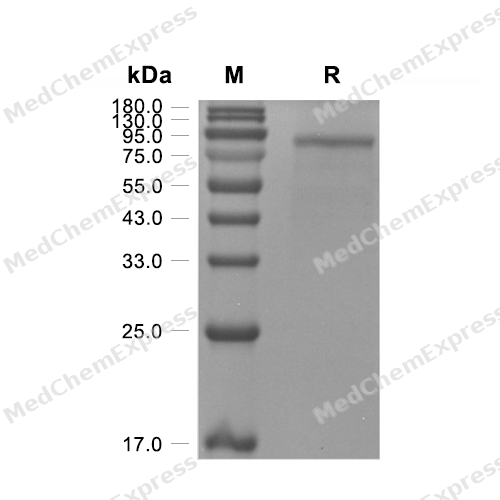
Purity - SDS-PAGE
-
Bioactivity - Cell-Based Assay
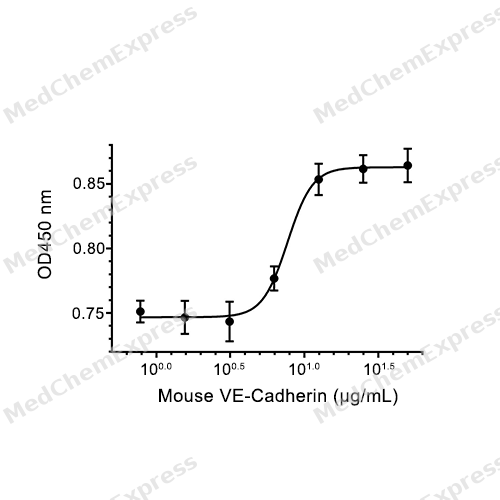
Bioactivity - Cell-Based Assay


Technical Parameters
-
Species Mouse
-
Source HEK293
-
Tag C-10*His
-
Accession
P55284/NP_033998.2 (G25-A592)
-
Molecular Construction
-
N-term
-
VE-Cadherin (G25-A592)
Accession # P55284/NP_033998.2 -
10*His
-
C-term
-
-
Protein Length
Partial Extracellular Domain (with Propeptide)
-
Synonyms
CDH5; Cadherin 5, Type 2, VE-Cadherin (Vascular Epithelium); Cadherin 5; Cadherin 5, Type 2 (Vascular Endothelium); Vascular Endothelial Cadherin; 7B4 Antigen; VE-Cadherin; CDNA FLJ51088, Highly Similar To Cadherin-5; Cadherin-5; Endothelial-Specific Cadh
-
AA Sequence
GPNFPQIDTPNMLPAHHRQKRDWIWNQMHIDEEKNESLPHYVGKIKSNVNRQNAKYVLQGEFAGKIFGVDANTGNVLAYERLDREKVSEYFLTALIVDKNTNKNLEQPSSFTVKVHDINDNWPVFSHQVFNASVPEMSAIGTSVIRVTAVDADDPTVAGHATVLYQIVKGNEYFSIDNSGLIFTKIKNLDREKQAEYKIVVETQDALGLRGESGTATVMIRLEDINDNFPVFTQSTYTFSVPEDIRVGKPLGFLTVVDPDEPQNRMTKYSIMQGEYRDTFTIETDPKRNEGIIKPTKSLDYEVIQQYTFYIEATDPTIRYEYLSSTSGKNKAMVTINVLDVDEPPVFQRHFYHFKLPENQKKPLIGTVVAKDPDKAQRSIGYSIRKTSDRGQFFRITKQGNIYNEKELDRETYAWYNLTVEANELDSRGNPVGKESIVQVYIEVLDENDNPPEFAQPYEPKVCENAAQGKLVVQISATDKDVVPVNPKFKFALKNEDSNFTLINNHDNTANITVKYGQFNREHAKFHYLPVLISDNGVPSLTGTSTLTVGVCKCNEQGEFTFCEEMAA
-
Molecular Weight
Approximately 75-85 kDa, based on SDS-PAGE under reducing conditions, due to the glycosylation.
-
Glycosylation
Yes
-
Purity
≥ 95%, as determined by reducing SDS-PAGE.


Product Properties
Lyophilized powder.
Lyophilized from a 0.22 μm filtered solution of PBS, pH 7.4.
<1 EU/μg, determined by LAL method.
It is not recommended to reconstitute to a concentration less than 100 μg/mL in ddH2O. For long term storage it is recommended to add a carrier protein (0.1% BSA, 5% HSA, 10% FBS or 5% Trehalose).
Stored at -20°C for 2 years from date of receipt. After reconstitution, it is stable at 4°C for 1 week or -20°C for longer (with carrier protein). It is recommended to freeze aliquots at -20°C or -80°C for extended storage.
Room temperature in continental US; may vary elsewhere.


Documentation
-
Data Sheet (239 KB)
-
SDS (252 KB)
- English - EN (252 KB)
- Français - FR (252 KB)
- Deutsch - DE (252 KB)
- Norwegian - NO (252 KB)
- Español - ES (252 KB)
- Swedish - SV (252 KB)
- Italian - IT (252 KB)
- Korean - KR (252 KB)
- Portuguese - PT (252 KB)
-
Handling Instructions (2659 KB)

Calculators
Concentration (start) × Volume (start) = Concentration (final) × Volume (final)


 Powered by Bioz

