



VEGF164 Protein, Rat (sf9)

Based on 1 Customer Validation
The VEGF164 protein is a growth factor critical for vasculogenesis, vasculogenesis, and endothelial cell growth, inducing proliferation, promoting migration, inhibiting apoptosis, and enhancing vascular permeability. It binds to FLT1/VEGFR1, KDR/VEGFR2, heparan sulfate, heparin, NRP1 and DEAR/FBXW7-AS1 receptors. VEGF164 Protein, Rat (sf9) is the recombinant rat-derived VEGF164 protein, expressed by Sf9 insect cells , with tag free.
- Species: Rat
- Source: Sf9 insect cells
-
Storage:Stored at -80°C for 1 year from date of receipt. It is stable at -20°C for 3 months after opening. It is recommended to freeze aliquots at -80°C for extended storage. Avoid repeated freeze-thaw cycles.


To place orders, for customer services and technical support, please contact: MedChemExpress USA
Tel: 609-228-6898 E-mail: [email protected] [email protected]


-
 Biological Activity
-
Technical Parameters
-
Product Properties
- Documentation
- References
- Help & FAQs




Biological Activity
Description
The VEGF164 protein is a growth factor critical for vasculogenesis, vasculogenesis, and endothelial cell growth, inducing proliferation, promoting migration, inhibiting apoptosis, and enhancing vascular permeability. It binds to FLT1/VEGFR1, KDR/VEGFR2, heparan sulfate, heparin, NRP1 and DEAR/FBXW7-AS1 receptors. VEGF164 Protein, Rat (sf9) is the recombinant rat-derived VEGF164 protein, expressed by Sf9 insect cells , with tag free.
Background
VEGF164, a growth factor with pivotal roles in angiogenesis, vasculogenesis, and endothelial cell growth, orchestrates a range of cellular responses crucial for vascular development. It stimulates endothelial cell proliferation, facilitates cell migration, prevents apoptosis, and enhances blood vessel permeability by binding to receptors such as FLT1/VEGFR1 and KDR/VEGFR2, as well as heparan sulfate and heparin. During lactation, VEGF164 may contribute to increased vascular permeability, supporting efficient transport of molecules for milk protein synthesis. Additionally, its interaction with the NRP1 receptor initiates signaling pathways essential for motor neuron axon guidance and cell migration, underscoring its involvement in embryonic development processes. Existing as a homodimer with disulfide linkage, VEGF164 also forms a heterodimer with PGF and interacts with isoform 2 of BSG, revealing its multifaceted molecular interactions.
Verified Bioactivity
Measured in a cell proliferation assay using human umbilical vein endothelial cells (HUVEC) and the ED50 is typically 1-10 ng/mL.
MCE Validation Data
-
Purity - SDS-PAGE
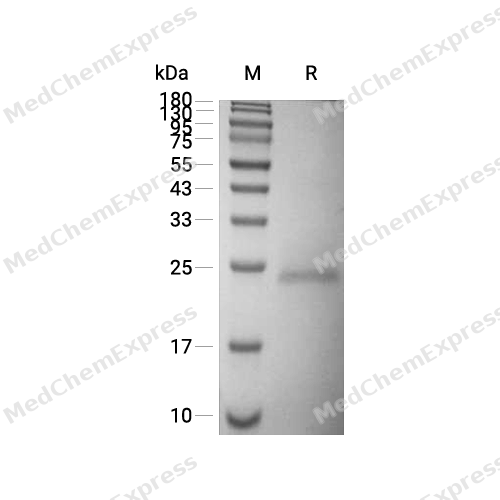
Purity - SDS-PAGE


Technical Parameters
-
Species Rat
-
Source Sf9 insect cells
-
Tag Tag Free
-
Accession
P16612-2 (A27-R190)
-
Molecular Construction
-
N-term
-
VEGF164 (A27-R190)
Accession # P16612-2 -
C-term
-
-
Protein Length
Full Length of Isoform-2
-
Synonyms
VEGFA; Vascular Endothelial Growth Factor A; VEGF; VPF; Vascular Permeability Factor; Vascular Endothelial Growth Factor A, Long Form; VEGF-A; L-VEGF; Vascular Endothelial Growth Factor A121; Vascular Endothelial Growth Factor A165; Vascular Endothelial G
-
AA Sequence
APTTEGEQKAHEVVKFMDVYQRSYCRPIETLVDIFQEYPDEIEYIFKPSCVPLMRCAGCCNDEALECVPTSESNVTMQIMRIKPHQSQHIGEMSFLQHSRCECRPKKDRTKPENHCEPCSERRKHLFVQDPQTCKCSCKNTDSRCKARQLELNERTCRCDKPRR
-
Predicted Molecular Mass
19.2 kDa
-
Molecular Weight
Approximately 25 kDa, based on SDS-PAGE under reducing conditions, due to the glycosylation.
-
Glycosylation
Yes
-
Purity
≥ 95%, as determined by reducing SDS-PAGE.


Product Properties
Solution
Supplied as a 0.22 μm filtered solution of 100 mM Glycine, 10 mM NaCl, pH 7.0.
<1 EU/μg, determined by LAL method.
Stored at -80°C for 1 year from date of receipt. It is stable at -20°C for 3 months after opening. It is recommended to freeze aliquots at -80°C for extended storage. Avoid repeated freeze-thaw cycles.
Shipping with dry ice.


Documentation
-
Data Sheet (263 KB)
-
SDS (254 KB)
- English - EN (254 KB)
- Français - FR (254 KB)
- Deutsch - DE (254 KB)
- Norwegian - NO (254 KB)
- Español - ES (254 KB)
- Swedish - SV (254 KB)
- Italian - IT (254 KB)
- Korean - KR (254 KB)
- Portuguese - PT (254 KB)
-
Handling Instructions (2659 KB)


References
[1]. Vempati P, et al. Extracellular regulation of VEGF: isoforms, proteolysis, and vascular patterning. Cytokine Growth Factor Rev. 2014 Feb;25(1):1-19. [Content Brief]
[2]. Murphy JF, et al. Vascular endothelial growth factor induces cyclooxygenase-dependent proliferation of endothelial cells via the VEGF-2 receptor. FASEB J. 2001 Jul;15(9):1667-9. [Content Brief]
[3]. Dixelius J, et al. Minimal active domain and mechanism of action of the angiogenesis inhibitor histidine-rich glycoprotein. Cancer Res. 2006 Feb 15;66(4):2089-97. [Content Brief]
[4]. Glorioso N, et al. Association of ATP1A1 and dear single-nucleotide polymorphism haplotypes with essential hypertension: sex-specific and haplotype-specific effects. Circ Res. 2007 May 25;100(10):1522-9. [Content Brief]
[5]. Khayati F, et al. EMMPRIN/CD147 is a novel coreceptor of VEGFR-2 mediating its activation by VEGF. Oncotarget. 2015;6(12):9766-80. [Content Brief]
[7]. Ferrara N, et al. Molecular and biological properties of the vascular endothelial growth factor family of proteins. Endocr Rev. 1992 Feb;13(1):18-32. [Content Brief]
[8]. Terman BI, et al. Identification of the KDR tyrosine kinase as a receptor for vascular endothelial cell growth factor. Biochem Biophys Res Commun. 1992 Sep 30;187(3):1579-86. [Content Brief]

Calculators
Concentration (start) × Volume (start) = Concentration (final) × Volume (final)


 Powered by Bioz

